
Located in the south of México City, within the cultural center of the Universidad Nacional Autónoma de México (UNAM), the Museo Universitario de Arte Contemporáneo (MUAC) presents the revealing exhibition titled Enrique Ježik; Obstruct, Destruct, Conceal. Curated by Cuauhtémoc Medina, this exhibition offers a selective survey of the most relevant aspects of the production of this creator born in Córdoba, Argentina, in 1961, who lives in Mexico since 1990.
The exhibition practically begins at the entrance of the main exhibition hall, with the work entitled En Defensa Propia (In Self-Defense, 1996). It is an unsettling display case full of human bones that allude to the methods employed by dictatorships to defend their idea of civilizing processes. It immediately becomes clear to visitors that their entrance into the exhibition space will not be free or remain innocent.
From this point on, viewers are immersed in a very potent and rude expressive trail. The aesthetic is marked at all times by another one that belongs to defense systems, videos of bombardments—that NATO made available to the public—or other videos taken from the Web that show those typical greenish night vision images.
Without buying into a predictable narrative, Ježik presents pieces that, despite not being arranged in chronological order, reveal one of the most intense artistic trajectories of his generation; given that during his early life while still in Argentina, he was already creating works that challenged the predominant art currents of that country.
An insightful look into war techniques, defense strategies—by the power and from the power—expressive forms contained in the objects of extermination, and, in more general terms, a language that perverts, through its own grammar, that which it pretends to ratify, are only some of the ways in which this artist reveals stark radiography of this parallel world that, like it or not, surrounds our spaces and limits all our movements.
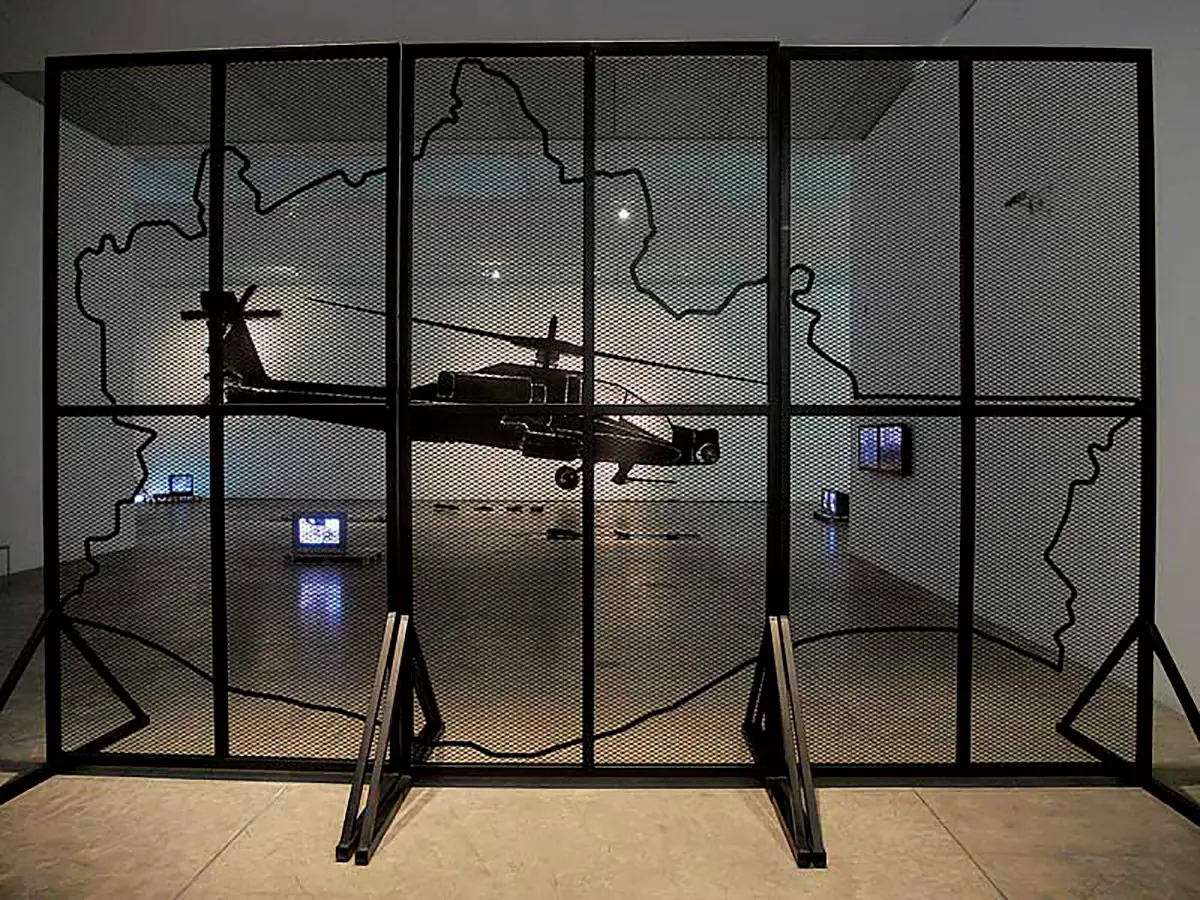
Perhaps two works that allude to the Mexican state of Oaxaca should have been presented within the same section of the exhibition. I speak of two pieces from 2007 entitled, Divide y Vencerás (Divide and Conquer), and Valla (Fence), which focus on the conflicts that took place in the state in 2006—the catalog of the exhibition appropriately placed them one beside the other on sequenced pages. Notwithstanding the intimate relationship that exists between the two works, observing them in separate exhibition rooms has the effect of making them appear as if they belonged to different series from different years. While it could have certainly been preferable to have both in the same space, the visual appeal of both works is such that they maintain it even when not shown together.
Divide y Vencerás is constructed with 520 steel sheets with the outlines of an equal number of state municipalities etched on them. The work addresses the absurd political division in Oaxaca and the intense conflicts that have emerged as a result of it. The second piece, Valla, is a monumental steel mesh that measures around 5 × 4 meters (16.40 × 13.12 in.). It depicts a map of Oaxaca created with steel and affixed to a structure that resembles one of the most representative objects used by the police to repress and contain social demonstrations.
Enrique Ježik is also known for his actions with heavy machinery. For the work entitled Esgrima (Fencing, 2001), he used two excavators with hydraulic hammers that clashed their tips loudly against each other in the interior of the Museo Ex Teresa Arte Actual in Mexico City. As if immersed in battle, each excavator—driven by specialized operators—would attempt to hit the tip of its counterpart while avoiding being hit by the other. At the same time, this clash of phallic-like tips—strong enough to drill holes in the pavement—also alluded to the irrational masculine brutality of the arrogant exhibitionism of the genitalia.
In 2002, one year after Esgrima, Ježik used a similar machine for his powerful piece entitled SOS. Produced in France, it consisted of an excavator that perforated the floor in a circular fashion, following the pattern of the international Morse Code distress signal; a series of marks that, once the action ended, remained as the clear outline of a political territory. The year 2002 also became the year of the work entitled Referendum. This work was produced in Canada and consisted of outlining on a wall the map of Canada using an electric demolition hammer, to then remove the entire section that represented Quebec.
Enrique Ježik: Obstruct, Destruct, Conceal is not an attempt to stylize violence. On the contrary, Je¿ik prefers to bring forward a discussion about the things that promote violence or that are somehow a by-product of it. His posture as a drawer of war objects, collector of testimonials, creator of pieces about devastated borders, or as a sharp critic of totalitarian regimes and their mechanisms of legalization is completely a neutral one. Through his work, he poses critical and emphatic commentary on contemporary ways to eliminate the enemy.
SANTIAGO ESPINOSA DE LOS MONTEROS