
Felipe Cusicanqui (1977) stands out in the art scene of Chile for renovating a language that every so often appears to run its course. The manner in which Cusicanqui achieves this is surprising for its extreme simplicity. He relies on tradition but uses rough supports and a style of painting that traps us into the old game of charming us from afar with a painterly beautiful image that, nonetheless, when observed from up close reveals only patches-colors and canvas. So what is new about this?
In Siembra (Sowing), a series exhibited at the Galería Patricia Ready at the end of 2011, the relationship between image and support was one of the aspects worth pondering about. On one hand, Cusicanqui depicts vast landscapes, visually clean fields, and beaches, spaces that lean toward geometric abstraction or that are inhabited by small individuals. All of his images are accomplished through an economy of gestures and Zen-like precision rendered on rough burlaps or sown sack. There are parallel lines, wide planes, vanishing points, and the vision of an immensity surrounding tiny human figures that, when observed from up close, are revealed as mere pieces of canvas, patches of glued sand, or splashes of pigment. On the other hand, there are also the still-life compositions in which the surface becomes abundant materiality, and painting is revealed in all its glorious presence. Among torn canvases and cut cardboards, patches of paint-splattered beside horse hairs or piles of hay that form flowers, poppies, or sunflowers wilting on old vases. Even the support—insofar as it is regarded as object or collage—sometimes becomes the subject: the crack on the cardboard, a petal, a fragment that insinuates gender, a figure, the burlap, the dirt.
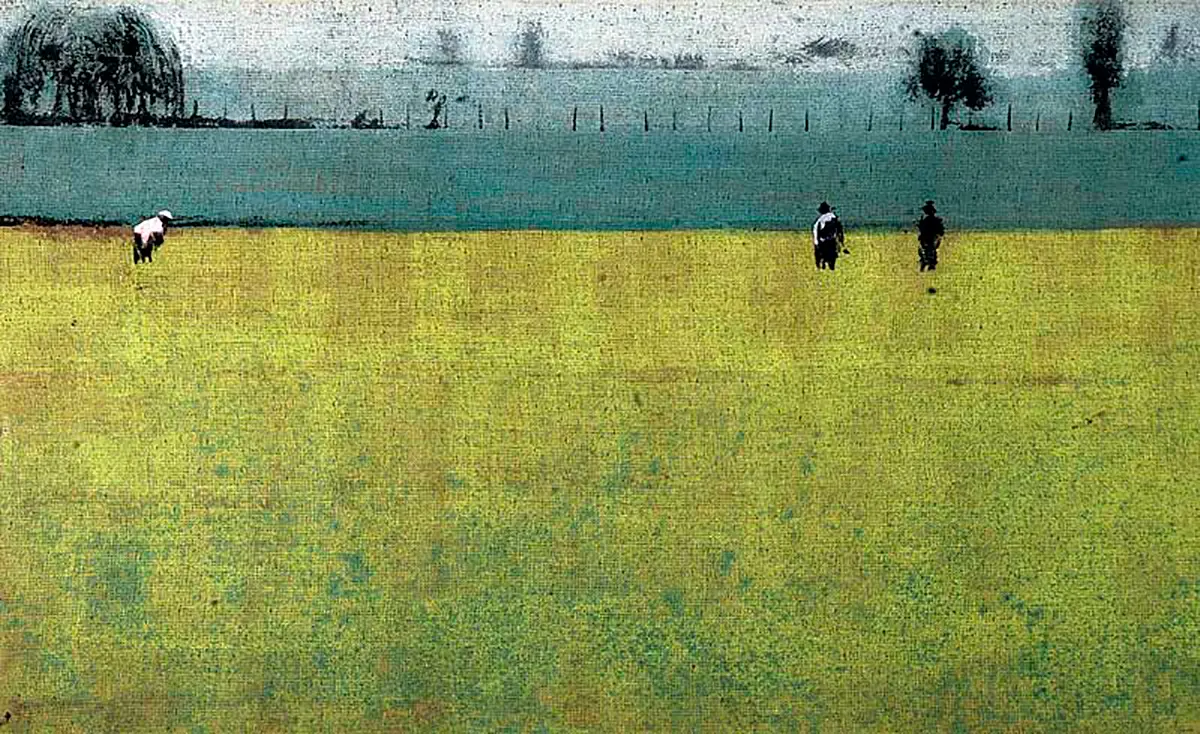
The paint is in a state of maximum tension between the representation of the model and the presentation of the language assign. There is something about the rudimentary nature of the materiality and the workmanship that is also present in the motifs Cusicanqui paints places far removed for the urban landscape that is captured by the artist’s during his travels through the country; intimate objects. This something prevents us from asking the conventional question about the “new” by highlighting the importance of context and the manner in which the artist relates to it.
Cusicanqui updates characteristics that are part of the local painting of the end of the 19th and 20th Centuries, such as the infatuation with the autochthonous landscape, in situ projects, and the presence of the pictorial patch. It is a way of relating to a context in which the work is born on the field and articulated in the workshop. The painter observes the rural or coastal landscape from afar, without ever relating to the supposed protagonists of his images: farmers bending down during the sowing, or vacationists taking a stroll on the beach; all remain far removed in the background like minimal figures aligned with the horizon. The landscape occupies the entire image, everything opens with ghostly forms towards and infinite that goes beyond the canvas frame. All is nothing more than the instant of movement. The gaze is fast and the assimilation of reality is produced through materiality with urgent gestures. The paint absorbs the elements of that very landscape it depicts: the hay, the horsehair, the sack, and the burlap are eaten and then are returned as landscapes of sublime quietness, or are transformed into noble flowers that live through their last colors.
That which appears to be an aesthetic gaze on the Chilean landscape—even a bourgeois one at that, detached from any social reality—brings us back to a perhaps idyllic landscape, to the insignificance of the human figure, to an aesthetic of barely suggested forms, and to the instant of loss. There is some degree of nostalgia in Cusicanqui’s approach to painting and, in this sense, some of his work could somehow remind us of Van Gogh’s Sunflowers (1888-1889), or The Angelus (1857) by Jean-François Millet. While the series by the Dutch artist stands out for its carnality, delirious tone, and a certain ill-fated sense of life that is reflected on the wilting flowers, the image by Millet, on the other hand, represents a very special instance in the history of art: it is a realism that is less social criticism and more impressionism; one that is beholden to an ill-fated predisposition toward existence. The rural landscape portrayed by Felipe Cusicanqui conveys a silence that is reminiscent of the scene of peasants praying during dusk in a solitary field. It was a very popular painting during the beginning of the 20th Century that would actually hide the scene of awake. But Cusicanqui’s landscapes do not rest on the significances of the Chilean countryside, but rather on the experience of a model that he uses to contrast matter against gesture, the human figure against the landscape, and the precarious against the sublime. As the context disappears we are once again left alone with pure painting in a game of tensions that is also nothing new, but that is capable of articulating an experience centered on our levity and fictitious nature of reality.
CAROLINA LARA B.