
The artistic trajectory of Gabriel Baggio (Buenos Aires, 1974) is one of the best-kept secrets in the Argentinean art scene of the last decade. While his appearances have not gone completely unnoticed, his name has yet to adorn the big marquees. This is perhaps because he purposely chooses the economy of small, private, domestic, and intimate works—actions and sculptural installations. It is no accident that several of Baggio’s works center on the benevolent transmission of the know-how associated with handicraft. Likewise, it is not casual that he has not achieved it through theoretical disquisitions, but by placing himself in the position of the apprentice. Baggio’s approach is to playfully assimilate the concepts in front of those who choose to witness it. In his works, he can be observed receiving cooking or crochet classes, as he shares with the public through his performance those moments of trial and error that are usually private.
For those of us who could not wait for the day we could see several of his works shown in the same place and woven by the thread of a good curatorship, the exhibition inaugurated by the Fundación Klemm certainly represents an event worth celebrating. In the exhibition titled In Praise of Desecration, Baggio displays in a generous space a series of works that include several of his recurrent interests, as they emphasize the sculptural element. The artist endeavors to recover old trades and images and stresses a predilection for the so-called minor or decorative arts. In this manner, the arabesque flower pattern of a worn curtain becomes an acrylic painting on canvas in the work titled Motivo para Cortina (Motif for Curtain, 2010), the ornament on a platter becomes the relief of an enamel ceramic in Motivo para Bandeja (Motif for Platter, 2011); or a set of old tools, like those his grandfather would use during the 1930s, are gold plated. Grandparents—his and others’ are regarded as wise persons and teachers—are a great source of inspiration for an artist devoted to elevating all things non-industrial; anything created outside the industrial markets that have been redefined by its sentimental value.
The decorative taste of Baggio’s Italian immigrant grandparents fascinated him every time he went to visit them as a child. Inspired by those visits, he created some tempera paintings that emphasize the idea of desecration. The artist uses the tempera pigments to copy, in a style somewhat reminiscent of Pop—with the naïve brushstroke of a school exercise—copies of works by the Italian masters that adorned the walls of his family home. Adding to the cycle of imitations that are as old as the world, Baggio copied a copy by Tulio Dotto of the work by Giorgione titled La Tempesta (The Tempest, 1506-1508). This gesture becomes relevant today as the art world is experiencing once again that old cyclic crisis; a crisis this time magnified by the demands from a large part of Internet users to dispose of copyright laws for texts, images, and ideas.
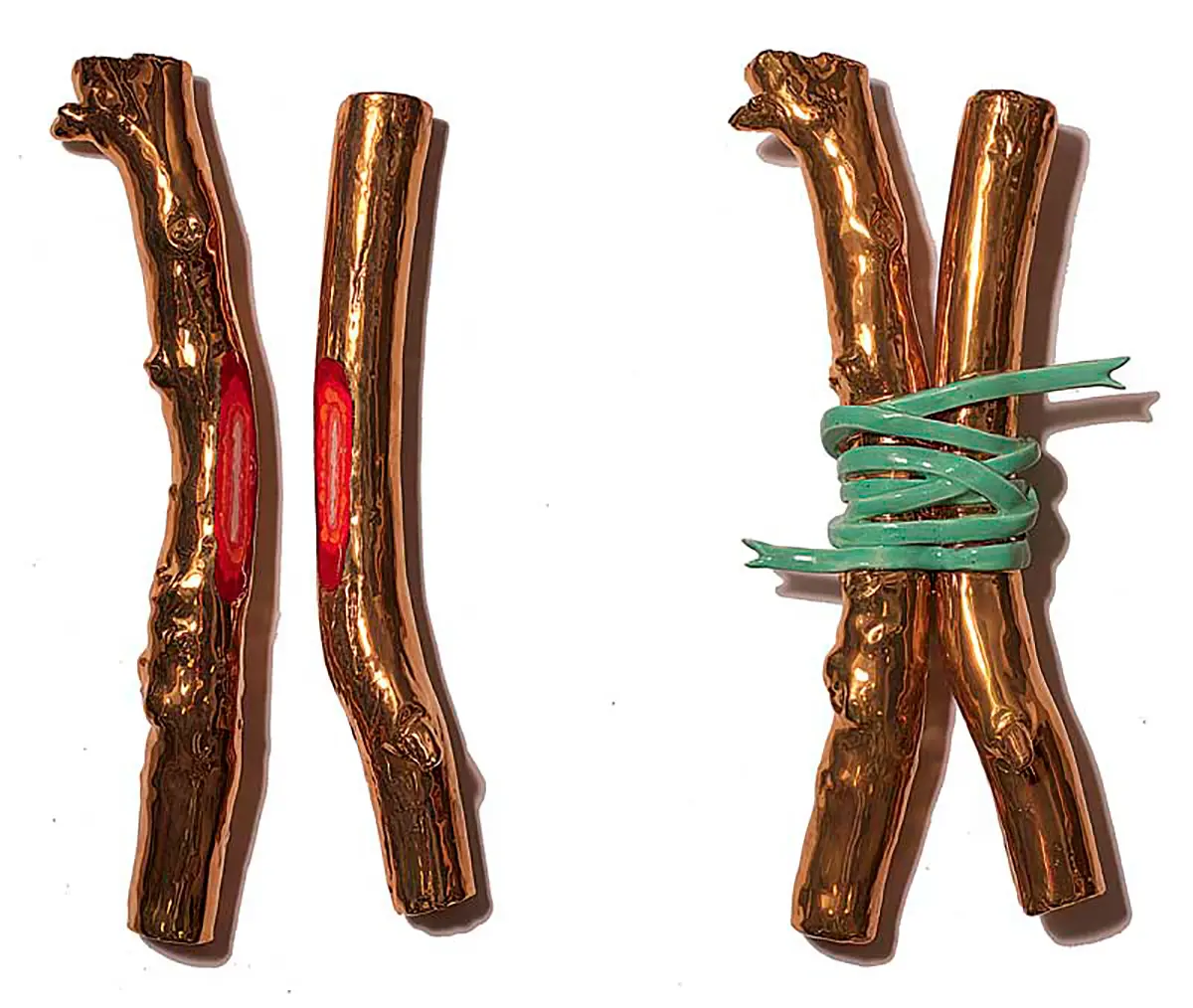
Without a doubt, one of the most beautiful and compelling pieces of the exhibition is Injertos de Aproximación Lateral (Laterally Approached Grafts, 2011). It is an enameled ceramic that measures 50 × 70 cm (19.7 × 27.6 in), in which Baggio confers three-dimensionality to an illustration taken from a garden book that his grandfather used to show him. Didactic in nature like many of his other works, this piece contains four twigs. Two of the twigs have symmetric cuts on their barks, while the other two are tied together so their union will eventually result in a graft that fuses them together. Several layers of meaning can be peeled from this work. Each answers to a particular way of understanding and experiencing art: there is a tribute to the knowledge passed on by our elders; a sweet metaphor about the possibilities of growth based on the communion between two people; and the addition of value gold can confer to simple twigs by disguising under a symbol of capitalism that which only has sentimental value.
EVA GRINSTEIN