
Guerra de la Paz is a creative team formed by Miami-based Cuban artists Alain Guerra (Havana, 1968) and Neraldo de la Paz (Matanzas, 1955), who have been working, consistently and systematically, since the end of the 1990s. With a large number of exhibitions under their belt at galleries and museums in the US and Europe—including the Miami Art Museum, Americas Society in New York, the Chicago Cultural Center, and the Saatchi Gallery in London, among others—Guerra de la Paz is inscribed in the international artistic scene with work that is solid and well structured.
By incorporating the readymade in their works, through traditional techniques and the use of unconventional materials, this artistic duo often reflects on historic themes and classic icons that have remained part of the contemporary narrative due to their profound significance. Their work also represents a sustained effort to bring forward a debate on global issues like the concern for the environment, consumerism, and waste culture.
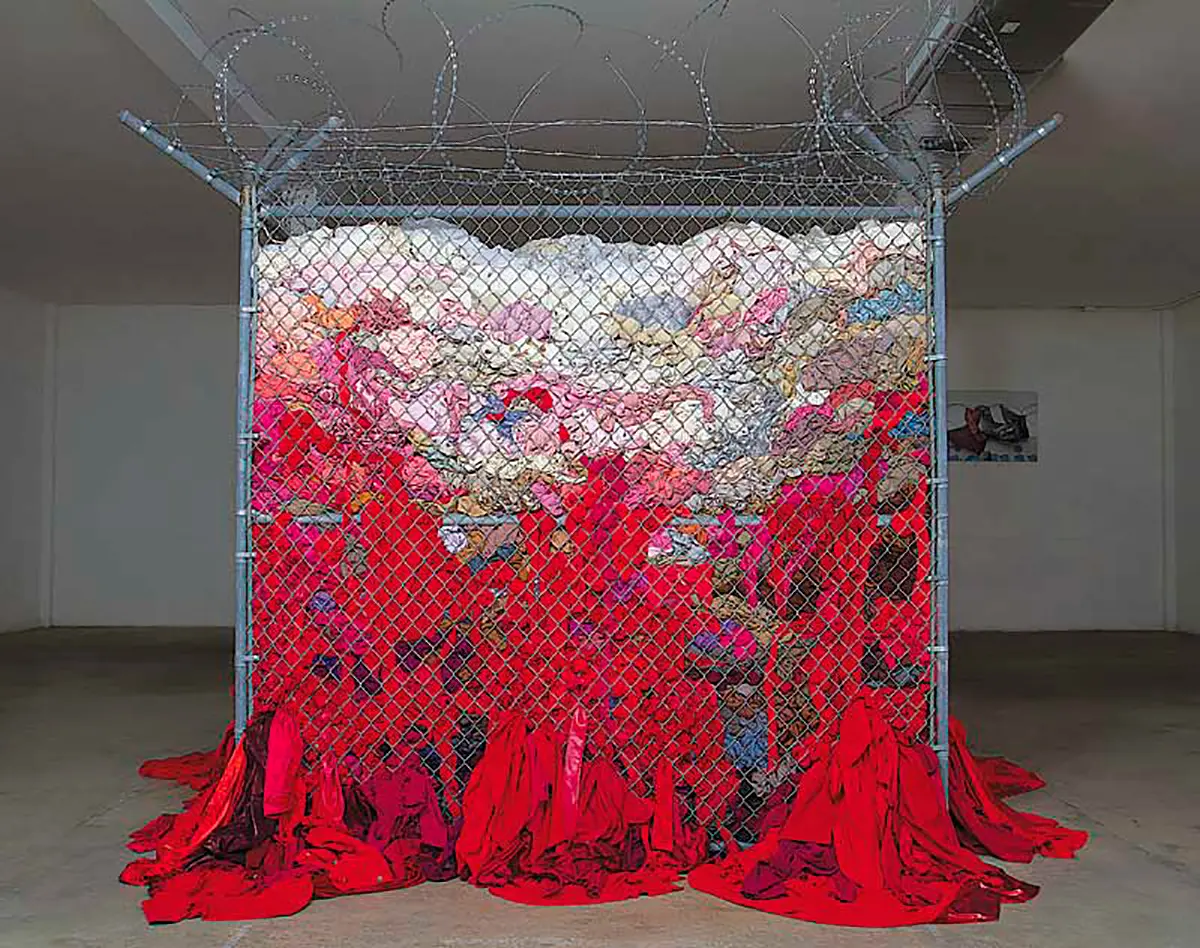
Praxis International Art–Miami presented at the end of 2011 an exhibition by the duo titled Barbed. Flanked by three photographs, an enormous installation, almost as high as the ceiling, was the center of the exhibition.
Alluding to the endless miles of industrial fences that expand across the Florida landscape—in which eventually remnants of fabric brought there by the wind end up getting caught—Guerra de la Paz constructs a symbolic structure in their photographs and installations that is hard to miss.
The photographs become the record that the duo creates during their approach to these landscapes. They are images of fabric remnants that, caught in the barbwire of the enormous fences, manage to individually carry the collective energy through the open spaces they struggle to get out of; pieces of fabric that are transformed day by day by the natural elements. Water, sun, winds, reduced them to warm shreds lacking any identity. Washed out and torn, they resemble human masses being moved in a circumstantial and random manner, following the guidelines that society imposes on its members.
The pieces of trash, their essence photographed and transported inside the gallery space to be used as the center of reflection, become the testimony of the process of social erosion that we are all subjected to.
On the other hand, the installation consisted of a perimeter outlined by a peerless fence with barbed wire that had a large pile of waste fabric—material that has been a central part of these artists’ work in recent years—in its interior.
An accumulation of large dimensions, the installation included fabrics of various textures that displayed an “internal order” reinforced by the washed-out colors. This time held inside large bundles, the fabrics became a metaphor for the social problems that once were local but that are now universal. They are also a sort of “three-dimensional photography” of the state in which a large number of groups of people are oppressed by the interests of a minority.
The pieces also become a reminder of the cyclical nature of history. These artists resort to representational patterns that allude to key moments in the narrative of the past of our civilization—such as the concentration camps or any other process of extermination of large groups—and decontextualize them, as they incorporate them in the contemporary stage. This is the manner in which they represent contemporary societies: amorphous masses where individuals are not distinguishable and where there is no chance to breathe.
At the same time, their work also reveals a profound relationship between human beings and their surroundings. This is evident in all the pieces that are included in this exhibition. The influence mankind asserts on the environment, and the way in which the latter transforms itself in response to that influence is one of the triggers used throughout the show. The fabrics and their interaction with the setting—the degradation to which these materials are subjected to with the passing of time—transform the landscape into an immense rainbow of vibrant forms and colors. The colors are carefully selected and used for a perfect composition that confers great drama to the piece.
The constant use of waste fabrics, whether these are traditional or not, has been a constant aspect of Guerra de la Paz’s work. In earlier pieces—and sometimes with a profound sense of humor—the fabric would become a vehicle of representation of scenes that remitted to art history, the revision of the centers of power, or the objectual representation of subtly lyrical ideas. This time, the artistic duo concentrated on the objective itself and built from it a system of relationships that lead viewers through several paths of interpretation.
With a consistent economy of resources, the two essential materials for the construction of these pieces—the wire fence and the fabric—become the voices and protagonists of the work. The voices, because it is through the materials that the artists’ fundamental ideas are communicated. Protagonists, because in a profound and delicate manner they are at the center of the entire proposal.
VALIA GARZÓN DÍAZ