
For several years now, Johanna Calle has been making drawings using letters instead of points and lines, thus conjoining writing and drawing. With these drawings, as Catalina Casas accurately noted, “Johanna Calle draws as she writes. She draws as she rebuilds. With thread, bolts, wire, needles, and cables she wades into literature, architecture, and music. And in the end, all are skillfully mixed and connected to become poetry. Only not the kind that is read, but the kind that is seen.”1 As well as infinite patience and great skill, Calle’s delicate drawings, subjected to painstaking exactitude, denote a process of reflection focused on language and on social issues, and interest in pointing out some of the contemporary world’s difficult problems still pending a solution.
“The use of language,” the artist says, “has been recursive in my work. I have made a drawing that reflects the language, letters, and signs. Not only the letters of the alphabet in themselves, but names whose semantics evoke eloquent titles, and also transcribed texts whose content and terminology emphasize aspects of the issue at hand. In my drawings, I deal with linguistic conventions as social arrangements where power structures remain latent.”
The show Signos articulated itself around a series of drawings that originated a book titled abecé, published by SW and the Casas Riegner Gallery, launched at the 12th Istanbul Biennial, and presented here for the first time in Colombia. These drawings trace structures that are formed using the letters of the alphabet, carefully drawn in black ink on the sheets of an old album from 1920, sheets on which the passage of time has left clear marks. Besides its exquisite aesthetic quality, this support gives the drawings a historical character, gives them memory, something that is preserved in the publication.
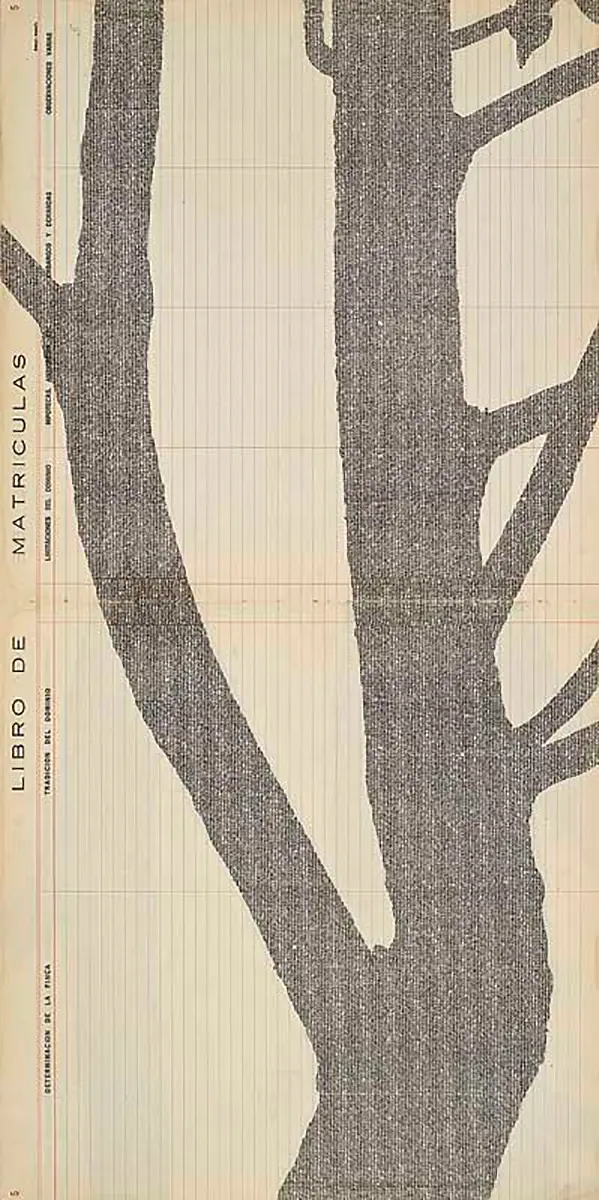
Three other series of drawings were included next to the one described above. One of them was made on the very large pages of a registry book used a long time ago for accounting purposes in rural areas. On those pages, Calle used an old Underwood typewriter to draw tree trunks. Their outline and surface are traced with words, with texts taken from the new Law of Victims and Land Distribution, recently signed by the President to provide justice for the victims of violence in Colombia. Another group of drawings presented a series of plants made of wire, and the third one was skeins of yarn or wool, with its lines forming a continuity of letters.
This connection of letters with drawing, between a visual and a written element, which gives rise to a “poetry for the eye,” reminds me of these words by Orhan Pamuk: “As the years pass, I am more and more convinced that literature is a matter of seeing the world with words rather than narrating it…” 2 There is an echo of this in Johanna Calle’s work of recent years. Her drawings make us see that writing can be used for draftsmanship, and in using it in that way signs are enriched, broadening according to the interplay established by the artist between the elements that give shape to her work: word and image; the material used (ink, wire…); and the support on which the drawing is made. That interplay generates harmonies that are revealed as we carefully study Calle’s drawings. At first sight, they are always beautiful enough to call our attention. For example, in the case of the tree drawn using an Underwood typewriter, their appearance is exquisite and intriguing enough to satisfy us as a formal event, But as we come to understand the implications of the support beyond the subtle play of the gray hues created by the texture generated by the letters and the delicate green and pink lines on the paper, their meaning is amplified. The artist’s intent, her concern for such social matters of difficult solution, as is the case of the restitution of land rights, are made objective in the visual act. Free of artifice, free of the intricate rhetoric sometimes present in works of art interested in social themes, drawing acquires form and meaning in a profound and coherent way.
Somewhere in his book Istanbul, Orhan Pamuk—who was a painter and draftsman in his youth—tells a story of his childhood, when he drew letters without knowing their meaning, following the same steps and rules he used to draw the world around him. I also note that, in an interview,3 Johanna Calle refers to her own school-age penmanship training through Palmer calligraphy, identifying there the same principles as in learning to draw. My great attraction to Pamuk’s writing connects here with my admiration for Calle’s painstaking, intelligent drawings, where the genre sees it's potentially expanded by the union of language and image.
NOTES
1. Catalina Casas, catalog for Variaciones, drawings by Johanna Calle, Casas Riegner Gallery, Bogotá, 2010.
2. Orhan Pamuk, Otros colores. Barcelona: Mondadori, 2008
3. Cecilia Fajardo-Hill, catalog for Variaciones, drawings by Johanna Calle, Casas Riegner Gallery, Bogotá, 2010.
MARTA RODRÍGUEZ