
Dissent is without a doubt the most genuine exercise of any democracy. In the case of totalitarian regimes, the act of dissent, however, becomes dissension.
Deployed for the first time in a strictly political sense in the 1940s in the late Soviet Union, the term 'dissident' has become an essential ideological weapon for centralized power to silence any diverging public opinion and in that way justify open repression and persecution.
The artistic proposal of José Ángel Vicench (Cuba, 1974) is a solid investigation of this crucial zone of contemporary Cuban society, where dissent, censorship, silence, and negotiation are part of everyday life.
Using as his point of departure the history of art, and specifically abstraction and the story of abstract art in Cuba, Vicench generates a shrewd commentary on current Cuban reality. The allegory, located firstly in the social realm, finds its correlate in the space of art through the artist’s commitment with his time, which in Vincench’s proposal is essential.
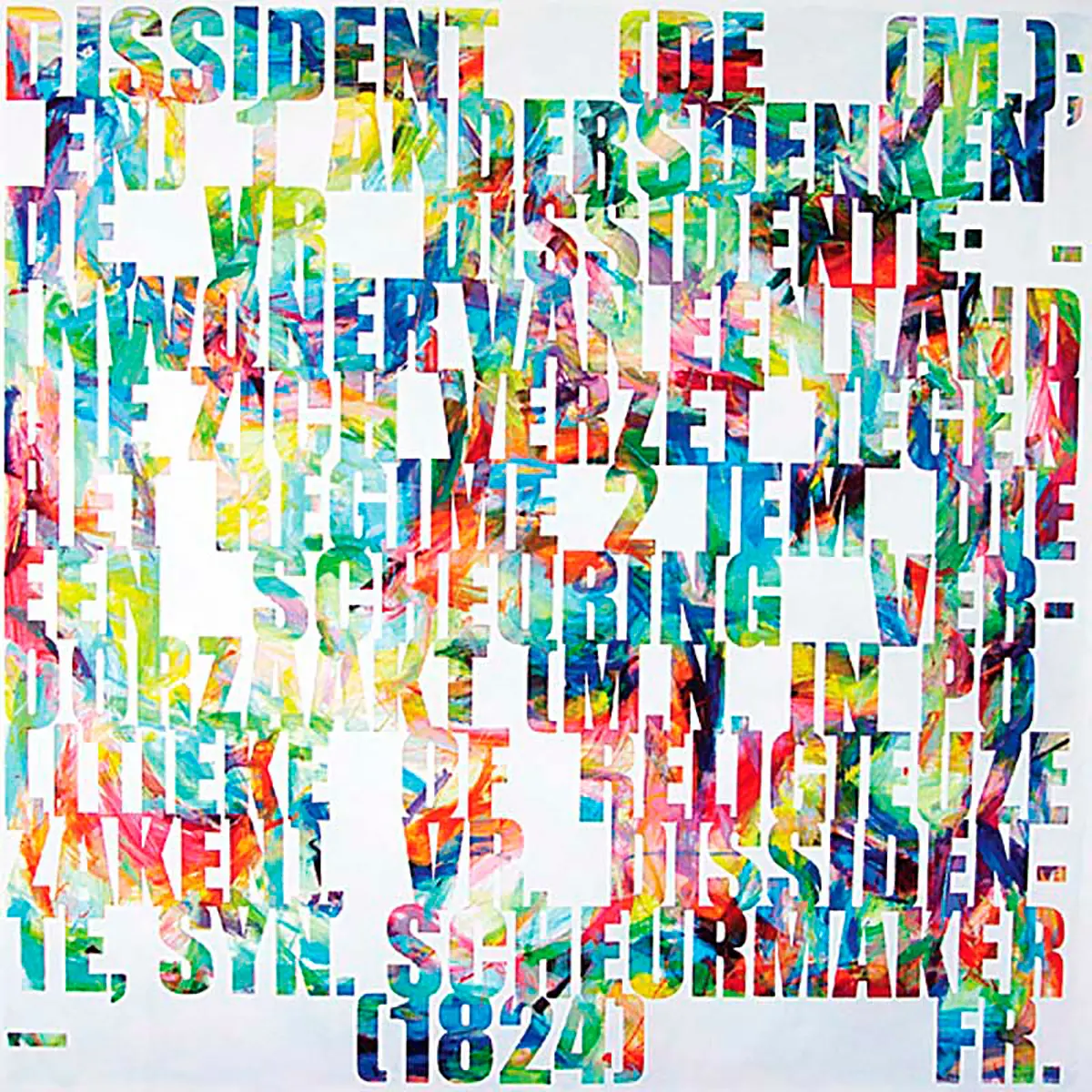
Vicench vs. Vicench: A Dissident Dialogue from Cuba, open at Art Space/Virginia Miller Galleries in Coral Gables, is the artist’s first solo show in the US. The show is comprised of two series developed by the artist in recent years: Disidente y Exilio.
The Disidente series starts with former US president Jimmy Carter’s visit to Havana in 2002, intended to promote dialogue between dissidents and the government, and the massive attacks against dissidents on the part of the authorities barely a few months after Carter’s departure. This wave of repression in the island—known internationally as the Black Spring—resulted in the imprisonment of 75 dissidents, sentenced variously to between 6 and 30 years.
Vicench vs. Vicench includes 14 highly distilled medium-format paintings from the series. In them, abstract expressionism becomes a symptomatic background on which—thanks to the use of stencils—the definition of the term in a variety of languages is superimposed: Russian, Serbo-Croatian, Spanish, English, Catalan, French.
The free forms of abstract expressionism, whose historical meaning adds new layers of reading to the series, are constrained by the rigid graphics and the definitions they carry. The use of multiple layers and the fragmentary character of the text generate an effect of scaffolded reading that in turn provokes an effective tension between the visible and the invisible, the permissible, and the silenced.
The notion of fragments is seconded in Cuba y la noche (2011), a unique mosaic comprised of 100 small-format paintings. Alienated in such singular accumulation, like an irreverent echo, the paintings in this installation inundate one of the gallery walls. We would seem to be in the presence of a multitude: a kind of collective voice clamoring to legitimize its point of view.
In turn, the series Exilio/Destierro (2011) uses luggage as the identity symbol of emigrants who seek to bring with them as much as they can from their original enclave. Such is the case of the installation Destierro VI, where the luggage adopts the cartography of the island.
The installation appropriates a kind of luggage (the “worm” bag) that is intimately linked to Cuban migration. The “worm” ('gusano'), as this kind of flexible tubular bag is commonly referred to, is used by the majority of Cuban families residing in Miami in their visits to the island to bring goods for their relatives and friends. Thus, the unidirectional relationship of departure is loaded with new meanings. The term 'gusano' also has a clearly defined ideological implication in Cuba, as the official world uses it to disparage all those who dissented from the ideology of Havana’s socialist regime.
In Exilio I, Vicench once again uses typography as a sufficient visual instrument. Each one of the impeccably made, craft paper throw-away bags is a letter in the text that gives the work its title. The empty bags underscore the uselessness of the baggage, while the individuated status of each of the letters points towards a sense of dispersal of Cuban culture and identity due to the continued bloodletting of more than half a century of exile and a fractured community.
As a complementary work created on-site specifically for this Miami show, Vincench presented Reconciliación. This delicate work is a Christmas tree made with cedar strips with a carved message, in English and Spanish, calling for understanding and harmony.
JANET BATET