
The work of José Manuel Fors (Havana, 1956) is an inexhaustible quest for evocation and remembrance. He is intent on a kind of archaeology of memory where fragments become the essential minimal unit, a triggering device, an illumination. Not by chance do the majority of his works partake of the notion of accumulation, so dear to contemporary art but also typical of the cabinets of curiosities of chambers of marvels of the past, where the pursuit of archeological remains, unknown treasures, and cryptic messages was the entryway to unsuspected universes.
In the specific case of José Manuel Fors, we witness a private, intimate quest. Often the objects included are part of the artist’s own personal history: photographs, artifacts, items from his family life or connected to his forebears or close friends, which, like decoys, lure us into a spiral that gives new meaning to the notion of a unidirectional arrow of time.
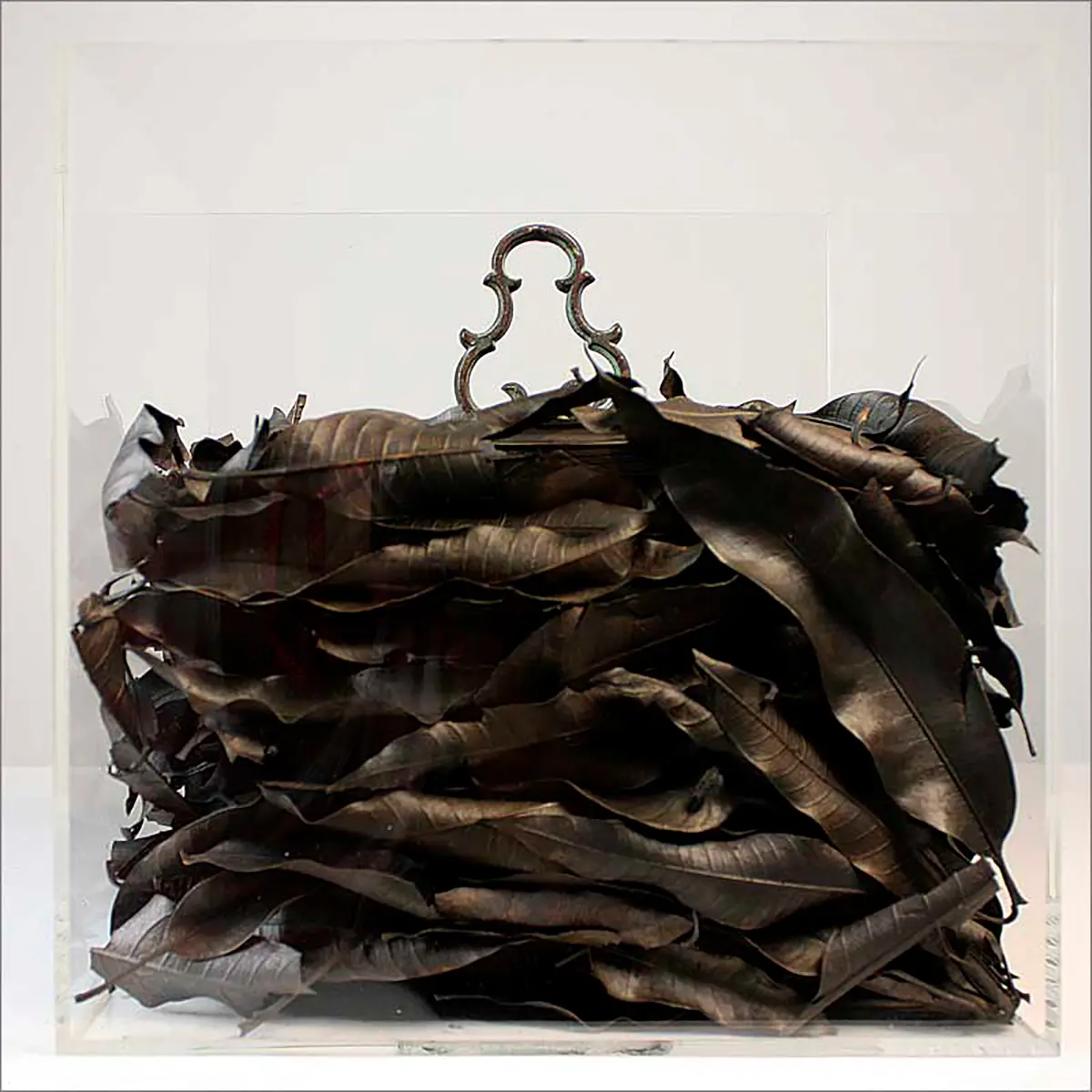
Fragmentos, open to the public for the winter at the Wynwood district’s Pan American Art Projects gallery, is inspired in the evocative power that underpins every work by Juan Manuel Fors, whose inexhaustible search through memory and in the objects of his everyday environment is connected to remembrance and its etymological roots in the Latin re cordis: to pass through the heart again. Fors’ work could very well be understood as archaeology of memory, not devoid of a certain metaphysical aura. A kind of religare that reconnects broken nexus through those signifying fragments.
José Manuel Fors’ work springs from several sources. Particular attention must be paid to the essential dialog achieved by the artist between aseptic, minimalist-tinged structures, generally transparent cubes denuded of any personality used by the artist as containers or borderline structures and become urns or reliquaries intent on apprehending that which is inapprehensible: the ephemeral, the immaterial, memory itself.
The show on view at Pan American Art Projects is comprised of three series created by Fors in the past two years. The first series, Atados de memoria, includes a number of albums with old postcards received by friends and family members since the early Twentieth Century. This poetic photographic installation is inspired by the widespread—and now almost extinct—tradition of letter-writing when letters and photographs were preserved in sets tied with a ribbon. The paradigmatic case here is that of love letters, which kept the relationship between lovers separated for long periods alive and aflame. If one of the parties ended the relationship, the letters were tied and sent back; often, they were burned in an austere ceremony.
Such is the aura infusing Atados de memoria. Behind each set of yellowing photographs made blurry by the passage of time, which alters the silver nitrate on the paper visitors intuits a story that will never again be deciphered. There are only glimpses, chimera, semi-closed doors promising a twist to our imagination and inviting us to remembrance.
The installation also expounds on disappearing practices such as the writing of epistles, now displaced by electronic media, and the radical shift undergone by the contemporary subject, trapped in the vortex of immediacy.
In Objetos Perdidos, we encounter photographic installations formed on the basis of the accumulation of fragments. Either based on photography or on the object itself, each one of these unsettling, often unrecognizable fragments are incorporated into abundant accumulations that give them meaning as new entities. The assumption of round, progressive shapes emphasizes the effect. A standout in this series is A la sombra de los maestros, where the artist appropriates moments of the history of art that have marked him personally and creates an umbrella-like structure that at once protects and shelters.
Finally, the series Cubos works as a clin d’oeil that brings us back to one of Fors’ earliest installations, created for the anthology of Cuban art Volumen 1 (Galería de Arte Internacional, Havana, 1981) and today included in the collection of Havana’s Museo Nacional de Bellas Artes.
In this new installation, Fors presents us with immaculate transparent cubes with a pillow of intervened leaves which supports objects that are the fruit of civilization and history.
Fragmentos is Fors’ first solo exhibition in Miami and many of the works have been created on-site.
JANET BATET