
Under the suggestive title The Eyes, Sometimes, the Alejandra Von Hartz Gallery located in the Wynwood Art District presents the first exhibition by Karina Peisajovich in the US.
Peisajovich was born in Buenos Aires in 1966. Her passion for art is connected to one of its most fascinating qualities: light.
The work by Peisajovich is inscribed in the tradition of geometric abstraction that is so dear to South America. But most importantly, she demonstrates a particular interest in the manner in which light and the theory of light interweave a very personal universe; one that for the first time is thoroughly presented in the thesis exhibition of the very personal visual proposal by Peisajovich.
Interested in the perceptive phenomenon of light and color, Peisajovich relies on a variety of mediums to explore this occurrence. In the first exhibition room of the gallery, visitors have access to two series that are a central part of the exhibition. Titled Color Theory, the first series consists of a very delicate installation of drawings rendered with color pencils. Consisting of 15 drawings that attempt to capture the magic of color, the series reconstructs the history of the various color systems that have been developed since ancient Greece. Some of the theories that explored and illustrated by Peisajovich in Color Theory include those by authors like Goethe, Munsell, Ostwald, Runge, Hering, Grosseteste, Mayer, Chevreul, and Young, among others. The result is at once delicate and extraordinarily beautiful.
In the same exhibition room and straight across from Color Theory, there is a recent series of photographs titled Every Time I See a Rainbow. Conceived by Peisajovich as an autobiographical document that narrates her daily relationship with light in a subtle manner. A rainbow becomes a sort of visitation for the artist who is surprised every day by the graceful quality of light.
In fact, most of the scenes depicted occur in ordinary, insignificant, and often colorless places where the magic of light transforms the moment.
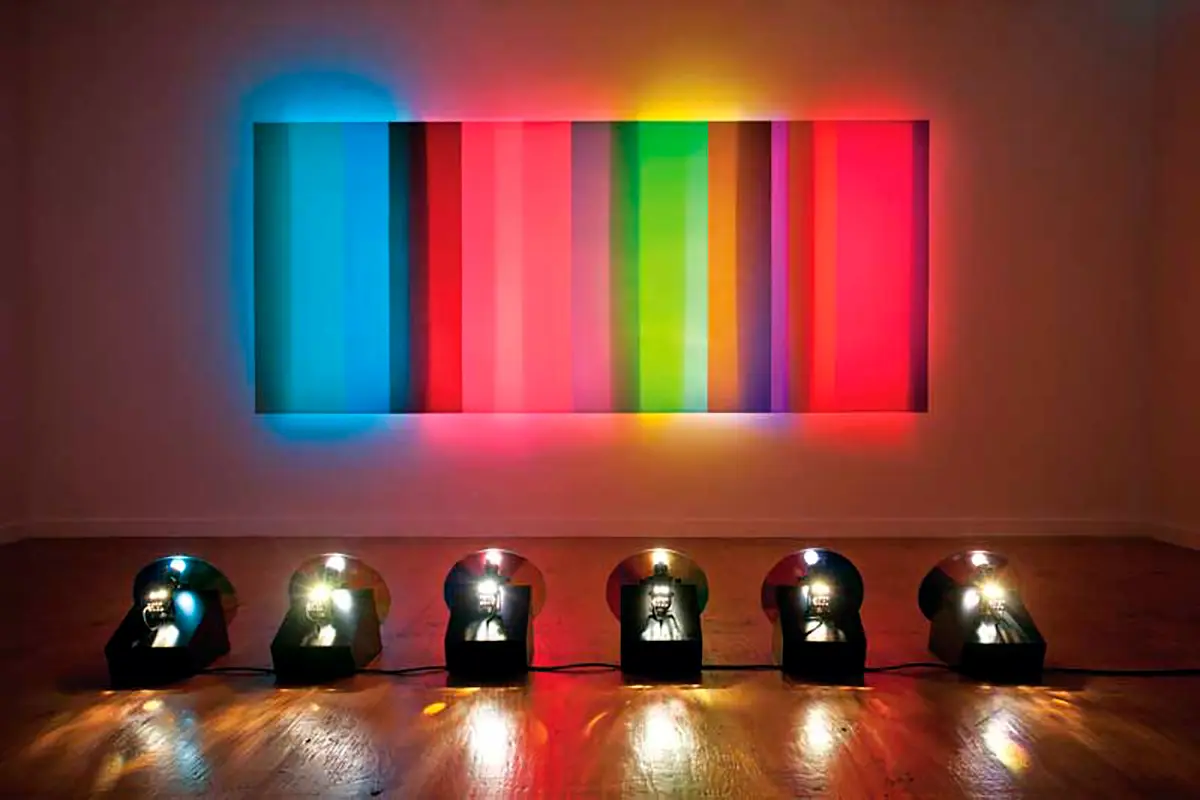
The second exhibition room contains the luminous installation RGB/CYM (Red, Green and Blue / Cyan, Magenta and Yellow). Projected on a wall painted with colors, the piece is a treat to the eyes.
Conceived as a processual project, the installation integrates time as an active element that encourages contemplation and purely perceptive enjoyment. Nonetheless, that which at first appeared just a play of lights and color actually constitutes a meticulous study on the two basic models of decomposition and analysis of color.
RGB/CYM (Red, Green and Blue / Cyan, Magenta and Yellow) contains two fundamental parts. The first one consists of vertical stripes of various shades of cyan, magenta, and yellow that cover the main wall of the darkened space and that corresponds to the subtractive color model used in the printing industry.
In perpetual interaction with these stripes of color are six projectors placed on the floor that show a colored sequence of lights based, once again, on the additive color model (RGB, or red, green, and blue). The additive color model uses light screens, such as TV, computers, etc.
Each beam of light corresponds in form and size to one of the color stripes painted on the wall. The interaction between the real colors—the colors on the wall—and the colored light that converges with the wall, generates an entirely new group of colors that in the end are the ones that viewers perceive.
RGB/CMY (Red, Green and Blue / Cyan, Magenta and Yellow) is a poetic commentary on the manner in which both color models interfere and contaminate each other during daily occurrences, as well as in the way they change our perception of a given event. As Peisajovich correctly points out: “We never really know how real colors actually look because, in everyday life, the two-color models are constantly interfering with each other. While during the day we observe that the leaves of a tree are green and, although we always think of them as green, during the night those same leaves appear to be black.”
The Eyes, Sometimes is a fundamental exhibition within the body of work of Karina Peisajovich.
JANET BATET