
Dádiva, Leo Battistelli’s first exhibition in his native Rosario after moving to Rio de Janeiro in 2007, opened in September of 2011. The artist is interested in maintaining a fluid relationship with Argentina; not only are his works seen often in galleries, at ArteBA, and in private collections, but he also returns to Rosario to, for instance, produce at the Verbano factory, a porcelain manufacturer, as he does in parallel at Luiz Salvador in Rio.
Battistelli belongs to a generation where some artists have returned to ceramics for their material in a renewed way. Up until ten years ago, this millenarian tradition seemed entirely exhausted in the Argentinean scene, devoid of new proposals on the part of artists, much less on the part of younger ones. However, since not too long ago but long enough that consistent developments can be identified in terms of technique, creativity, and concept, a salutary revival has taken place.
One of the first distinguishing characteristics in Dádiva with respect to Battistelli’s previous exhibitions in this city is his use of color. At times, white had seemed emblematic for him. Also, some time ago we were saying that his works naturally added fire, an element that contributes to the cooking that ultimately sets the form and produces the ceramic, to the basic ancestral materials of water and clay. From the start in Battistelli’s production, there has been a semantic symbiosis between the materials used, their natural and cultural characteristics, and the meaning of his works. Intertwined with his life experience, conjoined to his inheritance of memory, taken from his environment, these elements suggested for him the recovery of symbolic meaning to his art. To this, we must add the meaning of the different environments he has experienced, such as the Parana River in the city of Rosario and his work as a Lifeguard on its shores years ago, as well as, these days, the inescapable presence of the ocean in Rio de Janeiro. Moreover, for the artist, there is no distance between art objects and objects for everyday use.
There is a continuum between Battistelli’s life and work, connected to a view of the world where, as in ancient times, for instance, the four elements—earth, water, air, fire—are present in the basic conception of an essential reality or provide an understanding of the cosmos as a place where everything that exists, exists in harmony. Battistelli not only works constantly with at least three of those elements but is interested in achieving greater focus on states—liquid, solid, manifestation, evaporation—that evoke transformative processes. In accordance with that meaning and the implication of human beings in those passages, at certain points in his career, he referred to Alchemy, which had in fact as its objective the salvation of humankind and the cosmos. He speaks of levels of visible superior reality and of powers that can act on the concrete situation but reside beyond the visible appearance of the real, such as magical powers, in the specific case of this show.
Dádiva once again connected with this view of the world and added the inescapable evidence of Battistelli’s own geographic displacement.
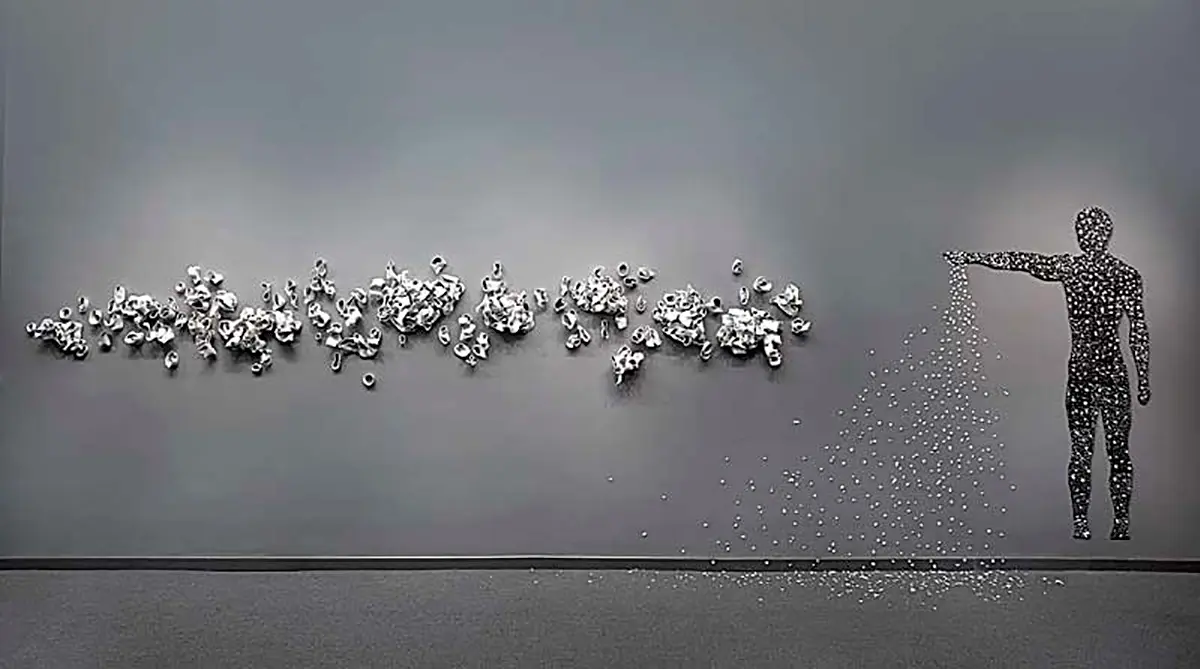
Poet and researcher Camila do Valle, who wrote the text for the catalog, connected this exhibition to 11571, held at the Klemm Foundation in Buenos Aires in 2004. The title of that show signaled the number of days lived. All the works were white, and they referred to Alchemy. There was a relationship with the artist’s biography, something also present in Dádiva, which records his move to a different territory, Rio de Janeiro, and his immersion in a different culture. Color is a novelty in this selection. And, in terms of his personal move, it would be preferable not to speak of borders between countries but of the experience of a different origin: a reconnection with nature. On the other hand, the colors used seem linked to the colors of the orishás, mortals that became gods in the Afro-Brazilian Yoruba religion. The thread connecting Battistelli’s previous works and the current ones is his belief in and expression of a sense of transformation. Each work here implied an event, a ritual, an offering of transformation. The largest work is a human figure that disseminates the ocean foam. A return, an act of thanksgiving, a symbiosis.
Gota de agua, Gota de sangre, Fuego y piedras de trueno, Espuma, Hoguera, La danza sin fin: these are some of the titles of the works that unveil the artist’s inner world.
Battistelli’s work remains attached to the idea of communion between man, nature, and territories, and to the malleability of the processes, he reveals through the universe very matter, expressed through artistic materials: clay and porcelain, rendered symbolic.
MERCEDES CASANEGRA