
Marta Chilindrón’s most recent exhibition coincides with the publication of a monograph of her oeuvre, covering her entire career. The sculptures on display at the Cecilia de Torres Gallery are so current and fresh, that it is hard to believe that the artist has been active since the 1970s and that she began her career as a realist painter. Nevertheless, as the catalog makes abundantly clear, the artist’s work is both consistent and coherent, following a lifelong exploration of perspective, perception, and the body. The exhibition both reassures and surprises. It consists of acrylic and twin-wall polycarbonate hinged sculptures, representational and abstract, that reference geometry and nature. The pieces drawn from life evoke organic forms—a cloud, grass, flames, water—while those that are abstract refer to nature more obliquely, through their reliance on the golden section. Together, the sculptures form a colorful grouping that is both visually arresting and thought-provoking. Their shiny, modulated surfaces invite us to play while also challenging received assumptions on the representation of nature.
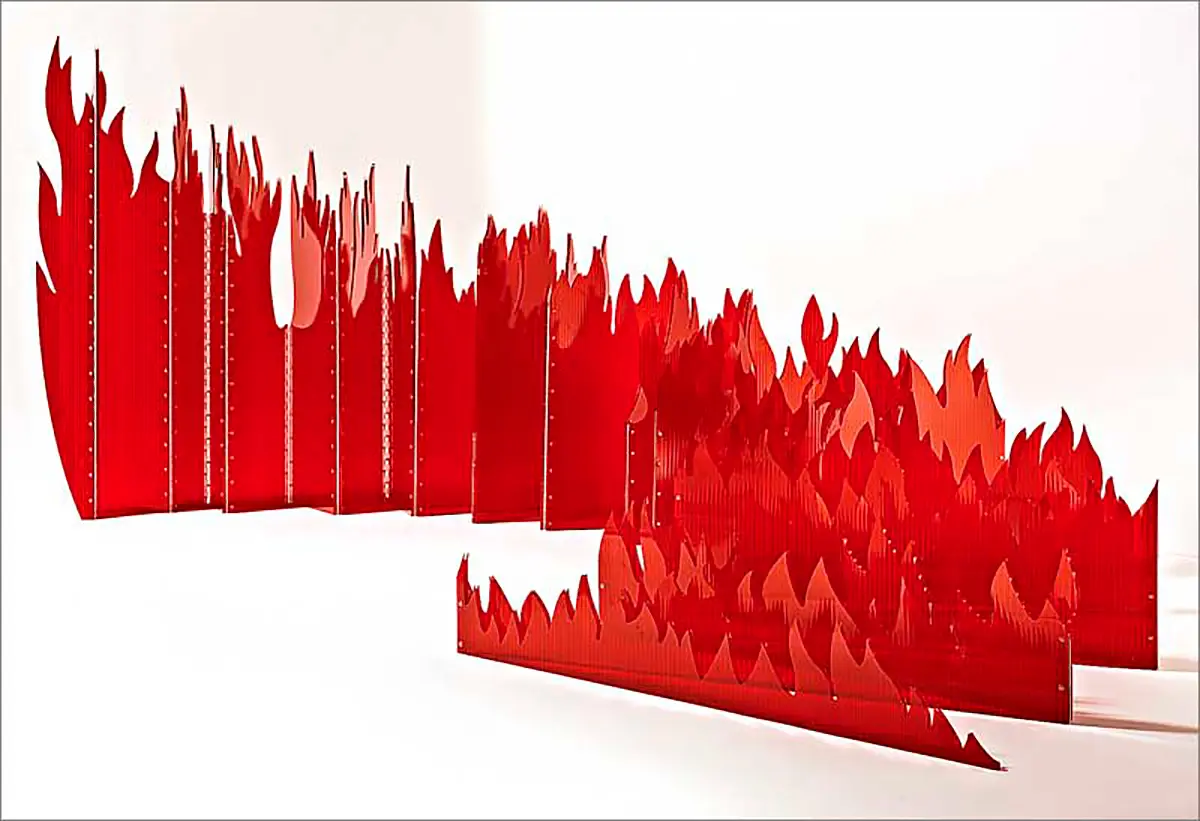
To a public familiar with Chilindrón’s works, the appearance of organic forms is an unexpected departure from a visual language that for years has sustained a rigorous exploration of geometry. The artist’s most characteristic shapes are squares, circles, triangles, and other basic forms that become the building blocks of ever-more-complex compositions that unfold in time and space. Her new sculptures are structurally similar to the geometric work in that they mostly consist of two-dimensional planes hinged together so that they may be folded closed or opened up. Thus, Fire (2010) closed up resembles a large red bonfire while unfolded suggests an unstoppable conflagration. Grass (2010) could represent a small hill or ever-growing and multiplying blades of grass. Both of these pieces, however, rely on irregular shapes to create new points of visual interest. Their unpredictability calls attention to the fact that nature is always in flux, its forms never fixed. The shapes described in Water (2011), however, are strangely regular. Repeating arcs that resemble a child’s drawing describe waves, but with each layer, the arcs become smaller, so that big flowing waves in the front give way to a tight repeating pattern in the back. Despite its regularity, the piece succeeds in maintaining visual interest through the shifts in scale as well as variations between translucency and opacity of the material. Among the sculptures describing nature, Cloud (2009) departs from the planar composition of the others. Hanging from the ceiling, it hinges in places while allowing empty space to penetrate in others, managing to capture the immateriality of the cloud with the most unexpected of materials.
As a counterpoint to the organic works, the artist also includes a series of abstract geometric sculptures. Contrasting the colors of nature are the bubblegum pink and fluorescent orange of 27 Triangles (2011). As a static object, the sculpture is very compelling, offering a complex composition of hinged equilateral triangles in two colors: orange and white. The orange appears pink from certain angles, adding to the visual interest of the piece. For the viewer who has the privilege of handling the sculpture, 27 Triangles has more to offer. Though the colors appear interconnected, each of the colored strands folds onto itself to create a single triangle. Through a few movements, a complex form becomes the paragon of simplicity. Two other works, Helix (2011) and Spiral-Green (2011), also demand to be manipulated in order to be fully appreciated. When closed, Helix consists of repeating wedges in blue and clear acrylic, interspersed at what appears to be random intervals but which actually follow the Fibonacci series. This is a sequence of numbers that adds up to the two previous numbers (0, 1, 1, 2, 3, 5, 8, 13...); as the numbers progress, the ratio between them stays constant, a phenomenon known as the golden section and which occurs in such natural elements as the nautilus seashell, flower petals, and pinecones. In Helix, not only do the wedges follow this pattern, but when opened up, the blue and clear bands of acrylic come apart, and each may be folded into a perfect circle. The piece evokes a similar sense of wonderment as Spiral-Green, a larger structure that upright consists of a series of wedges increasing in size sequentially, but that may be folded flat into the shape of a spiral, the quintessential expression of the golden section. It is worth seeking out a series of videos, posted on YouTube and on the gallery website, to witness the activation of these and other pieces. If one pays close attention, it may possible to recreate the artist’s engaging constructions at home.
TATIANA FLORES