
The Espacio Fundación Telefónica is located across from a well-tended plaza full of trees. With the installation of a large horn that “emulates an acoustic radar” and a hose that includes a set of headphones to listen to what is going on in the park, Martín Bonadeo (Buenos Aires, 1975) announces his splendid exhibition. His work reveals a restless mind that is passionate about the possibilities of art, science, and technology. Nonetheless, his inquiries are much more artistic and philosophical in nature than scientific. Likewise, to adequately present the impeccable conception and execution of the 10 pieces included in his solo exhibition titled Martín Bonadeo. Bellico, the artist performed exhaustive research and demanding experiments for more than six months.
The subtitle of the exhibition, Bellico, stems from a play on words that combines the name of the inventor of the telephone, Alexander Graham Bell, and the Spanish word bélico (war). Thus, the exhibition focuses on aspects of military science and telephony. According to Alma Ruiz, the curator of the exhibition, “The transformation of devices designed for war into everyday objects—such as walkie-talkies, GPS, and the Internet—is paradigmatic of government priorities and the manner in which the funds meant for scientific research are assigned.”
As an artist, Bonadeo has developed nearly fifty projects since 2000, including solo and group exhibitions presented around the world. As a professor, he founded and directs the Taller Experimental de Ciencia, Arte y Tecnología (TECAT) and the Centro de Innovación de la Forma en la República Argentina (CIFRA), two university spaces for multidisciplinary experimentation in Buenos Aires. His wide-ranging interests led him to approach El Cielo en la Tierra (Heaven on Earth), which he presented at the Fine Arts Pavilion of the Universidad Católica Argentina (UCA). There he resorted to unexpected tools, such as sand watches, lenses, compasses, thermometers, as he also included a patch of artificial grass in the multisensorial installation titled Pasto Termosintético (Thermal-Synthetic Grass, 2011).
A doctor in Communication, Bonadeo’s works specifically created for the Espacio FT are based on the subject of telephony—as a medium of communication and as a technological device. These works address the device’s development and history, through a succession of progressions and phases that have led to that which today is regarded as an indispensable device. The fact that Telefónica sponsors this project does not refrain this artist from questioning the frequent misuse of the telephone as a status symbol, a medium for isolation, or as an invasive vehicle. The installation titled Marketing de Guerra (Marketing of War) represents just one example of this. This piece consists of dozens of telephone cables semidetached from a column. It resembles a creeping plant, but one that produces sound. Is it the embodiment of a future in which nature will be completely vanished and then artificially recreated? No, this installation is integrated by “a cluster of cables and telephone parts that emerge from a column to pass along communications handled through the Central Telefónica Juncal (where the Espacio FT is located). Hidden behind the cables, the loudspeakers emit the messages recorded by the automatic answering machine in the artist’s studio. Most recordings are of political messages or messages from marketers attempting to sell products or services.”
Marketing the Guerra is just one example of the marvelous and contradictory offerings in this exhibition, where science and technology occupy a central place. It is difficult to observe this exhibition and, at the same time, describe the curiosity and wonder Bonadeo’s pieces elicit in the viewers. These are works that travel through time. One may draw from a 17th Century engraving, while another reproduces a scaled version of the airplane that broke the sound barrier—and immortalize the instant when sound becomes image; and others still represent the Fuga de Memoria (Escape of Memory), voids that are formed in a computer program, or the loss of all the data stored in a cellphone. How is it possible to write about technological devices whose mechanisms are sensed before they are completely understood? How could I add to the detailed description and mission statement that appears on the web page of the Espacio FT?
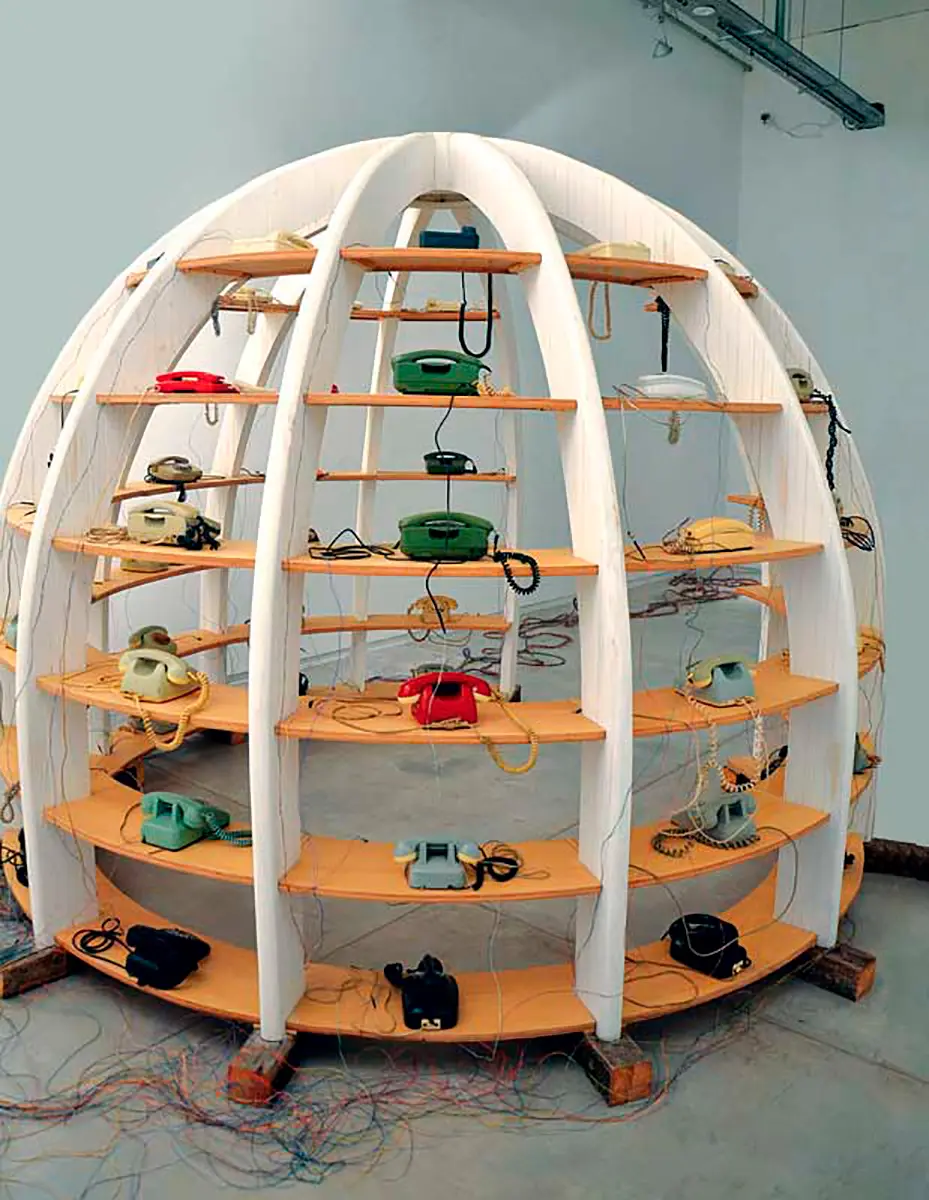
Depending on the knowledge each visitor brings to bear, he or she may be able to decode knowledge from the past and the future. Visitors may feel captivated by certain interactive pieces—as these offer immediate results—or others that, conversely, generate more questions than answers. Some may travel back to their childhoods when walking through the domed structure titled Resonador (Resonator, 2011)—assembled using an old switchboard and a collection of old and more recent phones—and listen to the sound of telephones ringing the way they used to, and not with the sounds of rap or cumbia, as they do today. Will viewers be able to follow the tracks that lead to the Argentinean Pampas in Paisaje Telefónico (Telephonic Landscape)? This installation uses archaic poles—old columns from the Espacio FT—and cables with green and blue electroluminescent wire, and includes a small clay baking house. Would viewers then be able to imagine the horizon that feels infinite?
Perplexed or certain, viewers are invited through this stimulating work by Bonadeo to reflect on the evolution of inventions and on the relationship between war and everyday life: on that which is real, virtual, and on the new realities that transformed forever our life and sensibility.
VICTORIA VERLICHAK