
The large rotunda of New York’s Guggenheim Museum offers a visiting experience that is virtually unique. The continuous ramp spiraling up along around a circular base allows for transparency of space that few other museums do, and this opens up into a variety of viewing options be they distant or up close, viewing works in groups or sequences or one at a time, even altering the sequence and progression of works in one’s journey. This openness can provide many opportunities for viewers and curators alike; it can also provide many challenges.
In recent years the museum has developed its Intervals series which was conceived to address a problem acutely felt by the institution. Whenever the museum is in the process of changing exhibitions in the large rotunda it cannot hide this fact by just closing off a certain gallery or section or providing a detour through space; much of the ramp will be involved in the de- and reinstallation process and much of the construction and process involved will be visible. Very little art will be on view, most of the building is still visible from one vantage point or another, and the entire space will be an evolving work-in-process. The artists involved in the Intervals series are thus invited to conceive of short-lived site-specific interventions with the museum during this awkward time.
The most recent of these projects were executed by Brooklyn-based Nicola López, marking her first work for a major New York institution. Titled Landscape X, this installation exploits the notion of architectural and structural transparency and transforms the necessities of deconstruction and reconstruction the museum is experiencing into virtues.
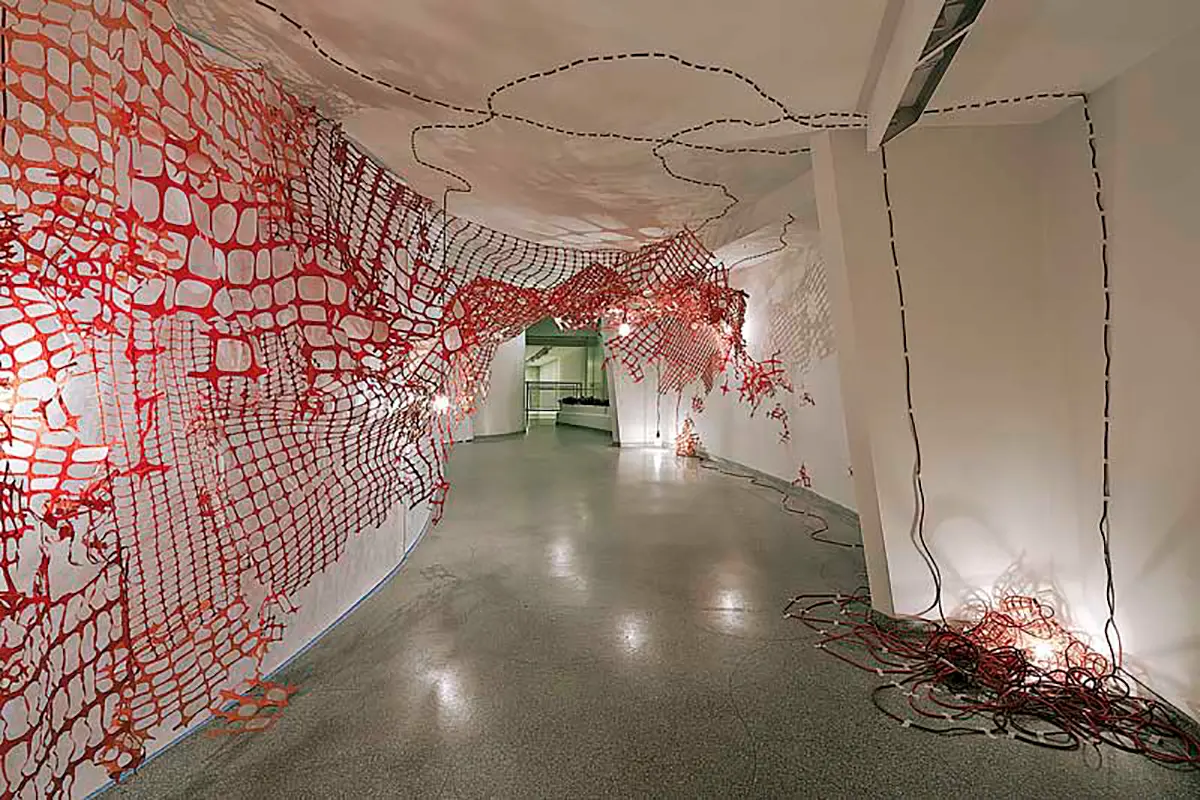
López, a graduate of Columbia University, has long been interested in anthropology and technology, in mapping and systems. In the tradition of Cezanne and Picasso and Braque, she examines and explores things by breaking them open, in the tradition of Duchamp she “pulls back the curtain” to expose the mechanics of display and combines nontraditional materials with fine art techniques to create an experience. During the installation of the Maurizio Cattelan exhibition, which demanded the use of the center of the rotunda, visitors were confined to the ramps and much of the openness of the space was closed off by a large scrim that encircled the interior of the ramp. Using the materials being employed by the installation crews—blue electrical tape, yellow barrier tape, plastic and metal mesh, electrical cords, wires, strings of lights, the scrim itself—Lopez demarcated the continuity of the ramp into different sections and passages, different “territories,” marked by pattern, color, or visual orientation and focus. At times it is clear by a refinement of pattern and display what is Lopez’s intervention; at other moments it is not so clear whether the materials one encounters were deployed by Lopez or the installation crew that continued to work through and around her. The scrim, for example, while required by the museum, is appropriated so seamlessly by Lopez that one could conceive of it as being her choice from the beginning.
Adding another layer of visual experience, Lopez also engaged the space by directly applying paints and graphics to the walls. These often take on curvy organic shapes and sprawling arabesque lines and add a sense of connectivity to the disparate areas. These graphic elements, with their resemblances to veins, organs, and cellular life forms, also seem to reveal a deeper understanding of Frank Lloyd Wright’s concept of organic architecture—i.e., that the entire building to be considered as one organism with interdependent and interconnected systems. Thus the space under Lopez’s transformation could be read as meta-machine, as a series of mapped systems, landscapes, or terrains, or even as a large organism (perhaps in the process of an autopsy).
Much of the power of this installation came from the paradox Lopez exploited of rendering the act of destruction as a creative act. By exposing the “guts” of an institution and its practices, Lopez seems to be part of a growing current, especially among Latin American artists, who employ themes of destruction, breakdown, or deconstructed architecture or design in their projects. It is interesting that while López’s installation was on view, Cattelan was overseeing the construction of the post-industrial tower from which his artworks were to be hanged in a symbolic gesture of collective suicide, execution, or lynching, and that once erected and the scrim removed, the entire rotunda would be transformed into a large-scale panopticon. Increasingly these projects convey themes of violence or some sort of socio-political commentary on government and society and the corrupting influence of drugs, guns, or money. Distrust of institutional authority or the breakdown of social, economic, or cultural systems is often inherent in the works as well.
López, however, makes no such overt thematic claims for Landscape X, and much of it does seem to be most committed to an aesthetic of necessity. Perhaps those who wish to extrapolate these other themes and issues from this project might question whether or not such thematic expectations from Latino artists are not beginning to border on cliché. Landscape X, for the short duration of its existence, was a visually rich and complex multimedia installation that engaged not only the physical parameters of its space but also the conditions and activities within that space during the time the installation was on view. It solved the visual and spatial challenges of working within a structure that was not whole or complete and answered the peculiar needs of an institution during what could have otherwise been an awkward period. Rather than critical commentary, it seemed to be more pragmatic and optimistic, and if its effects derived in large part from the purely formal and a sense of spectacle, it reminded us that sometimes with art that can be enough.
JOHN ANGELINE