
Presented by the French-Mexican association whose mission is to promote Mexican culture in France—InC France-Mexique—the exhibition titled Trackers is the first monographic exhibition in France by Mexican-Canadian artist Rafael Lozano-Hemmer (Mexico, 1967). La Gaîté Lyrique, and old theatre built at the end of the 19th Century created for operettas—Offenbach was one of its directors—was eventually bought, renovated, and transformed by the city of Paris. After enduring a long period of neglect that lasted almost 40 years, the theater reopened in March of 2011 to become the last “bastion” for the digital and musical arts. It houses a documentation center, a concert hall, and a magnificent restored “artists bar.” It is until now that the French public can discover the large and small scale works, centered on the electronic arts, that Lozano-Hemmer has been developing for over 20 years. With exhibitions and interventions presented all over the world—for instance, he represented Mexico in the Biennale of Venice—several texts by critics dedicated to his work, and even his own writings, it was about time that the internationally renowned artist finally had an exhibition in Paris, the birthplace of kinetic art in the 1960s.
Occupying the entire two-story exhibition space, the show includes 13 works created in the last 20 years. With the use of live cameras and tracking systems to capture the presence and behavior of the public, Trackers proposes a direct, ephemeral, and efficient interaction in real-time that allows a wider public to participate in Lozano-Hemmer’s first contact with the French capital. For many years—he began working with computerized tracking systems in 1991—this artist has been interested in the insatiable and alienating imposition of circumstances brought about by “Big Brother” into contemporary society. From the video surveillance tracking systems that are everywhere in the streets, museums, large stores, and in the public transportation system; to cellular phones with built-in cameras, webcams, and also electronic platforms, the harassment is constant and the private becomes public. A sort of mise-en-scène of people’s identity and/or personality is insidiously executed with the pretext of fluidity and democratization of dialogs and communications. It is important to remember that the movement detection systems were perfected to carry out the most recent technological wars which began with the First Gulf War.
Upon entering the exhibition, we almost immediately encounter an enormous eye looking back at us intensely. The piece is titled Surface Tension (1992) and consists of two double-sided screens. We have been forewarned: nothing will escape the gaze of those who observe us. As we get closer and eventually move in front of the work, its gaze never stops following us, we become “prisoners” of this dominant gaze. In the video sculptures by US artist Tony Oursler, the inquisitive “eyes-bodies” already interrogated our conscience.
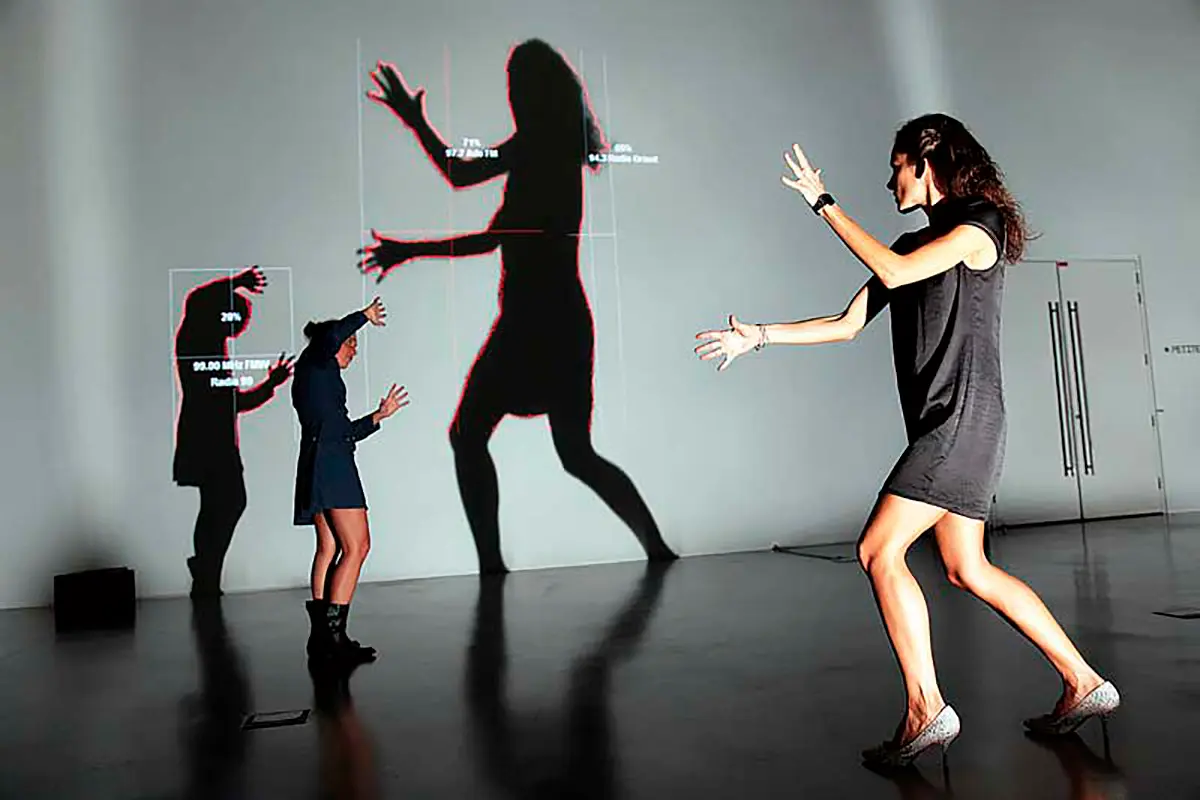
On the first floor, viewers can observe a mix of brief outbursts of sound that intermingle, superimpose, cut, and extinguish one another and then are immediately reborn. Frequency and Volume (2003) occupies an enormous wall where the shadows of visitors are projected along with the radio frequencies generated by their movements. Created at a time when the Mexican government was shutting down the pirate radios of autochthonous communities, the work questions this invisible—and perhaps more political than commercial—space created through the designation of a single wave frequency. Inside a closed room we find the work titled Apostasis (2008): immersed in a ludic pursuit that goes against any sense of reality and is therefore absurd, viewers attempt to “join” the circles of white light projected on to the floor. The piece The Year’s Midnight (2011) is named after the beginning of the poem by John Donne titled A Nocturnal Upon St. Lucy’s Day. It consists of an interactive piece that plays with the notion of one’s reflection. On the reflection of a fake mirror, the observer’s gaze appears as fast as it disappears, leaving behind an image that is at once anguishing and dreamlike. It is a reflection that references the traditional representation of Saint Lucy. Lastly, the work titled Make Out (2009) is projected onto another large wall. Constructed with 2,400 videos taken from the internet, the screening shows multiplied videos of couples kissing, as well as famous kissing scenes from movies. These images react to the movement; the texts and words placed in front of the images play an important role in the exhibition. In Third Person (2006) an interactive screen transforms the mimicking shadow of each visitor into words that randomly become more or less prominent within the outline of the silhouette. In the work titled Reference Flow (2009)—an installation designed to create more mental than visual confusion—a group of luminous signs with the word EXIT written on them and an arrow that points to the direction that should be followed, always rotate to the left when a person passes near them, without regard for the person’s actual trajectory.
Within the particular ways, it tailors the surveillance systems and urban impositions, the art of Rafael Lozano-Hemmer invites us through an enjoyable interaction with the works—that could have easily been more scary than amusing—by encouragement rather than intimidation, to become aware of the inquisitive environment we are immersed into, and to evaluate and try to understand the effects of this technological evolution that, in most cases, has already surpassed us.
CHRISTINE FRÈROT