
Xawery Wolski established his residence in Mexico City in 1997, following the long-standing tradition of European expatriate artists living in the country. He was born in 1960 in Warsaw, Poland, where he was educated at the Academy of Fine Arts. He also lived in Paris, where he attended the Academie des Beaux-Arts and the Institut des Hautes Etudes en Arts Plastiques; and in New York at the New York School of Drawing, Painting, and Sculpture. He later traveled to Carrara, Italy, where he was trained to master working with marble, thereby completing a comprehensive and classic education. Wolski also traveled to South America and Asia, spending time on both continents.
After receiving this type of education it is no surprise that he fell in love with the Mexican rich craft tradition; and soon enough his pieces started to show that influence, mostly by ‘borrowing’ technical aspects from it. Particularly visible in this exhibition, the artist presents a selection of pieces from a couple of series that he has been working on for at least the past two years. The diversity of the work, despite the fact that it was made during the same period, allows one to see a visual resume’ of this time and his oeuvre in general. Through it, we can see how his mind works and the subject matters that interest him; mostly, how he combined his classical background with the new techniques and themes.
The first piece that we see upon entering the exhibition space, Tzalan Blanco (White Tzalan), beautifully encapsulates this idea of integration into his new environment. The elaborate rows of small beads create a flowing cascade that evokes a ritual dress, all in white. Made of terracotta, silk thread, and acrylic, Wolski created what seems like a ceremonial gown, showing the visual and conceptual influence of anthropological objects. The title is a tribute to the Náhualt people and a direct reference to their textiles. By selecting it Wolski shows his assimilation of the culture and his understanding of the place.
Religion, especially Catholicism, has been an integral part of daily life in Mexico, and Wolski‘s Círculos (Circles) series are inspired by rosaries, commonly used for praying. These detailed renderings are made of perfectly round pieces of individual terracotta beads flawlessly aligned. The endless circles allude to the intimate process of praying, connecting time in an infinite ritual cadence. The color selection in this series is also inspired by the traditional red used in liturgical ceremonies. Wolski’s use of color and the attractive textures make these pieces very appealing.
Another series that he has been working on for a while, and that may be the most recognized of all his oeuvre, are his white terracotta chains. Placed as an installation in a room of its own, the thick chains hang from the ceiling and create a sort of ‘white forest’. From far away the chains seem ordinary, but upon close inspection, we realize they are made them from clay and not from metal, as anticipated. One of these works is part of the Rufino Tamayo Museum collection in Mexico City, and is currently on exhibition as well.
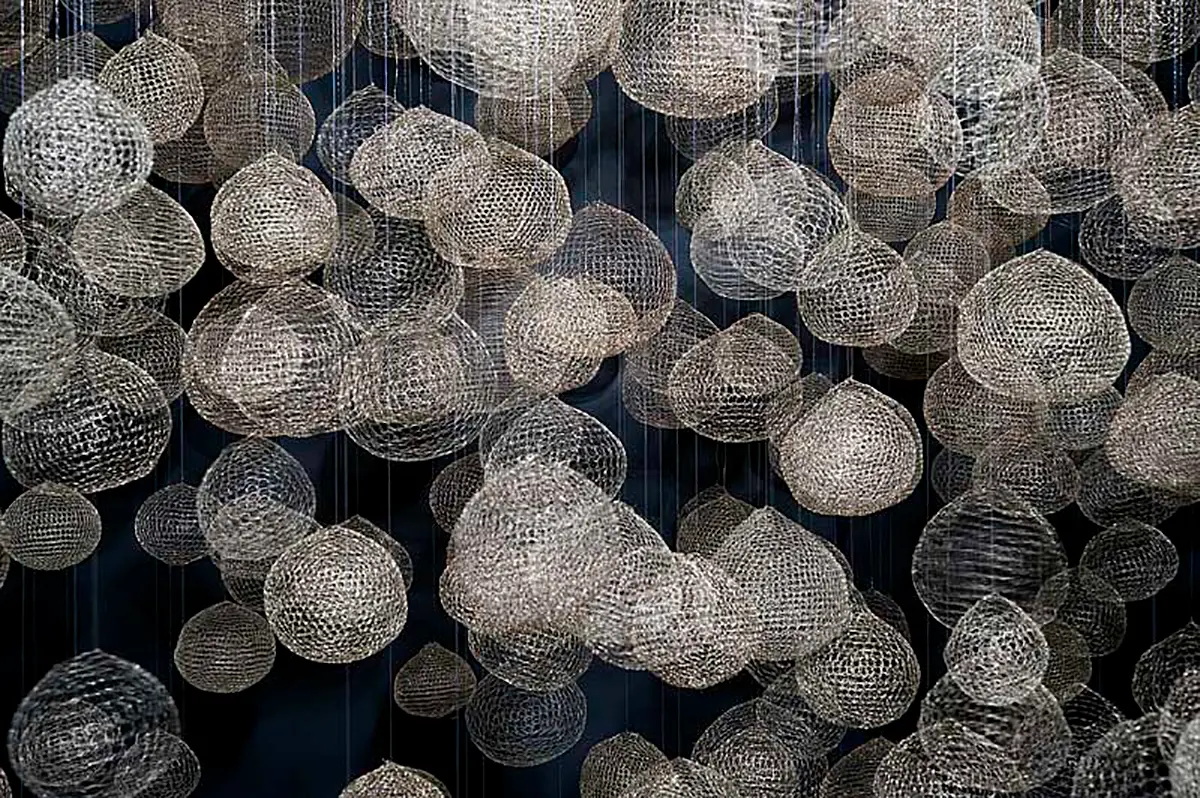
Perhaps the most attractive piece in this exhibition is Globos (Balloons), a delicate and seemly fragile installation consisting of an arrangement of crocheted fine wire structures. The composition reminds us of floating lanterns, an effect that is reinforced by the display, set against a dark wall.
There is a theatrical intention in the way he presents his works, and a tendency to use duplication as a way of structuring them. This pattern is clear in his installations, in which he uses the effect of repeating elements in a consistent manner. Although even the works that are not installations per ses how this tendency, it is on the second where this rule is more evident. A good example of this statement is Constelación (Constellation), his interpretation of a starry night in white. The stars are represented by hundreds of terracotta balls, all seemingly perfect from far, in an imitated uniformity. Up close we can see that each ‘star’ was individually made, therefore the intentional imperfections.
He is not afraid to experiment, and tries his hands on different materials such as clay and metals, creating beautiful renderings of objects made in trompe l’oeil effects, like the chains and his interpretations of textiles. He can be bold when selecting his palette, going from a spectrum of subtle combinations of different whites to a daring red.
Wolski’s work is time-consuming by nature and by the fact that he uses traditional techniques. This apparently naive deed makes possible the daunting confluence of past and present, and the juxtaposition of many cultures he has experienced in his life. His perception of time and his appreciation of history allow him to combine elements from Pre-Columbian civilizations with contemporary themes. Looking at his works we can see reminiscences of anthropologic and ritual objects integrated into his organic forms.
There is something spiritually inapprehensible in his works, a hidden narrative that comes alive upon reexamination of the pieces. His vision of art is cosmopolitan, deterred by time, space, or geographic location. Through his art, Wolski brings us his vision of life filtered by his vast, vital experience.
IRINA LEYVA