
Adriana Marmorek has been focusing on the theme of erotic desire for many years. This became evident in the female figures sculpted in clay and then cast in bronze that she included in this new exhibition. More academic in their initial phase, these figures eventually opened and fragmented until they turned into what viewers began to perceive as erotic works. This persistent emphasis on desire led Marmorek to commit to a theme that today has become a conceptual inquiry that has led her to explore installation and the creation of objects.
Last year, Hal Foster traveled to Bogota and spoke about The First Pop Age. Then, in the session dedicated to Richard Hamilton, he focused on the theme of desire, on the erotization of objects by the advertising industry that has quickly spread across the world through mass culture. This imaginary began to be shaped during the 1950s and continues to grow under increasingly perverse forms in the technologically-driven world of today. And this is precisely the phenomena explored by Adriana Marmorek in the most recent evolution of her work presented in the exhibition titled Basic Stitch: Double Knot.
Adriana Marmorek has worked with feminine objects like mirrors, cases, purses, and vanities in the past. This time around, her interest centers on lingerie and laces in particular. This fine and transparent fabric that originated in the East—and that was introduced in the West during the 16th Century—has acquired through time an important symbolism that is dual in nature. On one hand, because of its close connection to needlework, a quintessential feminine endeavor, it has been linked to another activity closely associated with women, according to the narrative of the West: waiting. The story of Penelope comes to mind, but waiting is also closely connected to idleness, frivolity, and inconsequentiality. In fact, one-piece, an embroidery on crochet, was titled Frivolidad (Frivolity). Nowadays, lace garments are massed produced, widely distributed, and promoted through advertising campaigns as symbols of femininity and eroticism; it has become a means to incite consumerism through the mobilization of desire.
The exhibition included several suggestive pieces whose meaning and intelligent interaction between the objects and the artist’s ideas, become clear as one begins to describe the work. Upon entering the exhibition room, viewers were received by an enormous underskirt, made with translucent fabric, hanging from the ceiling. Behind it, there was a large bright red mural with an understated drawing that formed a lace. As one approached this section of the work, it became possible to recognize that, instead of flowers, the pattern consisted of nipples that multiplied across the design. The underskirt invited viewers to have a look underneath. Once there, the gaze would find a video showing a sky projected on to the area where the female genitalia would normally be. The sky stood for that promised land where everybody wants to go. Vaporous clouds moved before the curious and malicious gaze that zoomed in this desired, forbidden, and hidden world.
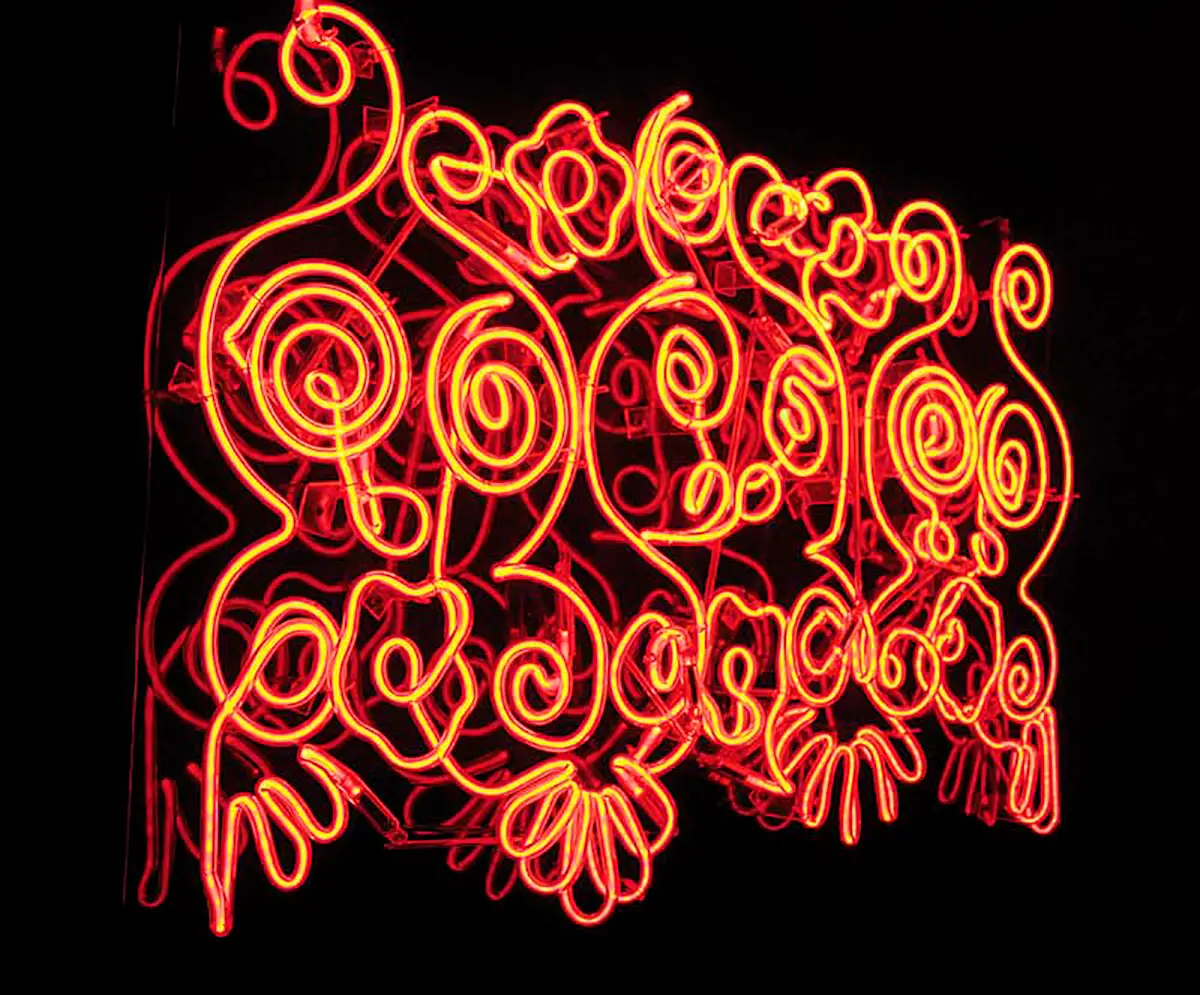
A life-size brassiere made of glass hung from the wall held by thin silk bands. Like the other works in the exhibition, it was a delicate piece that also included a lace. In another section of the gallery, viewers could observe an immense lace created with neon lights. It was entirely different in nature than the glass piece. While the glass brassiere displayed a transparent and colorless lace whose beauty, delicacy and fragility were accentuated by the rest of the piece, the luminosity and bright colors of the neon lace, on the other hand, conferred it qualities that were closer to the world of advertising, or to a highly risky type of nocturnal party adventure. The flowers on the lace would produce sparks constantly, as the high voltage turned them into something menacing and capable of electrocuting anyone who would dare to touch them.
A series of drawing-like works that depicted several types of laces were also part of the exhibition. Upon getting nearer to these subtle pieces, one discovered that they were actually not drawings but photocopies of lace fabrics. Through them, Adriana Marmorek underscored an approach to art that leaves any manual virtuosity behind in favor of conceptualization.
There were also some other images and texts that served to clarify the sources that led to Marmorek’s artistic process. The artist included the last words of Molly’s monologue that are part of James Joyce’s Ulysses and where desired is explicitly named. Clippings from women's magazines from the 1950s to today showed lingerie advertisements and postcards in which lace appears as an element of women’s and men’s clothing.
The laces by Adriana Marmorek stitch together two worlds that are well-known to her: advertising and art. Once a communicator by trade, she worked for several years in the world of mass media and advertising. She eventually abandoned those fields to pursue her artistic career; in order to delve into “that obscure object of desire” and cultural construct that is the female body and the objects associated with it.
MARTA RODRÍGUEZ