
Eleven drawings, two watercolors, and two sculptures (all from 2011) were included in Cuban artist Alexandre Arrechea’s solo show El objeto sacrificed.
The exhibition amply confirms the fascination this artist has always felt for objects, which he relates to one another in search of articulation for his ideas. The questions triggered by the conjoining of unconnected items or icons are the basis of his post-conceptual poetics, indebted to Marcel Duchamp’s legacy of the prevalence of the conceptual aspect of the object and the discoveries of meaning through chance procedures. While these principles were assumed by the group of which Arrechea was a member, Los Carpinteros, his later work with technological supports, materials, and kinds of art that were not in the group’s practice gives his individual creations a profile of their own, with the dichotomous nature of many of his productions as a tactical move in a critical-reflective discourse.
Through eight years of an independent career, Arrechea has traveled from the use of simple objects as the catalysts of a series of experiences, to prioritizing his simultaneous interest in specific topics for whose exploration he has needed to expand the range of materials and diversify his media while preserving the semantic payload and the presence of the object. Personal memories; the private and the public; citizen vigilance; historical period and their aesthetics, nature, and progress: these and other topics connected to remembrance and also to everyday life were on display in El objeto sacrificado, like philosophical statements derived from his observation of the behavior of contemporary society. Here, the adjective “sacrificed” makes explicit the suppression of any utilitarian sense of the object in favor of its use as a metaphor, or in favor of adding to it new virtues that carry specific experiences.
A sled in flames is the paradoxical image that triggers a series in graphite. As German artist Thomas Schebitz has noted, “Drawing is the most important way of connecting an idea to its execution”; we are thus not surprised by the number of drawings in this show. A great example presides at the space: El pasado aún está abierto a interpretaciones. It portrays an old Underwood typewriter with traditional lamps on its keyboard, their scale switched for that of the machine, to illuminate ideas and induce a reinterpretation of history or of writing, a fused appearance of old artifact, period lighting, and an entry into the imagination.
Several drawings are a tribute to the industrial and design production of the 1940s and 1950s. These express the artist’s nostalgia for the Twentieth Century in the face of the changes operated in many industrial products by the development of new technologies, as is the case of the typewriter itself, now completely replaced by the computer. Inscribed in the same universe is Aliento y Vapor, an iron connected to an old microphone that, according to the artist, refers to the memory of his mother ironing while listening to the radio. This work, as well as the expressway whose trajectory describes the outline of a butterfly—remember that many mega-constructions recreate figures from the animal or plant worlds—establish bridges between worlds that are supposedly divergent: nature and the city, in this case, the domestic and public spaces in the previous one. In other instances, the relationship between the objects represents statements. For example, the association of a gun with one of the spires of the Sagrada Familia (from which the work takes its title) presented as its projectile, makes us think of the ways in which architecture can respond to ideology and represent power. Meanwhile, Arrechea in El agua bajo mis pies use the semantic opposition of the anchor (fixity) that supports the handlebar of a bicycle (movement), in an attempt to give levity to a heavy element and enunciate how difficult it is to move something that is sunken and anchored. In Oxígeno, an oxygen tank connected to microphones, the suggestion is more literal. In this way, Arrechea has created a kind of meditative literature on the basis of the connection between objects, not deprived of commentary on his own identity as an artist. Such is the case with Carpintero infinito, a bird is drawn according to the descriptions of naturalist Alexander von Humboldt, where the artist posits himself as his own discovered; here he substituted for the bird’s main tool, its beak, Brancusi’s column, the tool used by the artist.
Arrechea doesn’t only link objects or their attributes. At the center of the gallery, a sculpture materializes the idea that humankind and its creations are connected, as are the disciplines to one another: the idea that nothing is really on its own. From the rib of a supposed Adam, lying on its back, there emerge two chairs that remain connected to his body. It symbolizes the artist’s relationship with design and architecture and the blurring of the boundaries between these disciplines, a relationship Arrechea transforms into an object, a unique body.
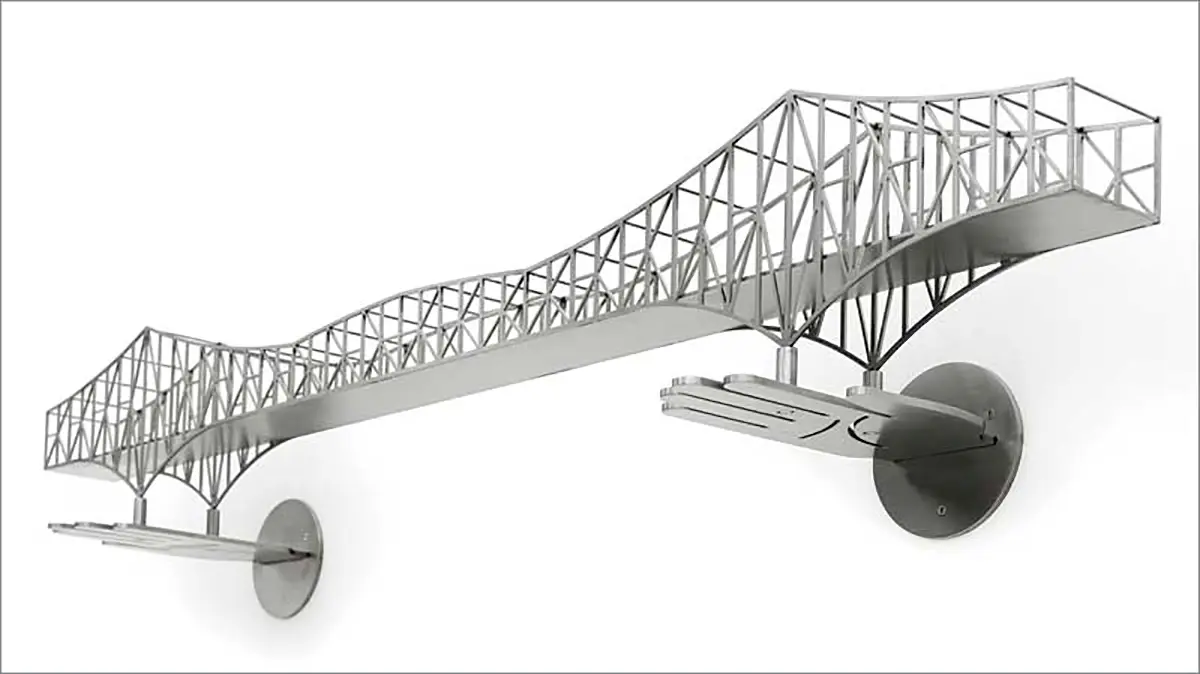
While the topics explored may be moored on local, contextual, or personal matters, the use of universal codes and images make Arrechea’s work appealing for any audience. This is reinforced by the impersonal character of his works, the result of a search for decontextualization and a pluralistic gaze, able to bring together two perspectives on any issue. The second sculpture, La dimension del gesto, is a good example of this. We don’t know whether the hands supporting a bridge are giving or taking, and we don’t know whether we go back or forth on the bridge; the work symbolizes a gesture of giving but it is attached to the wall. And the ambivalent character of questions woven around a long-standing yet greatly current trope, such as the bridge—synonymous with connectivity, communication, migration— give Arrechea’s work global character and perspective, according to the times we live in.
MARGARITA SÁNCHEZ PRIETO