
In the exhibition, the artist gathers many years of experience working with screen printing, using plastic sheets and glue to superimpose on the painting canvas. From her beginnings, during the so-called Geração Oitenta (Generation of the Eighties), she has harmonized her paintings with strong colors and striking brush strokes. Beatriz Milhazes is part of Brazilian modernism.
Beatriz Milhazes’ pictorial work begins with a confluence of artistic movements in her socio-cultural environment, from Tropicalia to Bossa Nova, dancing to the rhythm of the sublime and exotic beauty of her native Rio de Janeiro. Milhazes recreates the ancestral legacy of Rio’s sweet romanticism, fused to contemporary realities.
Many of the blossoming, colorful, spring-like images we see in Milhazes’ painting originate in her small and compact studio, where the artist, born in Rio de Janeiro in 1960, has worked since 1987. It is located right next to the city’s lush Botanical Gardens; inevitably, she finds there the inspiration for her flowery shapes and patterns, her delicate whirlpools, her leaf-like figures.
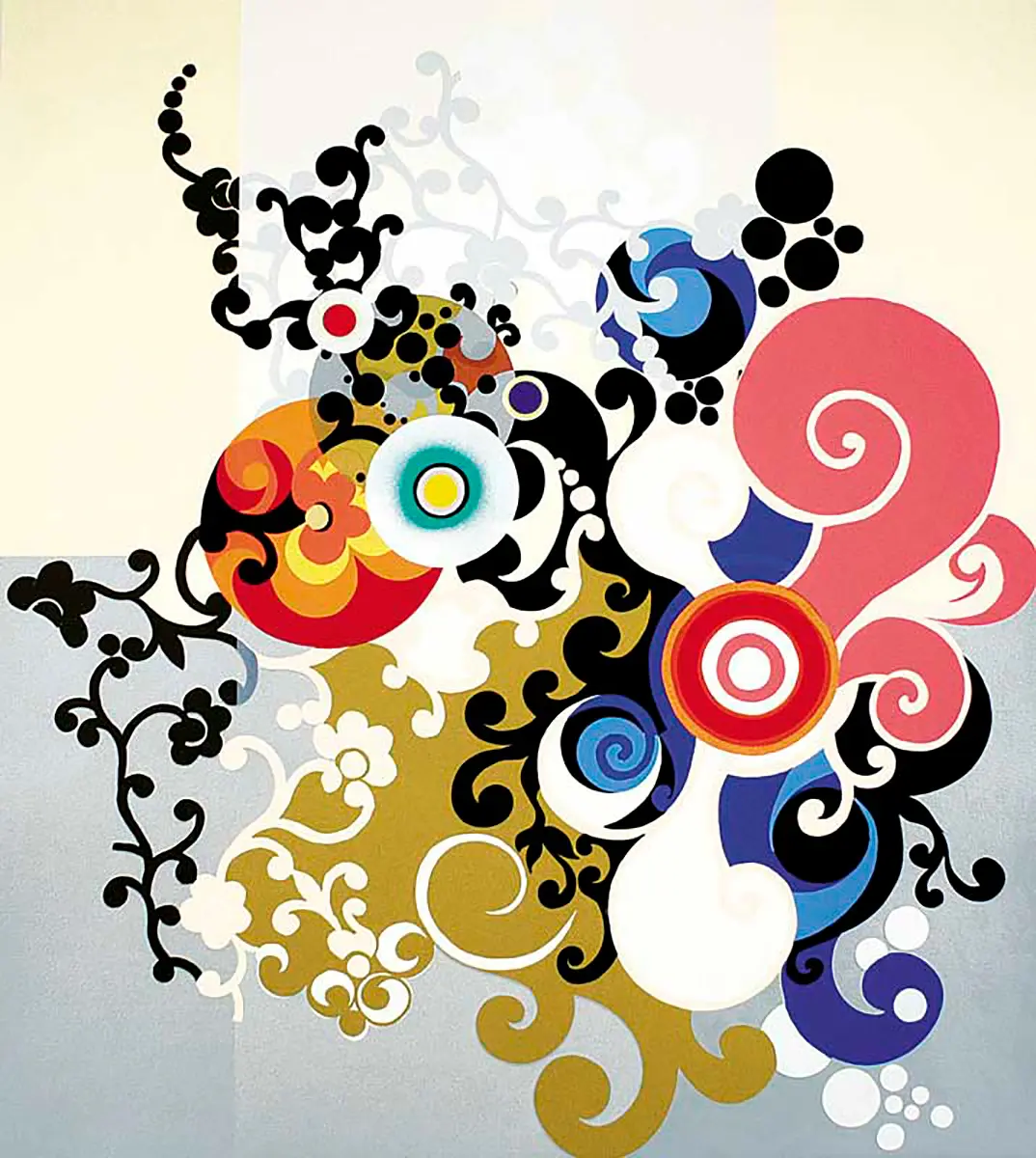
The artist has also been influenced by the atmosphere of her native city and its rich urban admixture, and her work incorporates chitão (the cheap, colorful Brazilian fabric), jewels, embroideries, and symbols from popular culture. Other influences include architecture—particularly the work of Roberto Burle Marx, the landscape artist and garden designer who created the Copacabana boardwalk—and pop icons such as Emilio Pucci’s fabric patterns. Her pictorial inspiration comes from Seventeenth-Century European artist Albert Eckhout, who traveled through colonial Brazil, and from Tarsila do Amaral, the modernist Brazilian artist, as well as Matisse, Mondrian, Le Parc, Bridget Riley, and Frank Stella.
Milhazes’ flowers are not a commentary on color, print, arabesques, or empty decorations, but on their role rituals, conceptualizing a vital parade of printing in her everyday environment; so, her inspiration emanates from transculturation and its endless aesthetic potential.
Milhazes’ art finds support on the precepts of the serigraphic pictorial tradition and in her experimentation with mixed techniques from contemporary art. Her paintings reveal for us a variety of readings and aesthetic paradigms, establishing a play of conceptualization where her work expresses the fact that description is unnecessary because it can mar the interpretive freedom of the artistic image.
Beleza Pura is the title Milhazes gave painting starting in 2006. “The word ‘decorative’ is usually pejorative when applied to art. I am not afraid of beauty,” she declared that year. The title also refers to a hit song of the same name by Caetano Veloso, one of the central figures in the 1960s Tropicalia. While not explicitly political, the vital energy of that movement of artists and musicians was directed against cultural monotony during the military dictatorship in Brazil. Elements of folklore mixed with American and European influences are also present in Milhazes’ work.
Her paintings are the product “…of the crazy struggle between baroque figuration and rigorous construction,” as noted by Richard Armstrong, the current director of the Guggenheim Museum in New York City. Armstrong was one of the first observers outside Brazil to make note of this artist. In 1995, he invited Milhazes to participate in the Carnegie International. In 2003, Milhazes represented Brazil at the Venice Biennale.
Milhazes’ work navigates toward the dancing circle of love. That carnival of passions surrounded by lush beaches and bohemian music offers us the flavor and versatile rhythms of her tropical Olympus, where Latin America’s magical realism fertilizes the sanctuary she has built, proposing a fascinating mixture where orishás and angels come together in perfect harmony. Milhazes’ carnival is a confluence of poetics that emanate from the soul, evoking the warm lyricism that seduces the glamorous of her inner Rio de Janeiro.
Such glamour is also due to Milhazes’ unusual work process. Early in her career, she worked with collages, through the introduction of fabric into her paintings. In the late 1980s, she began to draw the outlines of her flowers and mandalas on a transparent plastic sheet, coloring them with acrylic paint and then cutting them out after drying. Afterward, she switches these shapes around the canvas until they find their final position; there they are attached to the canvas with the color surface facing down and the plastic cover is pulled away, often to be used in other works.
For the past decade, the range of her paintings has broadened even more. She has returned to her earlier collages, now adding paper in various colors rather than fabric; she uses a shining metallic blue, candy wrappers, marble paper, and chocolate wrappers. In this way, the overabundance of visual stimuli that characterizes her entire oeuvre is newly emphasized. Milhazes drives the viewer’s gaze around the surface of the work, without a place for a pause. Her works move between great ornamental beauty and an overload of shapes, colors, styles, and artistic assumptions.
SILVIA MEDINA