
Desastres del corazón was the title of Catalina Mejía’s show at the Museo de Arte Moderno de Bogotá late last year. This show presented an introspective, essentially autobiographical vision, in the artist’s own words, where drawing, painting, and installation explore the emotions and oscillations of the heart. Like a cardiogram, Mejía’s works are situated in space to make visible a series of elements that speak of the deepest feelings, belonging in this case not only to the artist’s private world but to all who experience her art.
Mejía’s drawings and paintings become veritable love letters, containing words such as rosas y espinas, usted, wish, trust, etc. These letters with no recognizable addressee are like the messages launched by a lonely castaway hoping for a response in his or her remote isolation; unanswered calls that amplify the disconsolation of love. These elements, among others, seem to flow from Mejía’s work and make it impossible for us to remain indifferent to topics that have been explored for centuries by literature and art. Who doesn’t feel destabilized by these issues? Who hasn’t found himself or herself immersed in such disasters of the heart, shipwrecked by them? Questions all that arise, among others, as we are confronted with Mejía’s art.
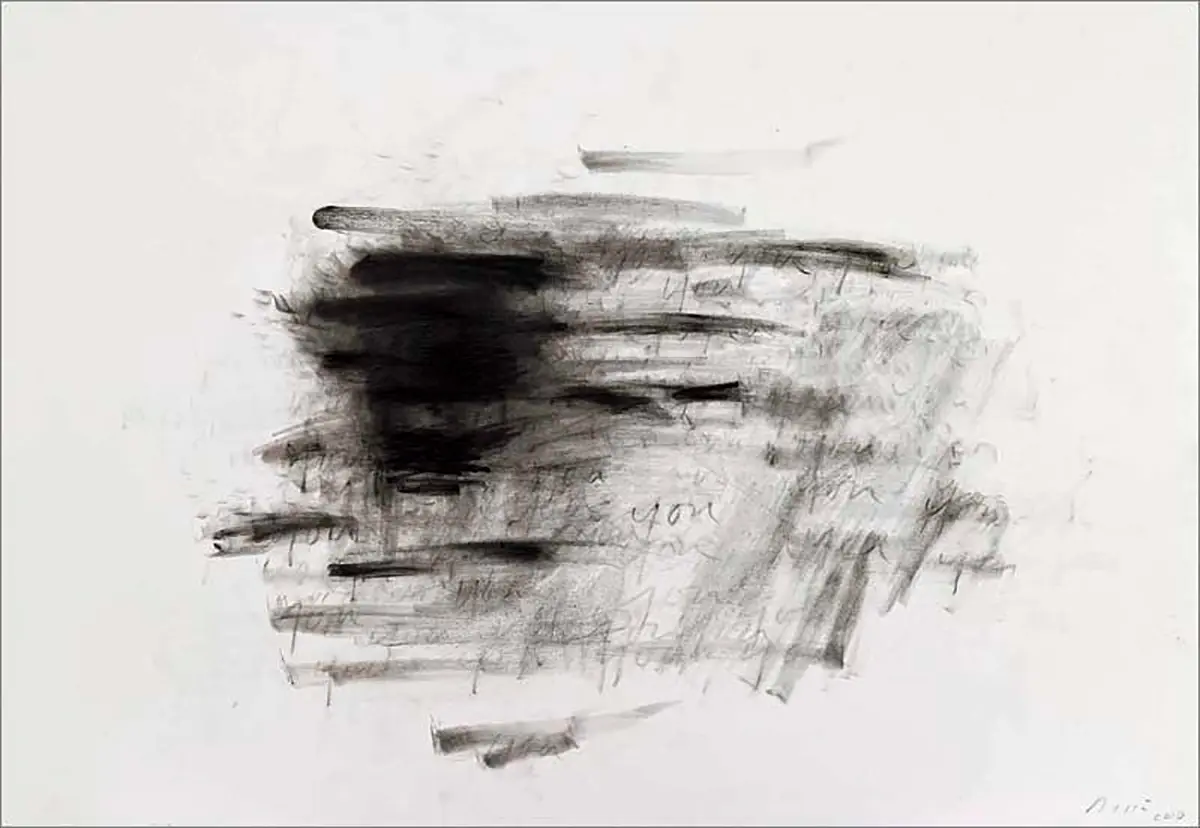
Philosophers, writers, and artists through the ages have interrogated love as a notion and a feeling, and this is the terrain on which Mejía’s work is grounded. Frustrated loves, impossible loves, longed-for loves, loves lost: such are the drivers of an artist whose work constantly uses crossed-out or practically erased words as if love were indeed required to always scrap what came before and start from scratch. A kind of journal overflowing the space of a private notebook to install itself on the wall. Here, words become the visual and conceptual support of the work of art.
It bears noting that Mejía used a conceptually similar device when she was nominated for the 5th version of the Luis Caballero Awards in 2009: in her “libraries”, words and books fused with painting to create new images, with the book titles emphasizing feelings and states of the soul. Something similar occurs here, in Desastres del corazón: words emerge forcefully only to disappear behind erasures and scratches, just as love, as the artist seems to insist with this visual device, is an eternal process of erasing and starting anew.
With an element of humor and irony, this show also includes a materialization of impossible love through a series of phone books arranged on a shelf, a work titled Looking for You. The search for love is unending, and this work leaves a phone call in suspense. The long list of names, organized alphabetically, suggests that love awaits in those pages; if it seems absurd to think that ideal love can be found there, in truth the absurdity is that of love itself.
Another interesting work is a night table covered in books whose titles speak of long, unending nights when reading fills the gap left by love. Here, loneliness is the protagonist, and books are all we have for the company.
Each work in this show contains a story. They seem private and intimate, yet they are at the same time true mirrors on which we see ourselves reflected. These mirrors allow us to see —as was the case with Mejía’s Bibliotecas series—fragments of our own selves. The conceptual strength of Catalina Mejía’s art resides here, in this mirror effect, as she reminds us that no other organ is as exposed as the heart to the oscillations of the soul.
Speaking of such matters of the heart and of romantic feelings today, when everything is determined by utilitarian relationships, may seem uninteresting. However, Desastres del corazón calls us to look closely at what remains of romantic love. In truth, the work of Catalina Mejía speaks to us of a great tragedy and a great loss, when the traces, the residues, the pieces, and fragments of what had seemed so solid configure cartography and an X-Ray of what is most intimate to human beings.
In this exhibition, Mejía presents us not only with a virtuoso oeuvre but also with her ability to confront such a complex theme, one that artists have approached in many different ways. There are traces of romanticism in her work, but not the kind of romanticism that would engage in an apologia of sublime love, but the kind that clearly tells us how impossibly complicated romantic love is.
RICARDO ARCOS PALMA