
Dámaso Ogaz. Mail Art, Visual Poetry and Conceptualisms, is the title of the first posthumous exhibition dedicated to Dámaso Ogaz. It presents a group of collages, drawings, paintings, and objects displayed alongside postcards, stamps, slides, photocopied publications, and handcrafted printed materials. Under the curatorship of Félix Hernández, with a museography by Clemente Martínez and the documental assistance of Ana Victoria Sánchez, Lorena Concha, and Jesús Osilla, the project presented at the Galería de Arte Nacional from September 2011 to January 2013, reconstructs the internal, implosive, and meticulous immensity of the body of work that Ogaz created during almost three decades. Her work is at the inaugural epicenter of a genealogy that will eventually contain—with various degrees of subtlety—the Photo-informs, Acu-paintings, and intervened maps by Claudio Perna, the expressions and Action poems by Diego Barboza, and the Informational events by Marco Antonio Ettedgui.
Víctor Manuel Sánchez-Ogaz, the artist’s complete name, was born in Santiago, Chile in 1924 and died in Caracas, Venezuela, in 1990. He studied art and design in his hometown of Santiago where, in 1961, he also began to put together exhibitions. In 1961, Ogaz traveled to Venezuela to organize the Museo de Arte Contemporáneo Americano in Trujillo, and to direct the Experimental Visual Arts Workshop in this institution. In 1963 he traveled to Paris to exhibit his work at the Galerie Lambert. He moved to Venezuela permanently in 1967, became involved with the artistic-literary group known as El Techo de la Ballena, and showed his work—essays, poetry, and drawings—alongside them. He began teaching in 1968 in several places across Venezuela and founded the Escuela Experimental de Diseño in Valera (1976). He founded the experimental magazines Cisoria Arte and Ediciones La Pata de Palo, both during the beginning of the 1970s. Likewise, he stayed in close contact with some of the main representatives of Mail Art in the continent, Clemente Padín among these.
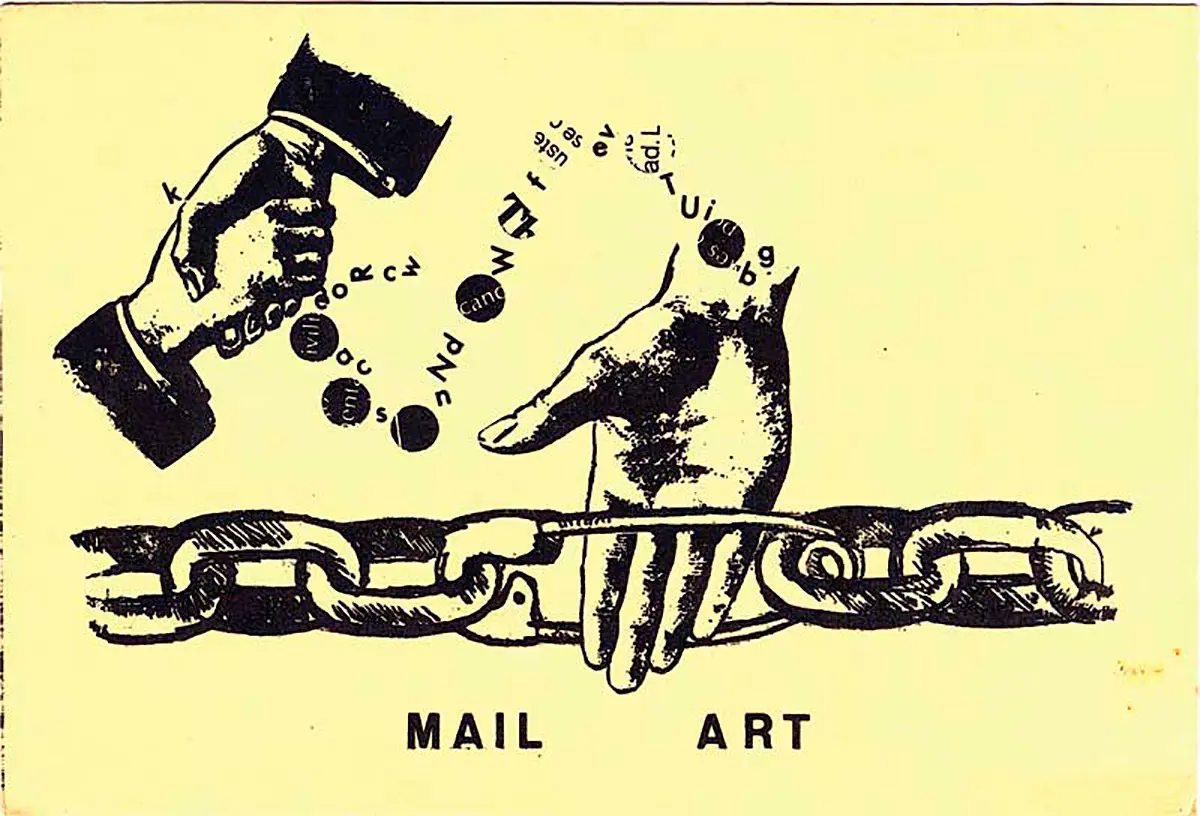
Understated and ingenious, this exhibition presents around 350 works and documents, displayed in showcases and mobile Plexiglas devices, alongside texts, facsimile publications and gigantographies displayed on the walls and floor. Notable from this group of works is the drawings and paintings of guillotined bodies exhibiting erratic gesticulations, like marionettes without masters. These creatures of diverse appearance—some of them showing zoomorphic characteristics and mechanical prostheses—would alternate between scorn and lust. On the other hand, the more serene than structured tactile poems by Ogaz, place more importance in combined solutions, as they emphasize the intriguing presence of signs in the space.
Assembled with small and medium-sized pieces lent by his family and by private and institutional collections, the exhibition works as a sort of interactive collage. The walk through the exhibition unfolds amid epigraphs and typographic balancing acts that recreate the refined disorder that dominated Ogaz’s work. Certainly, the monumental scale of the new headquarters of the Galería de Arte Nacional stands in sharp—and disconcerting—a contrast to the minute proportions of the materials exhibited in the Temporal Exhibition Room 1—nothing that strange, if one considers that during his time Ogaz refused to work with traditional supports and rejected any institutional pompousness, in favor of experimenting with alternative models of production and circulation. Thanks to this fortunate paradox—without it, this body of work would have continued to be unappreciated to this day—it is possible to take a first close look at his work.
Solitary and anarchic by nature, Ogaz cultivated erudition and black humor as he constructed hybrid imagery of disarticulated figures and rough calligraphies. In the essay titled La Ballena, Jonás y lo Majamámico (The Whale, Jonah, and the Entanglement, 1967), the artist defined his own creed by describing it as an illicit act, without recipes or masks, to generate “integrations and essential liberties.” Based on that motto, Ogaz turned reverence into an antidote against academic taxidermy and proposed “a search within illegality of a reality not deformed, betrayed, divided; in sum, a cancerous cell on the eyes of the official rules of social conduct.” He did not seek adhesions or received praises, except for the militant complicity of the writers and artists at El Techo de la Ballena, who was imaginary Jonahs like him and were absorbed by the intoxicating effects of the absurd. Ogaz was a follower of surrealism but attempted to reach beyond oneiric games. He liked canonical literature but preferred the chaotic conjunction of words and images. Likewise, he advocated subversive art, and yet—as Juan Calzadilla observed—he stayed away from political posturings.
Ogaz’s work superimposes the illustrated sordidness of counter culture on elements from new figuration and Informalism, along with certain reminiscences from the brutal schematism of Dubuffet. Such sources appear dissolved in a whirlwind of images and letters that accumulate on his collages, drawings, and postal experiments. There, words flow, free from punctuation, with syllables shredded as if they wanted to escape the univocal nature of semantic conventions. Arte(f)actos, C(art)a, (art), Co(reo)arte, are just a few examples in which language is torn between the ludic and the rational. Nonetheless, at times this oscillation of meaning uses humor and solemnity as extreme poles, as it can be observed in one of his collages with the inscription Te BI or not TE BI.
In the introduction of the book of visual poems titled Pauta para el Uso (Guidelines for Use, 1975), Juan Liscano writes that Ogaz places us before an “extreme, and systematically anarchic, disorganizing effort.” In this sense, his proposal is developed in a parallel horizon removed from “suffocating normalities” and disciplinary hierarchizations. Nothing that happens there can be reduced to a single meaning, even the deliberate crossed-out parts and irregular stuttering by the typographic characters that fight for the surface. Letters and images enter the ambiguous rotation of the ocular world and configure fragmented plasticity of infinite connotations.
FÉLIX SUAZO