
The most immediate and evident appeal of Ernesto Neto’s work is perhaps the way in which it takes us into a different, yet not altogether unfamiliar, world. The production of this Brazilian artist (Rio de Janeiro, 1964), a unique hybrid of sculpture and installation, is presented as a clear-voiced invitation for us to contact the works directly, calling us to study it carefully and, moreover, to touch, smell, and interact closely with the objects for the enjoyment of our senses.
Visitors to Neto’s most recent exhibition at the Museo de Arte Contemporáneo de Monterrey will experience how his works provoke viewers into an intimate relationship in a game of touches that are sometimes child-like and innocent and sometimes filled with a greater, more evocative sensual charge. La lengua de Ernesto (“Ernesto’s Tongue”), an exhibition gathering a good selection of his work between 1987 and 2011, suggest an immersion into the artist’s inner world, where travelers find direction through sensorial impulses in a space that seems filled with pulsating vitality; Neto’s works literally appropriate the museum’s rooms, covering the space like membranes that, timid or bold, vibrate, contract, and expand at the lightest touch.
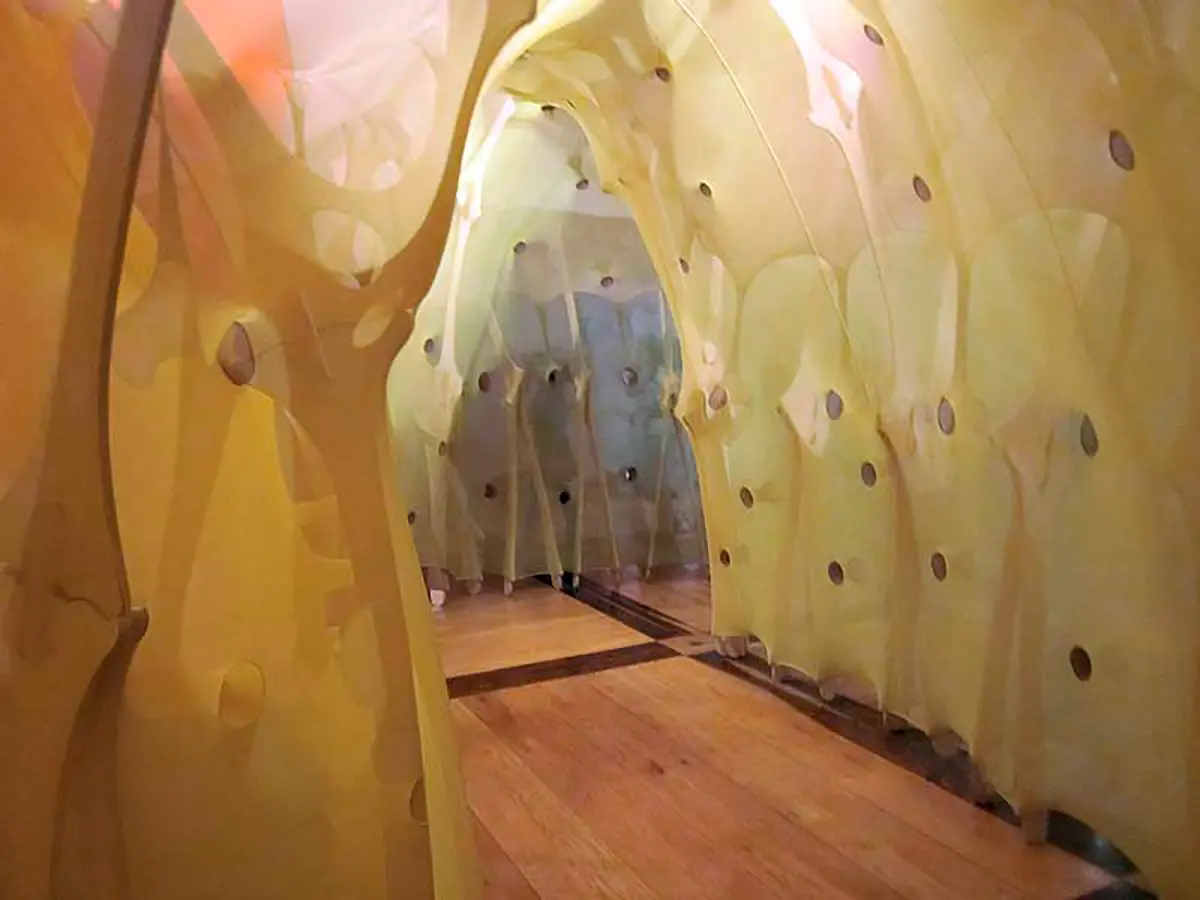
In the strictest sense, the show does not propose a pre-established course. Visitors will walk around the museum’s various galleries like micro-organisms seeking symbiotic connections with a biological entity that, although larger in size, evinces unequivocal signs of vitality. Neto’s sculptures —or, if you prefer, installations— evoke interior spaces, but not in an abstract or intellectual sense but, rather, in a biological one: the shapes that govern Neto’s work resemble human organs, in a clear attempt to explore the organic microcosm that is essential to our being.
Beyond that, Neto’s works often feature, in a clear indication of his quest for the sensorial, references to the quintessential sensory organ: skin, emulated through a variety of materials that are comfortable to the touch, such as lycra, worsted yarn, polyester, which are infused with different kinds of spices in order to provoke sensations that exceed the purely visual or tactile. In his installation Symbio in test tube time — The Flavour Happens in a State of Being Flavour Flower Womb Domu, a long tunnel on whose walls, made of lycra and spice-filled stockings, the viewer, like a wandering cell, is forced to stop and touch and breathe the aromas of a structure that resembles a blood vessel system.
Similar in form, Nave Deusa—a kind of room built in lycra and stockings—invites viewers to penetrate into unknown territories that offer, most genuinely and disinterestedly, a comfortable alternative space similar to a mother’s womb. Another equally striking installation is The Dangerous Logic of Wooing, which viewers access by means of a subtle interplay of touches on hanging shapes presented with exuberance. In the same vein, Divagar pá num machucar a luz que pinta o meu acceso prods viewers to abandon a merely contemplative stance and to fuse into the work through tactile and even olfactory caresses.
To be sure, Neto’s production—so far away from conventional sculpture—seeks to incorporate its audience into the work of art, making it an active participant through open and free interactions. Neto’s art is thus proposed as an activity where artwork and viewer are engaged in mutual exchanges, completing and complementing one another. Indeed, having us interact with the work is one of the explicit purposes here, as viewers can even go beyond physical contact and appropriate the object itself, as in Humanóides, which resembles a fluffy couch that nevertheless can be worn as a suit that alters the participant’s—no longer just a viewer—physiognomy and making them appear as a comically shapeless being.
Seen globally, the work of this Brazilian artist exhibited in La lengua de Ernesto reminds us of the most primordial experience of the world, the experience that reveals the human condition as essentially corporeal, sensorial, where the sensual delight is still undifferentiated from the most innocent game. The world alluded to by Neto’s work is one still uncorrupted by the heaviness of every day: lightness, levity, freedom, the joy of the senses, the delight of play are all words that, somewhat inaccurately, express Neto’s desire to recover the memory of a universe where the human and the universal are not radically apart.
JESÚS EDUARDO OLIVA ABARCA