
From October 20 to December 31 of 2011, the Centro de Arte La Estancia presented the exhibition titled Jaime Castro – Video Art. Scenery of a Fabled World, the first video art exhibition presented at this cultural center.
As curator Félix Hernández wrote in the show’s accompanying catalog, the pieces presented on this occasion showcase, on one hand, the solid formation of Jaime Castro (San Cristóbal, Venezuela) as a sculptor, and on the other, his interest in the theme of landscapes, which Castro approaches from a historic perspective. His is a story of the changes this theme has undergone over time.
This artist resorts to audiovisual media to activate a contemporary discourse on the landscape, in which fragmentation, simultaneity, and the recurrence of a temporal dislocation of the image, give his works a tessitura of unreality that reinforces a deeply subjective approach. The artist himself has said that his connection to the landscape is based on the need to record his own experiences as a wanderer, and to communicate the “sensitive moments” that occur when contemplating and experiencing the environment.
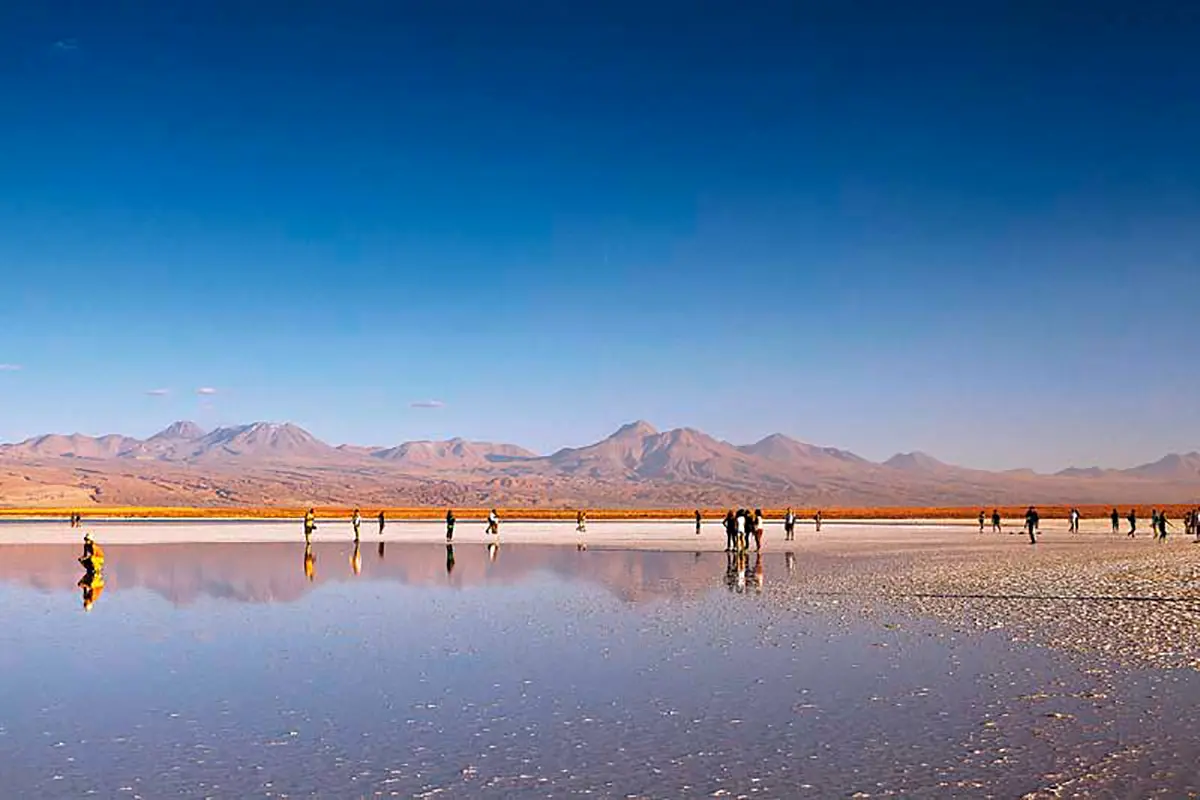
The exhibition included a large-scale photographic series, videos, and a video environment. The works present viewers, on one hand, with urban landscapes of densely-populated areas—like those found in India or Shanghai—and on the other, deserted areas with unusual natural landscapes—like the Dead Sea or Patagonia, among others. These contrasts reveal the artist’s constant interest in the study of “the relationships between the natural and artificial worlds, and the cultural mediations that determine them.”
The city of Caracas is another recurrent theme in his work. The exploration of its scenery directly links Castro to the Venezuelan landscape tradition as a source of inspiration centered on that city and, particularly, on El Ávila National Park. The artist portrays Ávila Mountain as the keeper of the city that rests at its feet, in a fragmented image that allows and, at the same time, impedes simple contemplation; its depiction suggests a dislocation that corresponds to the urban time. Castro also describes Caracas through its neighborhoods and popular areas. There, he captures zenithal images that reflect one of the central characteristics of the city, and one that is accompanied by the faces of the inhabitants observed as they travel on the Metrocable—a gondola lift installed by the government to ease the access to other elevations that, just like El Ávila, are defining symbols that form the features of the Venezuelan capital.
The photographs, videos, and the video environment, all reiterate alternating images of urban and natural landscapes. Some of the photographs approach the strangeness of the landscape, where the presence of human beings is diminished or, at least, rarefied by the presence of geography far removed from that which is considered the touristic parameters of heavenly beauty. The format and special technique used to render the pictures bestow upon these “extreme landscape” images of singular topography—geysers, deserts, glaciers—a sense of unreality, artificiality, and a discursive distancing that remind us of the photograms of fiction films—which maximizes their communicative potential and, paradoxically, their subjectivism.
Created by skillfully manipulating the image, these “staged spaces” are particularly eloquent in the portraits of megalopolises like Singapore and Malaysia, where the incredible technological development appears to remove the urban space from reality and into a world of fables.
The natural landscape is sometimes the source of a poetic display that the camera uses as an instrument to translate emotions and sensations. The tropical forest that accompanies the road from the Venezuelan city of Maracay to the coastal town of Choroní, is captured by Castro as a record of the vertiginous foliage of the trees. Throughout the video—recorded from a moving vehicle—the trees are transformed into lights and shadows, into patches that suggest both lush vegetation and an equally rich interior.
The exhibition Sceneries of a Fabled World describes the remarkable process of maturation of Jaime Castro’s artistic work. It showcases a conscious trajectory based on inquiries about the landscape and this artist’s unrelenting experimentation with new media, which has allowed him to redimension his subject and to express it from the complexity of the contemporary approach.
KATHERINE CHACÓN