
Avant-garde artist Jaime Liébana presents Juego, an exhibition comprising 50 works in a variety of materials and techniques such as iron, marble, granite, wood, mixed media, oil on wood, semi-precious stones, plated wood, and painted wood. The show is titled Juegos (“Games”) because “humor is a constant in my work. When a form captures my attention, it is submerged in my ‘persona imaginary’, populated by fantasy, play, magic, and color. In this way, the creative process develops a new means of expression.” 1
In the same way, he works with different materials, Liébana doesn’t stick to a defined visual language. The sole common feature is the phallus, appearing in at least 20 works here. Besides the phalluses, nothing indicates that these are the works of a single artist. There are decorative works with Japanese motifs, a self-portrait that only uses lines of wood, and wood-plated mannequins. There are also two old commodes, one wood-plated and the other painted in oil, both functional. Working in this manner, Liébana is challenging art’s own raison d’être. He is a great popular art collector and his home is like a museum, with popular art items that have traveled the world to various exhibitions filling the rooms. Thus, some of his own works tend to resemble works of popular art.
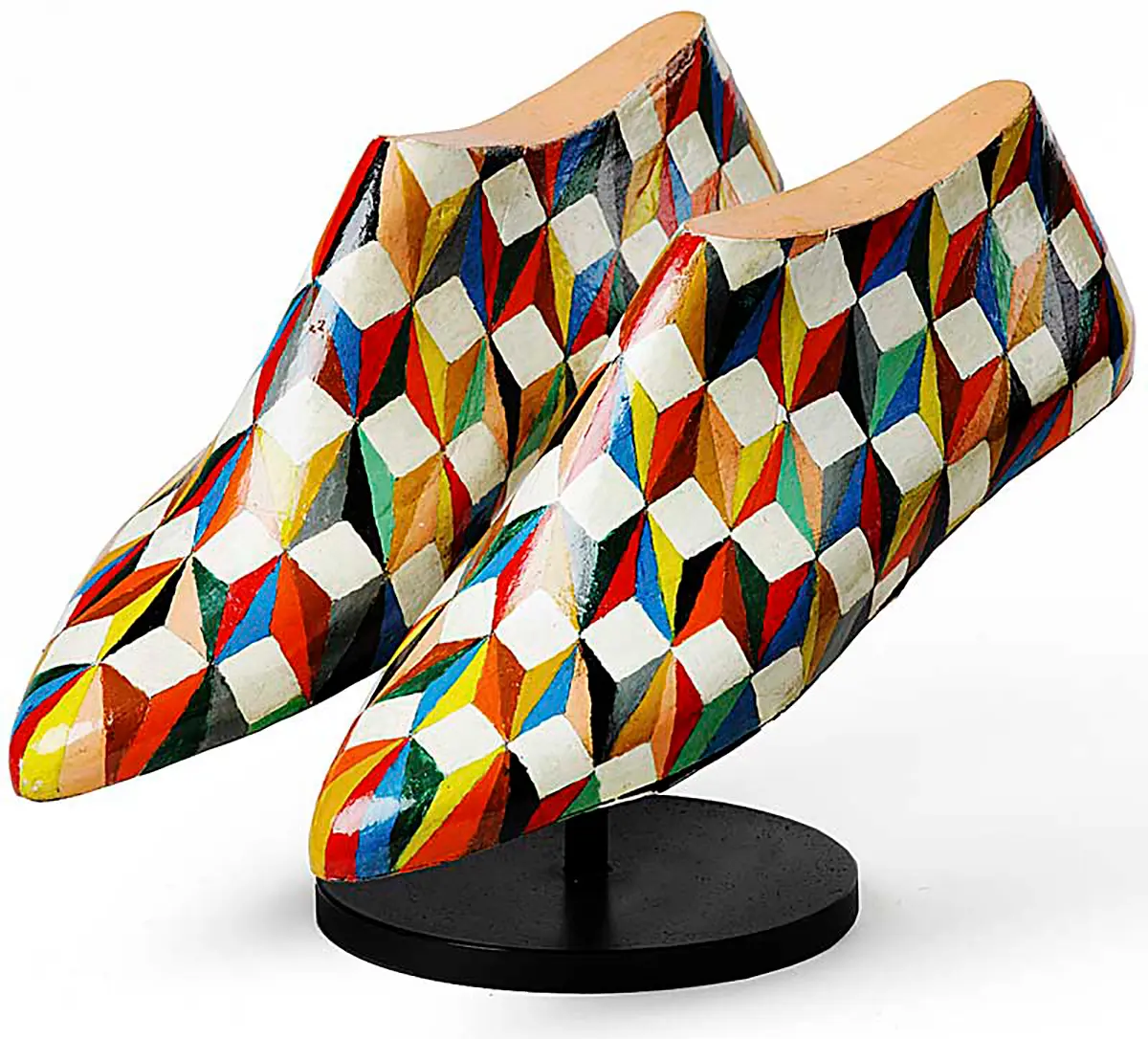
One of the show’s most striking works is Hormas, where we see a shoe-making last finished in wood. A beautiful material, a spectacular look. This is like Dada art or anti-art. Extracting a work of art from a shoe tree or some such item is a bold, avant-garde move. There are tree works that use these objects, and they all possess great visual impact. Two of them are plated, one is painted. The artist himself plated them because Liébana is also an antique restorer. Plating is hard work, requiring the cutting of each small piece, fitting it to the mold to form the design, varnishing it twice, sanding it, and then varnishing it again, several times.
Another sculpture, Pacae, represents a fruit (also known as pacay) grown in northern Peru. As Liébana lived in northern Peru during his childhood, these are good memories for him. He created four sculptures around the same motif, two pacae fruits in marble, and two in bronze. Liébana represents the fruit with its skin peeled off, and the view of the pulp gives the work strength and beauty. One of these sculptures uses white marble and resembles nothing he has made before.
In Bombardeo sobre Berlín I, mixed technique and oil on wood, we see the outline of the city, with phalluses raining down like bombs. Twenty-six multicolored phalluses fall in formation on the city, their alignment generating a sensation of order and control. The work doesn’t come across as vulgar; it is rather subtle. Liébana explains: “It seems that ‘Civilized Man’, so perfect, so serious, so solemn in his predetermined role, is capable of the most terrible and destructive acts. These, for me, become ‘uncivilized’ comic-book characters capable of bombing entire cities into oblivion, in this case the city of Berlin.” 2 Here Liébana combines a joke with a profound human reality, creating something original and real and giving added weight to his creativity.
Yo is a self-portrait created in a rather peculiar way. The artist made it with pieces of woodcut in long, narrow, spaghetti-like strips, painted in different colors and in different shapes, and glued to form his own outline; the result is an interesting work of art displaying great creativity and aesthetic sense.
In this exhibition, Liébana explores the theme of eroticism and the phallus as a humorous reference. His collection of Moche ceramic includes a warrior sporting a phallic headgear, intended to give the figure greater virility and strength. In his visits to collectors, Liébana discovered that many of them had Egyptian obelisks as the centerpiece of their living rooms. Playfully, the artist wants to substitute a phallus for the obelisk. He says, “In many cultures, the phallus is seen as a giver of life. Two serious pieces in that shape (the ceramic and the obelisk); my imagination started to play with them, and new expressions emerged.” 3
With this show, Liébana proved a bold avant-garde artist who uses working tools and antiques to produce highly creative, entertaining, and beautiful works. And also functional items, as in his commodes, a first in the art scene. This exhibition has undoubtedly made a mark in the art scene.
NOTES
1. Interview with the artist, January 2012
2 Ibid.
3. Ibid.
AUGUSTO CHIMPEN