
Leaning on known links between cinema and the visual arts, Luis E. Camejo challenged the traditional painting exhibition space—on this occasion, the enormous Pabellón located in modern Havana, at the time hosting the 33rd New Latin American Film Festival—to propose new readings on instants, moments, or rather photograms, of memorable films of all times.
His interest and passion for the cinema were already visible many years back and it is possible to affirm that most of his most meaningful paintings were influenced by films and photography. Camejo interpreted their images and two-dimensional compositions as fragments of larger works full of cultural references and a generous share of affections and memories that take viewers beyond the purely visual.
Thus, today Camejo’s specific relationships and interests as a creator are articulated to offer a hybrid between film, photography, and painting that functions as an organic and coherent whole capable of maintaining the specificities from each of its components: that is to say, a large bowl of soup, ajiaco; a stewpot full of flavor that we savor in our mouths in its entirety, as we identify its ingredients.
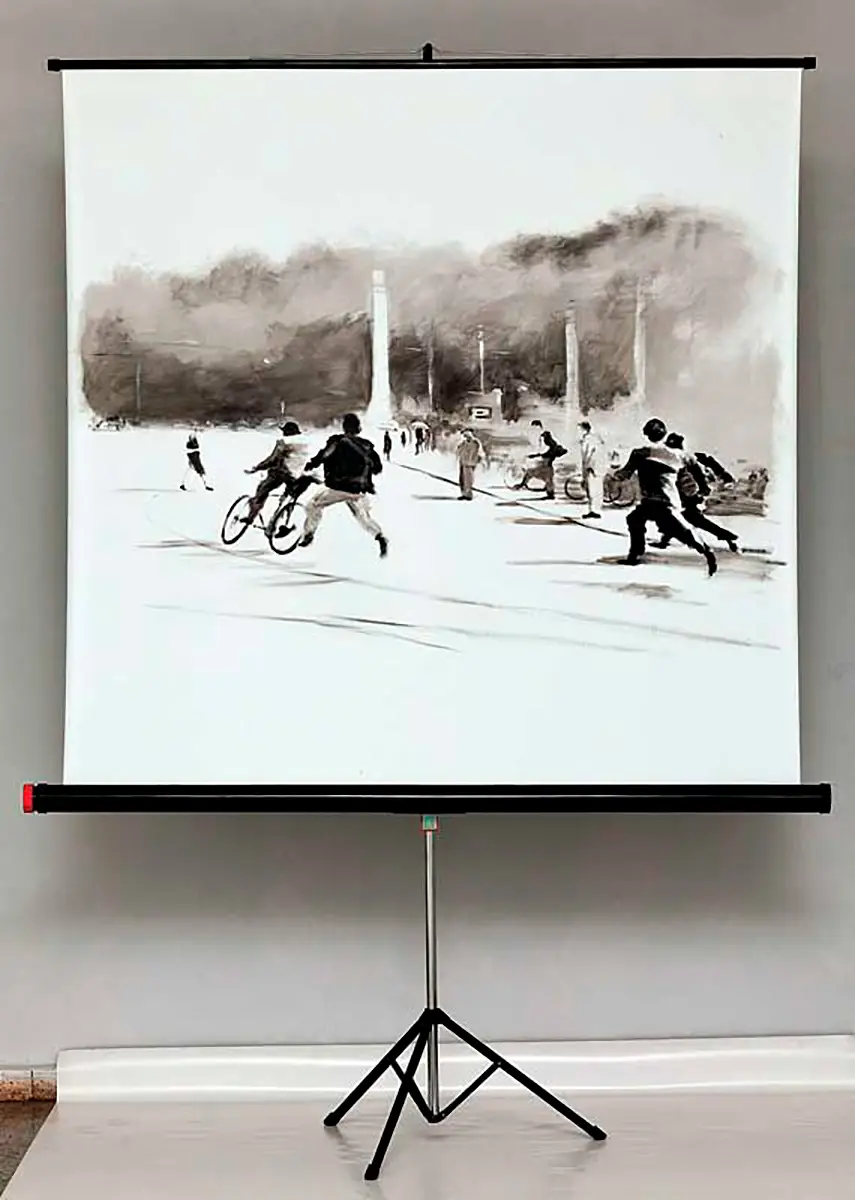
When we stop to observe each of the portable projection screens that Camejo now uses for the first time as support in his artistic trajectory—one that is new for us too, as spectators—and recognize, first of all, the use of conventional pictorial materials like acrylic, our perception becomes overwhelmed by a mixture of unexpected wonder and expectation: what do these mobile screens actually contain? Just painting and nothing else? Altered, diluted, or blurred photographs? Sketches or informal drawings? At its core, it is the physical and cultural expression of an intervened object by a creator without any preconceptions about the purity of the artistic act; a minor iconoclast who appears to have found a new way of expressing himself, amid a world where nothing seems new any longer; a world that cannot establish the meaning of form with exactitude.
As we are just about to abandon that feeling of uncertainty, we suddenly discover a melancholic and sad Giulietta Masina at the exit of a nightclub, a Robert de Niro prying through the rear-view mirror of a New York cab, or a Sergio Corrieri walking with his head bowed along the broad esplanade in Havana, known as El Malecón. Each of them “painted” in black and white in that small mobile screen Camejo discovered; small enough to take it home to continue feeding the memories and associations that have overwhelmed us in the past in some of the thousand dark and mysterious movie theaters around the world. Pintura para Llevar, para Recordar, para Vivir (Painting to Take, to Remember, to Live), could also be the title of that sui generis exhibition in the middle of the complex panorama of contemporary Cuban art; so in tune with the countless actions—contingent upon our civic behavior—we nowadays are subjected to.
Camejo does not solely offer to address those great and well-known interpretations by personalities from the history of cinema, he also approaches other scenes that require a certain degree of expert knowledge about the history of cinema, in order to establish if the fragment of a movie actually belongs to Dancing in the Rain, Bicycle Thieves, or Blade Runner. Consciously or not, Camejo demands active participation from the viewers, and a sort of cultural complicity that can openly lead us to the enjoyment of discovery, of doubt, and of a good memory.
Although since the end of the Nineteenth Century the relationship between cinema and painting has influenced the careers of many prominent artists—each seeking revitalizing experiences from which to launch their respective careers—Camejo approaches that hybridization or marriage of two fields from a different angle, as he places himself in a different perspective that requires the greater and deeper knowledge of the culture of cinema, and of all things having to do with the imagination, which we now possess—excessive, if I may say so—in the early 21st Century. Thus, the exhilarating familiarity we find in each work.
Camejo adds in this manner another chapter to an enduring pictorial trajectory, closely associated with photographic realism, in a singular approach to that current that dominated the 1970s and nourished the symbolic production of a passionate group of young artists. A current that today validates a unique artistic language in the artistic landscape of Cuba.
NELSON HERRERA YSLA