
Luisa Gubbins’ first solo show, presented at the Museo Pedro de Osma, comprises 18 works: 8 sculptures and 10 paintings. Gubbins explains: “The show is titled putting on my patent leather shoes and starting everything anew because it is an attempt to go beyond the fact of surviving an accident. I want to verify the fact that I am advancing towards the recuperation of everything that was lost. And it is like starting from scratch; so, we do this with the patent leather shoes we always wore to childhood parties.” 1
Gubbins’ way of painting is unique: what you see has a given appearance, but there are details that deform the image. For example, Zapatos Italianos presents a rope where a pair of shoes hangs, but if you look carefully you’ll notice that one of the shoes has a slightly longer heel, with a somewhat different shape. The straps are different also, and one of the shoes is floating; it seems to hang, but a second look reveals that this is not so. For the artist, this has a psychological meaning: life is not as it appears on the outside; there is more inside, and it remains unseen. This obviously applies to all of us as well. At first sight, it all seems like, but on a second viewing it all changes, and this happens with almost all of Gubbins’ paintings. Behind the shoes there is a wooden box leaning on something we can’t see; in the painting, the box appears to be hovering in space. You see something, but it is not the entire story.
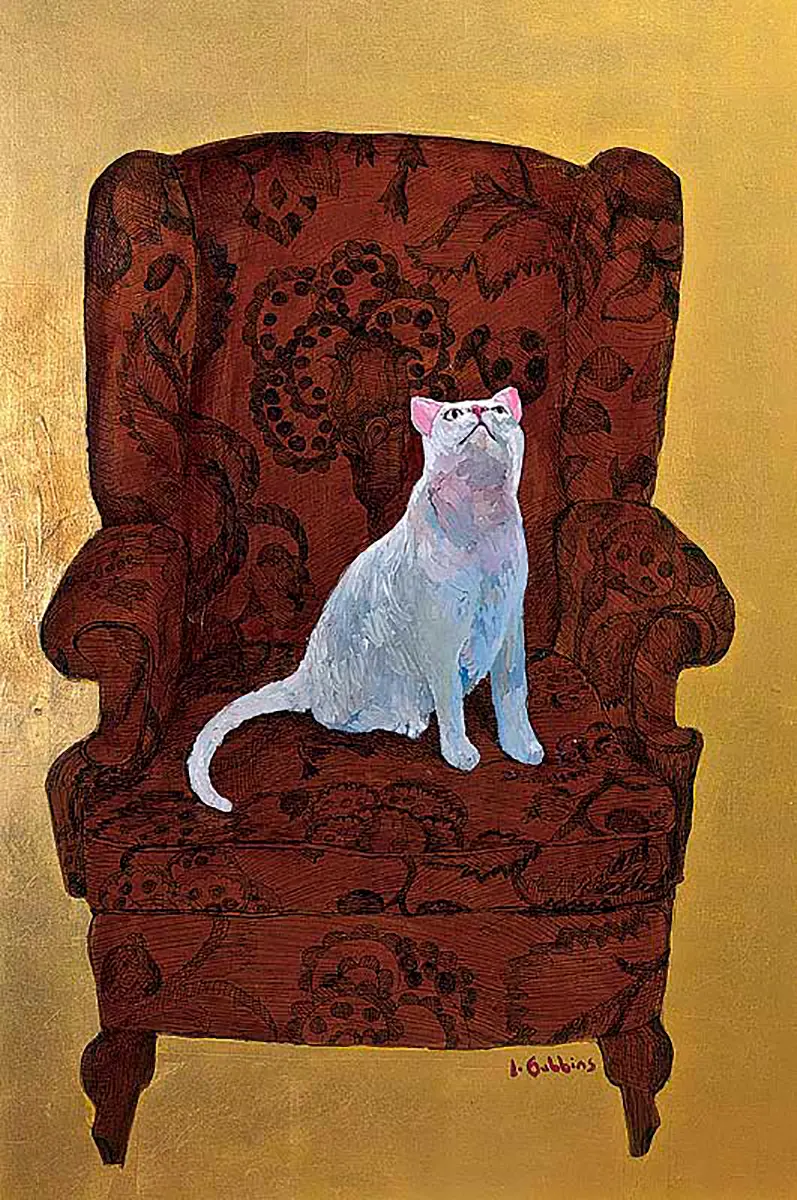
In Carlotta, which depicts a female cat sitting on a couch, the figure is mostly white but its neck, shoulders, and ears are pink, while the back, chest, and legs have bluish hues. The couch is exquisitely painted. One of the couch’s arms is taller than the other one, the backs of the arms have different shapes and decorations, and the legs differ also. The backrest has two supports on the sides, one almost round and the other straighter. Again, at first, everything appears the same, but then we notice the dissimilarities.
In Los Olvidos, Gubbins shows a room with a desk and some objects. We only see the black shapes, but some of the objects have labels with names in English such as “banana”, “apple”, “limes”, “wine”, and “light” as if she needed them to remember the names of things. Things she can’t remember are painted in black, and we only see their outlines: are lamps, chairs, the sofa, the plants, and, on top of the desk, what appear to be some lemons and an orange. The greatest difference is on the desk and is its coloring: the left side is darker than the right side. While the left is brown, the right is cream and orange. Something that isn’t solid, but shifting and irregular. I imagine this is the state Gubbins found herself right after her accident.
The sculpture Cairelas depicts five obese, nude women, all similar in shape but different in color. This work was inspired by a Spencer Tunick performance in which Gubbins participated, along with 7,000 others, in Barcelona’s Plaza de España in 2003. With their thick legs, large bosoms, and voluptuous hips, the women’s bodies resemble the Willendorff Venus. Psychologically, this way of representing the female figure refers to divinity and to life-giving powers. Why did Gubbins represent only women, when the performance also included men? Because her works have a deeply personal character and she infuses all of them with her own sensibility.
Her painting Luisa Bipolar was inspired by Frida Kahlo’s Las dos Fridas. In Gubbins’ work, we see two versions of the artist in a sitting position, as in Kahlo’s, but we don’t see any chairs or chair legs. The figures seem to be floating in space. Unlike Kahlo’s painting, where we can see the floor and clouds in the background, in Gubbins’ work the background and the floor are a single color: purple, a symbol of spiritual strength and the transformation of negative energies into positive ones. Gubbins uses colors and their meanings in her work. The figure on the left wears traditional Indian dress and footwear, in reference to Gubbins’ love for indigenous art. The figure on the right wears a black cocktail dress, her hair is disheveled and her feet bare. They hold hands, signifying the different personalities inhabiting the same individual. The “Indian” Gubbins is a figure of strength; the other one is in mourning, recovering from the car accident she suffered thirteen years ago. The absence of chairs is typical of her work. What you see is not the appearance of things. The show is well presented and highly personal. Just like that accident left a deep mark on the artist, Gubbins leaves a mark on us with her interesting, personal, beautiful works.
NOTE
1. Interview with the artist, February 2011.
AUGUSTO CHIMPEN