
“…in art, there is nothing more tragic than being in a rush.” Marco Maggi
Nc-Arte presented in Bogotá the solo exhibition, Optimismo Radical, a Marco Maggi Project. With his deep study of space and its relationship to time, with his exaltation of the simple and the every day—and at the same time, detailed and delicate—and with his fascination for that which is not seen but remains there, Maggi invites us to follow a path that not only reformulates the limits and dimensions of draftsmanship but opens up new conceptual spaces that promote the de-acceleration of the day to day in order to contemplate a world beyond the light-weight, saturated visions of the contemporary age.
Optimismo radical, installations adapted on-site and a series of single works opens on the ground floor at NC-Arte with a 10-meter tall column covered with more or less 12,000 yellow post-it notes. Facing this work—from which the show takes its title—on the floor is Incubadora: a serpentine model of 500 reams of white paper, where the hues of the surfaces fluctuate between primary colors and white. On the wall opposite to the column is Cascada 1, an installation that at first glance appears as a group of white envelopes, organized with precision. Following the path suggested by the labyrinth, the reams of paper climb the stairs of the gallery and reach the second floor, where the mountains of paper end on a bridge, Escalera sobre Puente, down from the crevices of which 10 white envelopes fall down vertically and remain suspended in the air, Cascada 2. Also on the second floor is a series of single objects that function on their own but belong together in the same conceptual poetics. Some examples are Turner Box, 35 mm, Google Plexi, and the Homenaje a Mondrian, a painting that alludes to the exemplary figure of Neoplasticism and where, if we look in the reverse, we can find a print of Mondrian’s own Broadway Boogie-Woogie. It is important to note that, although Maggi is not married to any single theory or history of art, the principles of Neoplasticism—such as the use of primary colors and pure shapes such as the square—do resonate in his work. As for Mondrian, the use of primary colors and geometric bodies is for Maggi a way of retaining the essence of the work of art; these are forms that all of us can relate to. This show, with works that are unique in their different formal aspects, ends in the same conceptual hiatus, referred to the need to generate spaces for the training of perception towards subtlety, and to approach time more slowly.
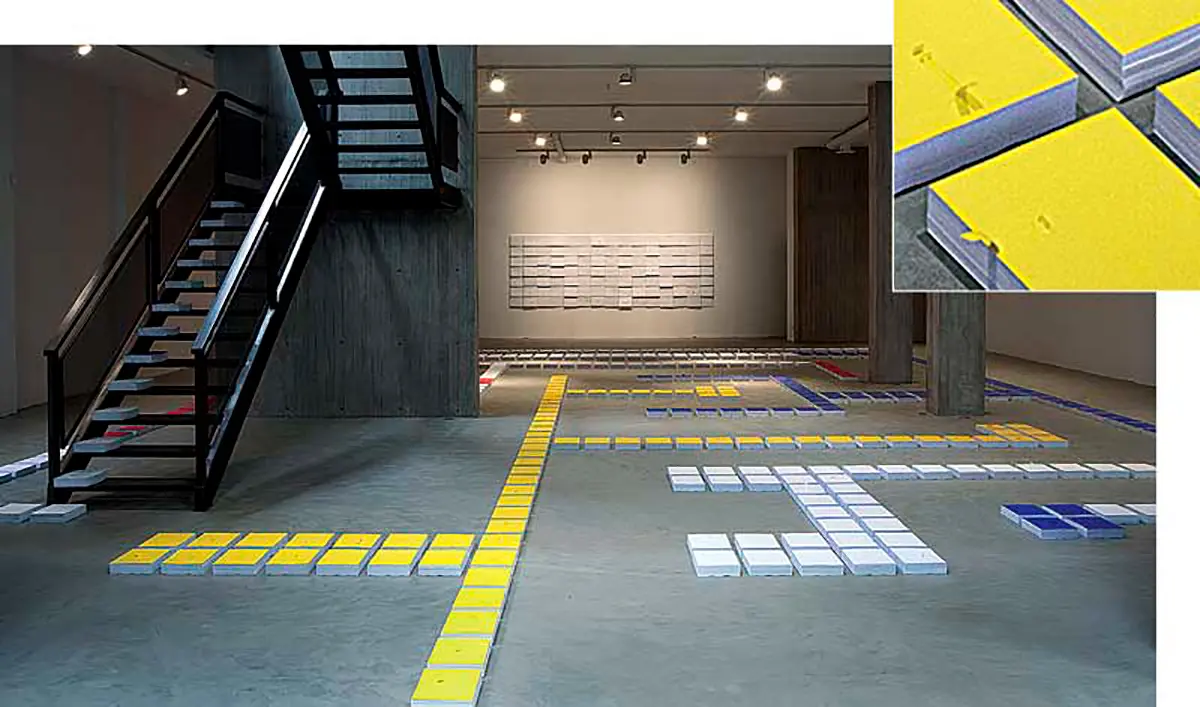
As viewers contemplate the works in Optimismo Radical, new depths are revealed by the weight of the insignificant. The labyrinthine rhythm of Incubadora not only invites us to slow down our pace but identifies delicate figures on the surface of the paper reams. Similarly, Casacada 1 reveals different ranges of color behind the finely cut figurines. In Incubadora and Cascada 1, are the relief figures small architectural models, or perhaps a story? It is irrelevant; the framework and the content do not matter, what matters is what is communicated by the totality: to slow down, to observe, to think.
It also bears noting the air of ready-made that permeates several of Maggi’s work. The artist uses the most simple and mundane elements and loads them with meaning through his design of space, through the paradox that arises as the result of his delicate interventions on the material (which is, to a degree, industrial), and, like the pioneer of the ready-made, Marcel Duchamp, play with words in his title, generating ambiguous interpretations. The clearest example of the importance of Maggi’s titles is in the column at the entrance, Optimismo radical. What are post-it notes but the scraps of paper on which we jot our to-dos, marginalia, and important thoughts? The size of this column is not the only thing that can take our breath away; above all, it is the idea that in the course of our lives we accumulate so much stuff, and have so many pending matters, that it is often difficult to confront existence with a measure of optimism. Maggi suggests we be radical and fearless in our optimism. Through the use of such simple materials as these pieces of yellow paper, Maggi doesn’t only implement the materials that are the signifier, but gives his work, by means of its title, a signified—a meaning.
In Optimismo Radical, Maggi invites us to revisit the ontology of drawing—and of art in general—and its possibilities for exploration. As a result of its constrained historicity, drawing is seldom able (or even attempts) to go beyond the margins of the sheet of paper. It is precisely the need to free drawing from its past, from its canonical restrictions, that Maggi presents a new proposal. The artist is able to challenge the bi-dimensionality of drawing with his scalpel and his handling of light and shadows. His ambition for detail is, in the end, a juxtaposition of the imperceptible—the most micro—and the general, the all-encompassing—the most macro. Maggi’s intensity is not intended only to act on a formal level; his language on paper is ultimately a path leading into a conversation with a concept. As he reminds us, “I propose a visual field that wants to multiply our sympathy for the insignificant.”
VANESSA ADATTO