
A pioneer of monumental social sculpture, Marta Minujín has been pushing the envelope for six decades. Her orchestrations of material, technology, and participants uniquely presaged the multi-connective tissue of contemporary society. The exhibition at Henrique Faria Fine Art showcased three of Minujín’s projects: one each from the 60s, 70s, and 80s.
One of the Argentine artist’s central tenets has been to manifest an interface whereby the expected roles of audience and artist are realigned: “An art action created to break rules of intermissions and to bring you into participation through sound and mystical exuberance.”
In Simultaneidad en simultaneidad, enacted in 1966, Minujín introduced a wired version of a happening. Designed in collaboration with Allan Kaprow in New York and Wolf Vostell in Berlin, the concept was to create a concurrent network of activity and association. Black and white footage from the resulting Buenos Aires site flickered on one wall of the back gallery. Shown as a triptych, spotlights and cameras caught and transmitted the entrance of performers. Sixty local media personalities were included in the event.
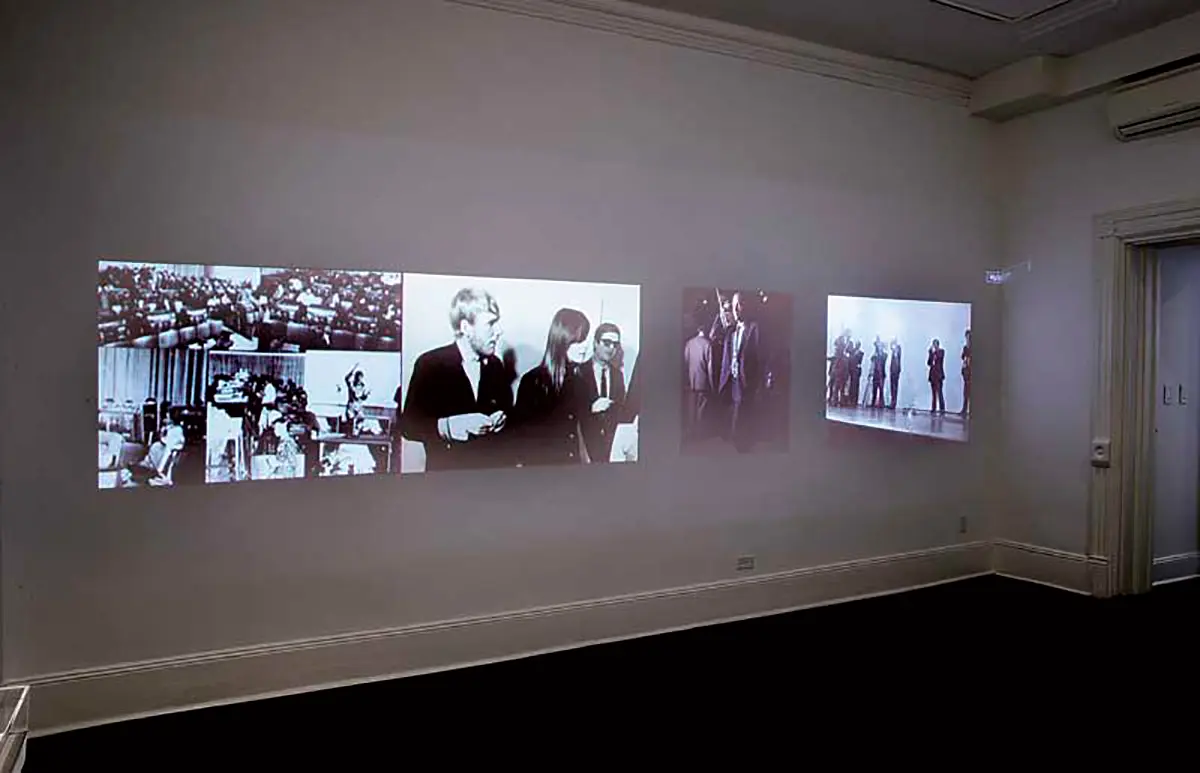
Prior interviews and photographs of these participants were shown as each one entered an auditorium. Every seat was equipped with an individual television. Additionally, participants were called at home and sent telegrams, generating a larger complex. The message was to be the medium, incorporating new technology like closed-circuit television and signaling new possibilities. Terms such as “overall environment” and “interactive art” were yet to come.
A quickly wrought seating chart is one of the remnants of the spectacle. Ink on cardboard grid brings back the fervor and spontaneity of the project. Attesting to Minujín’s intense social energy, another document—an address book from the period—is open to a page with the phone number for Max’s Kansas City.
Three black and white drawings for a taste of liberty project occupied the middle gallery. This work from the 70s was wildly impractical. It was never realized although it was seriously considered by different entities.
The Statue of Liberty was to be re-created out of wire mesh and then covered with hamburgers. Perfunctorily rendered, the drawings of this ambitious proposal are nevertheless daringly restive. We see a rendition of the green lady being constructed by tiny people. Lying horizontally on the ground, she is half completed. In the next piece, she’s been raised and we see workers attaching beef patties over the grid.
In the third piece, a worker elevated by a boom lift blasts the meaty morsels with a flamethrower. Crowds of people are receiving buns for their burgers. It’s worth noting that McDonald’s actually entertained the notion of supplying the fare.
At the heart of Minujín’s projects is the concept of participation. Passive viewing is replaced with active involvement. Dramatic, appealing, and downright audacious, she is repeatedly able to tweak viewers while seducing them.
Formally, the artist united materiality and conceptuality in intense interfaces, where symbols clash and ideas are subverted. Juxtaposing one of humankind’s most revered figures with a commercial juggernaut is an act of iconoclasm. But it is also a way of co-opting diverse entities and re-messaging their projections.
In the 1980s, Argentina underwent a long period of economic hardship. Responding to the crisis in 1985, Minujín staged one of her best-known pieces, Paying off the Argentine Foreign Debt with Corn, ‘the Latin American Gold'. Confronting the global economy’s emerging hegemony she made a symbolic gesture. She substituted corn for money to remunerate her country’s debt, using her friend Andy Warhol as a beneficiary.
In a series of twelve color photographs, the two artists sat on simple, red folding chairs that faced in opposite directions. Dressed in uniform black against a white backdrop, both were bathed in an aura of ambassadorial agency. They resembled matching bookends, crowned by unusually light hair. Surrounding their feet was a bounteous mound of half-opened ears of red and yellow maize representing South American wealth. Reading from left to right in the sequence, the two start out with their backs turned to each other. Next, they begin a dialogue and finally, Minujín presents Warhol with ears of corn. A new edition of six larger prints was made for this show. Updated connotations of colonialism, exploitation, and justice resonated in the metaphor of corn as gold. Elevating the discourse further, Mesoamerican origin myths purport the first people were made of corn.
Minujín’s oeuvre proves prescient throughout her career. Her socially interactive projects took advantage of new technologies that have become central to our daily lives. The calamity of sovereign solvency that plagued Argentina is playing out again in nations such as Iceland, Ireland, and Greece. Her sense of economic fairness is vital for artistic involvement in current civic affairs.
Minujín reaches into the future, anticipating antecedents and generating energy. Generous, witty, and grand, she’s a visionary.
JEFFREY CYPHERS WRIGHT