
I have known and studied the work of artist Melvin Martínez (San Juan, 1975) since 2004 when he established himself as one of the most promising young abstract painters in Puerto Rico. Back then, his large and medium-scale canvases revealed an effective combination of original choices, passionate lyricism, and very well-thought-out harmonies. His work was well received and attracted the interest of the most sophisticated collectors. In the exhibition he presented at the beginning of 2005 at the Galería Viota, along with a group of paintings that showcased his interesting experiments within the traditional discourse, he also showed a small painting rendered with shades of red, which included an incision that looked like a scar and, underneath, a shiny fabric that was also red. I loved this work and bought it from him at a reasonable price. This small work became the link that would eventually lead Martínez to begin painting his extraordinary and controversial paintings: dramatic compositions created with glitter on paint and resins; compositions that established a dialog with many of the leading painters of the New York School—specifically, with Jackson Pollock and other masters of drip painting—compositions full of lights, rhythms, and depths; compositions where colors and textures complement each other as they create singular visual sensations.
This new aesthetic discourse by Martínez—a discourse that could be defined as an intelligent and intoxicating fusion between Kitsch art and Postmodern Pop—made him stand out from the rest of the abstract painters of his generation and from the three other previous generations of artists in Puerto Rico. He was doing something daring, innovative, different. Nonetheless, his luck did not change until the end of 2005, when he won the First Prize at the prestigious International Painting Prize of Castellón in Spain—an award with a purse of 60,000 euros. From then on, everything began to change in Martínez’s life and, in 2006, the artist was invited to participate in ARCO-Madrid in Spain, CIRCA in San Juan, and in the exhibition titled Kitsch Utopia, in Dusseldorf, Germany. Later on, he exhibited his work at Art Basel Miami Beach and in several European capitals.
After coming to terms with his success, Martínez continued experimenting with daring combinations of colors in his paintings and decided to incorporate several materials in order to create new textures and visual plays. This resulted in truly wonderful works that stood out because of their size and the energy they projected. He also decided to work on three-dimensional pieces and went on to exhibit huge and tempting birthday cakes. In Puerto Rico, and outside the island, the name Melvin Martínez—already represented by Yvon Lambert in France—was mentioned alongside artists as renowned as Allora & Calzadilla, Arnaldo Roche-Rabell, and Rafael Ferrer. Then, the financial world crisis shook the entire art world and—as it also happened to many other established or emerging local artists—the crisis affected the sale of his works. It is then when he begins working on the project The Material, reviewed in this edition of ArtNexus.
Unfortunately, the island of Puerto Rico has become one of the most important bridges—in this instance an aerial one—for drug trafficking from Latin America to the US, only to be surpassed by Colombia and Mexico. Drug money has become an integral part of the Puerto Rican economy, and drug consumption—marijuana, cocaine, and heroin—and the territorial wars between drug dealers to maintain their drug spots, make the Chicago of Al Capone look benevolent by comparison.
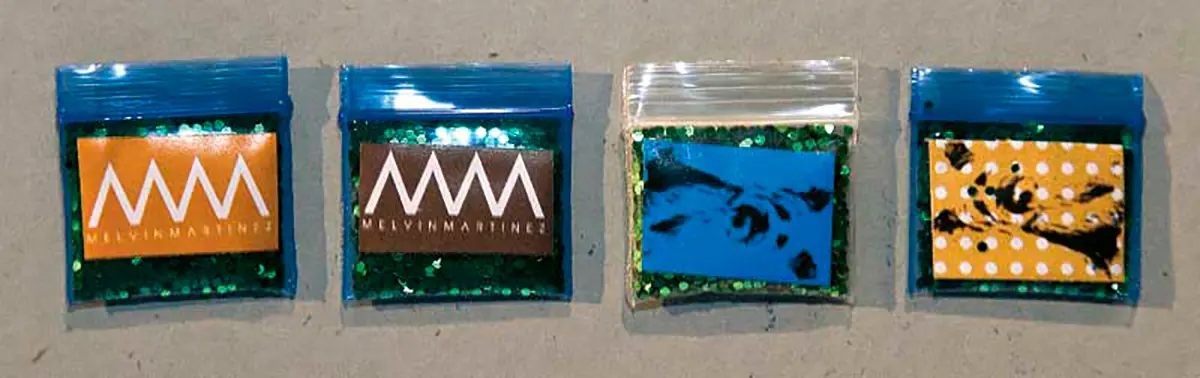
As a way to comment on this sad reality—and to reach a public that otherwise could not afford his paintings—Martínez joined forces with cultural agent Alexis Figueroa to develop the concept of selling the glitter he uses in his work as if it were a drug: bags of marijuana, cocaine, and heroin; kilos of marijuana, cocaine, and heroin; as well as small mirrors with cocaine “lines.”
According to Martínez, this proposal also shows us the art world “as an addiction.” He believes that, to a certain extent, art collectors treat collecting as an addiction because they will buy art even when they don’t have a place to see it. Martínez also points out that “therefore, I decided to use this criminal world, and the cycle of traffic and sale of drugs, as a reference and to transform the glitter—in this instance three colors, one for marijuana, another for cocaine, and another yet for heroin—that I use in my works, as the drug or ‘the material’ bought in the street: art as a drug, my imitation of drugs as art.”
The project has been a complete success because, just as it occurs in the drug world, customers can buy “the material” at the drug “spot”, or they can have it delivered to the doorsteps of their homes or workplaces. The bags with glitter are individually sold. Buyers can create their own works with them if they choose to: framed repetitions, simply placed them on a table or inside a container, or “in the hiding place where no one ever goes,” as the memorable song Mrs. Robinson, by Simon and Garfunkel, goes.
MANUEL ÁLVARES LEZAMA