
Meyer Vaisman (Caracas, 1960), a Venezuelan artist of Romanian-Ukrainian descent with an important artistic trajectory that expands over 30 years, presents his most recent body of work in the exhibition titled Superflat Donkeys and Zooms, his first solo exhibition in the United States since 2001.
It is not easy to summarize Meyer Vaisman’s vast career in a few sentences. He grew up in Venezuela and eventually moved to New York where he studied design and fine arts. There he was formed as an artist and participated in a large number of exhibitions. Alongside Elizabeth Koury and Ealan Wingate, he co-founded the International with Monument Gallery in 1984. He was linked to the Neo-Conceptualists of the 1980s and, with a group called Neo-Geo—that also included Ashley Bickerton, Peter Halley, and Jeff Koons—who at that time was known as the “Hot Four.” Through very different types of visual strategies, the group would question the myth of originality in the work and the excessive commercialization of art, as they would incorporate everyday objects and unconventional or massive processes into the production of the artwork. In many instances, the group would address political themes and social criticism.
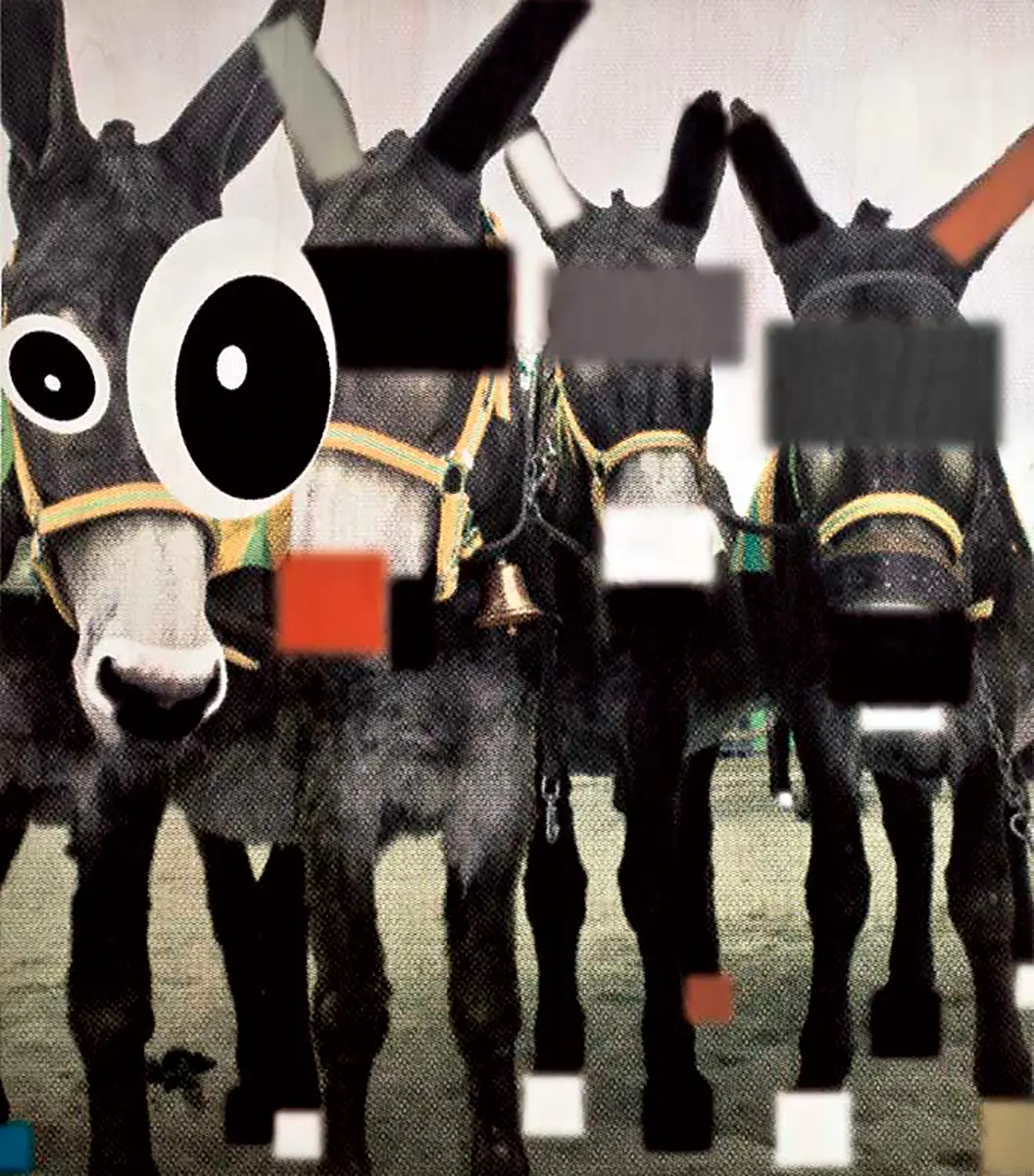
Superflat Donkeys and Zooms consist of seven two-dimensional works created on laminated wood panels, painted with industrial printing inks that, like visual assemblies, combine photographic elements with pictorial ones. The series is based on two photographs that depict a herd of donkeys, digitally manipulated, and intervened with paint. The pictorial interventions consist of hiding the animals’ eyes, legs, and ears from view through the superimposition of geometrical forms. Some of the eyes have been greatly magnified and made rounder—like is done in Japanese cartoons—thus emulating the oval shape that Vaisman often used in his earlier works.
Vaisman creates works that stem from a central piece. From there he draws geometric fragments that he then uses to build new forms. It would appear as if Meyer Vaisman were trying to establish a private conversation with the history of art through the reduced abstraction he obtains from the initial figuration. What exactly do we see when we observe a work of art? What part of the work do we focus on? What do we retain from such observation? These are works that reflect on the physical act of observation and the intersections of the gaze. They also speak of the movement created by the zooming effect that brings us closer to the elements that are part of an artwork. Through them, Vaisman is able to make the leap from figuration to abstraction, as he invites viewers to establish associations between contiguous images. The important thing here is the artistic process, the configuration of a body of work that unassumingly presents this singular relationship between the artist and his work. In this instance, there are similarities between the process of conceiving and executing the work and the response by viewers inside the exhibition room—a fluctuating relationship without a doubt. Vaisman destroys the palimpsest of images and refines them in the form of large geometries. In this manner, from the oval-shaped donkey eye emerges a large elliptic image that reminds us of his earlier paintings; from the square that censored the gaze of another donkey—like the blurred faces of children in magazines that were concealed that way to protect their identities—emerges a large orange square reminiscent of a Rothko; and so on and so forth, in an attempt to un-do the collage of the original image.
In Vaisman’s almost entire body of work, we encounter a dialog between reality and representation, mass production and handwork, artificiality and truthfulness. In the broadest sense, his work has to do with simulation and the manner in which we replace reality with the construction of our own particular realities, through the impeccable articulation of the images he presents to us. On one occasion Vaisman mentioned that he detested the world of comics and animated cartoons. However, it is precisely this syncretic element of the comic, the very one that he has employed through the years as part of his strategy or as satirical commentary. This can be observed in his pictorial work, the goblins of caricatures, the portraits on coins, and, currently, the intervened images of donkeys. On the other hand, throughout his artistic career Vaisman has been using animals as a point of departure for his work: the live chickens he showed at the 2nd Guayana Biennial, in 1991; the paintings in which he drew in a cartoonish style the head trophies of hunted animals; the series in which he used taxidermy turkeys dressed with wigs from the early 90s; as well as the more recent sculptures of turkey skeletons. Just like the turkeys or the chickens, donkeys are overwhelmingly considered animals of inferior intelligence, and even of a “lesser” standing than other species from the animal world. In this particular instance, donkeys are also known for being stubborn on one side and submissive and hard-working on the other. Is Vaisman offering a commentary on both the potential and the limitations in the role played by contemporary artists? At any rate, with Superflat Donkeys and Zoom, Vaisman would appear to be attempting a conversation from several places: from the perspective of the artwork—and the history of art—that is dismantled to be once again reconstituted; from the point of view of the artist whose work is a mirror of the perceived reality; from the viewers who see themselves reflected in the work; and the society that laughs at itself.
AMALIA CAPUTO