
Like a building façade, a unique display welcomed viewers into René Francisco Rodríguez’s show at the Museo Nacional de Bellas Artes. Under the arch created by the furniture thus (re)created, a multitude of small men formed the sentence: “Beban de mi copa pequeños” (“Drink from my cup little ones”). In this way, the artist transformed his exhibition Viejo Verde, as the winner of the 2010 National Arts Award, into a suggestive invitation to cross from the public space into a site where eroticism outlined the private sphere. In this new approach to the topic, we encountered also other issues, delineated on the basis of that amalgam that constitutes each artwork, which combines different symbolic resources and elements that have characterized Rodríguez’s discourse for over a decade.
In the proposed conceptual unit, a time-worn figure whose masculinity revived the sense of eroticism fought for its virility, concentrated on the erection of its phallus, and the enjoyment of the stimuli that caused it. It also alluded to a moment in life—an epoch—frequented by obsessions and manias. A time when one struggled to treasure the past and use it as a point of reference. The “design” of this project, resulting from the artist’s introspective impulse and his own life experience, is related to the path followed by René Francisco since 1998, in connection with Tubosutra 1 (a sexual allegory built through the recycling of toothpaste and medicine tubes) and La subasta, the initial work in his series of paintings-screens, presented that year in the 2nd Contemporary Cuban Art Salon, concerning which the artist declared at the time: “The deconstruction of codes, symbols, and paradigms of a different nature—through the use of sexual and erotic stereotypes—goes towards the revelation of problematic areas connected to the art market and its mechanisms of commercial perversion, but also to certain critical, negative, polemic aspects that are present in man’s very behavior in contemporary society.” 2
The show, open to the public with a performance where elderly men flirted with and made flattering comments to younger women, had as its center a large-format painting in which a kind of faun seduced a girl. Contrary to its most common meanings, in this painting, the color green represented obscenity and concupiscence. As in the rest of the exhibition, the history of art was the support underpinning this work’s lyricism and its old, familiar aura, complemented by the excellence of the artist’s handling of wood, sealing the sensuality of that which was novel in the past and is today ancient and held only as a point of reference.
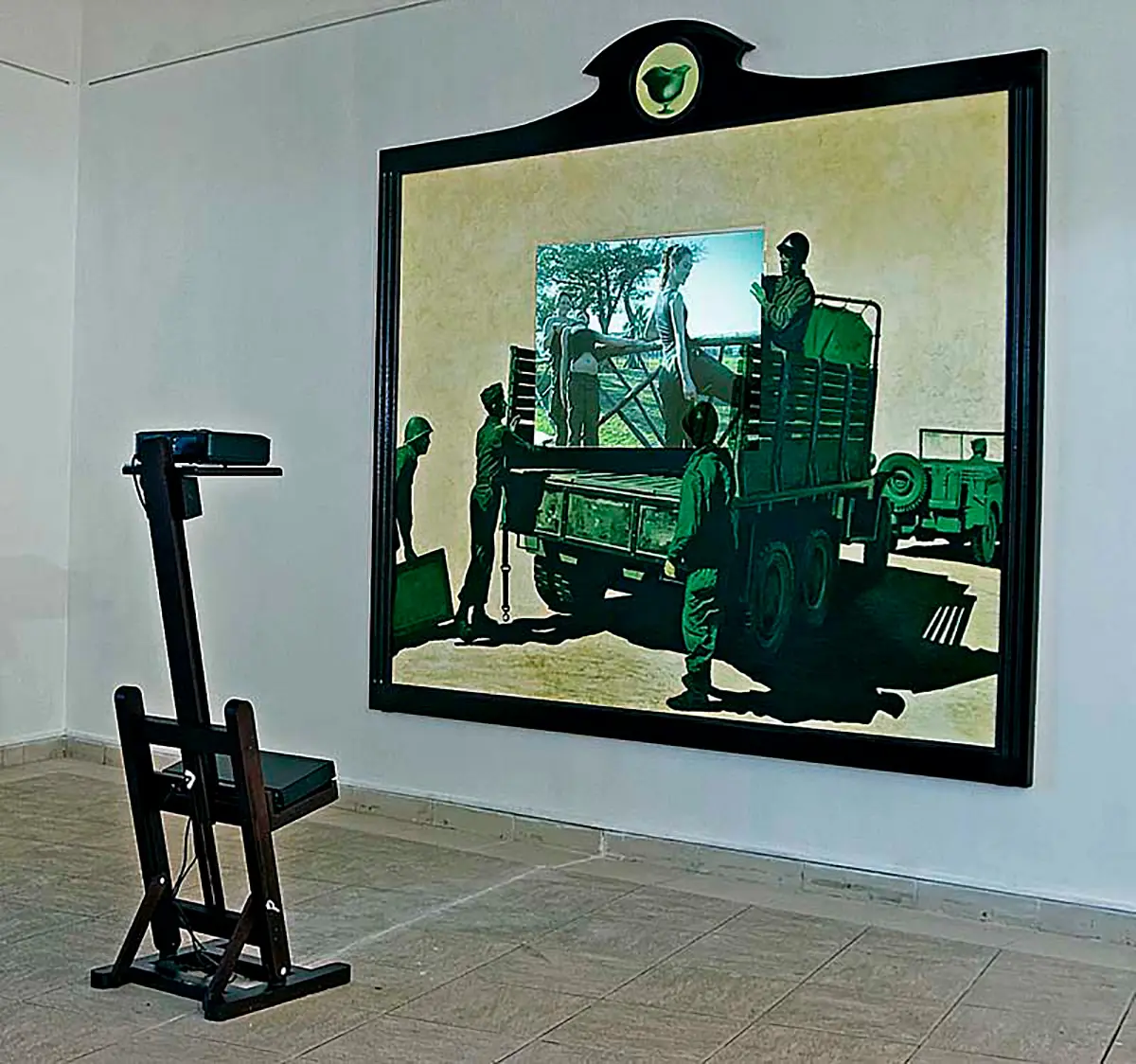
Integrated without dissonance to that neoclassical-seeming realm, characterized by the masterful execution of each artwork, were a variety of means of expression (drawings, painting, artifacts, installations, video projections). The canvas reproducing a moment from World War II when several soldiers carry a painting onto a truck is completed with the projection of photographs where a group of young women dressed in olive green fatigues recreated the same action under the title No más soldados. In a different direction, Rodríguez’s glass desk was a Japanese erotic carving, and on it an iPad reproduced an endless sequence of the same nature and different origin. The drawer chest became a contextual narration achieved through a series of sculptural vignettes, while a very large metronome integrated the artist’s self-portrait to the instrument’s wooden structure so that the pendulum was transformed into a phallus and an attribute of power.
Some of the works were a kind of furniture that defined the show’s ambiance. Their theatricality underscored the playful interaction between past and present, mixing in symbolic way elements that appear frequently in Rodríguez’s discourse with the recreation of historically hallowed languages in which he is interested. The highlights: his pointillism, tubes transformed into sexualized characters or phallic symbols, and the masses with those tiny men that this time around formed windows (similar to the “captcha” system) of piquant flirtatious comments.
The sharp irony always present in René Francisco’s explorations around the relationship between individual and society, art and life, art and politics, turned Viejo Verde into a juicy grid of references and meanings. Together with the history in which all of this is inscribed and its bodily make-up, as well as the sensory aspect, came freedom.
NOTES
1. Tubosutra, a parodic fusion of the words Tubo (“tube”) and kamasutra, was the title of an exhibition comprised of small-format sculptures created using recycled toothpaste tubes (as well as some installations, drawings, and paintings), presented in Cuba at Havana Gallery in 1999, and at the Goch Museum in Germany in 2001.
2. René Francisco Rodríguez, in: catalog, II Salón de Arte Cubano Contemporáneo. Centro de Desarrollo de las Artes Visuales. Havana, Cuba/Alezio-Lecce, Italy, 198, p. 106.
CLARIDAD BLANCO DE LA CRUZ