
Puebla’s Museo Amparo presents a group exhibition marked by the eloquent, clear-cut museography with which the discourse of its curators, Angelie Scherf and Ángeles Alonso Espinosa, is conveyed. At the bottom, we still breathe the usual multifariousness that characterizes such shows, but there is something familiar and comforting here: a recognition that everyday life is to be found in art. It is satisfying to encounter artworks whose concept is intrinsic to representation, artworks that are well executed and offer a palpable coherence throughout the exhibition.
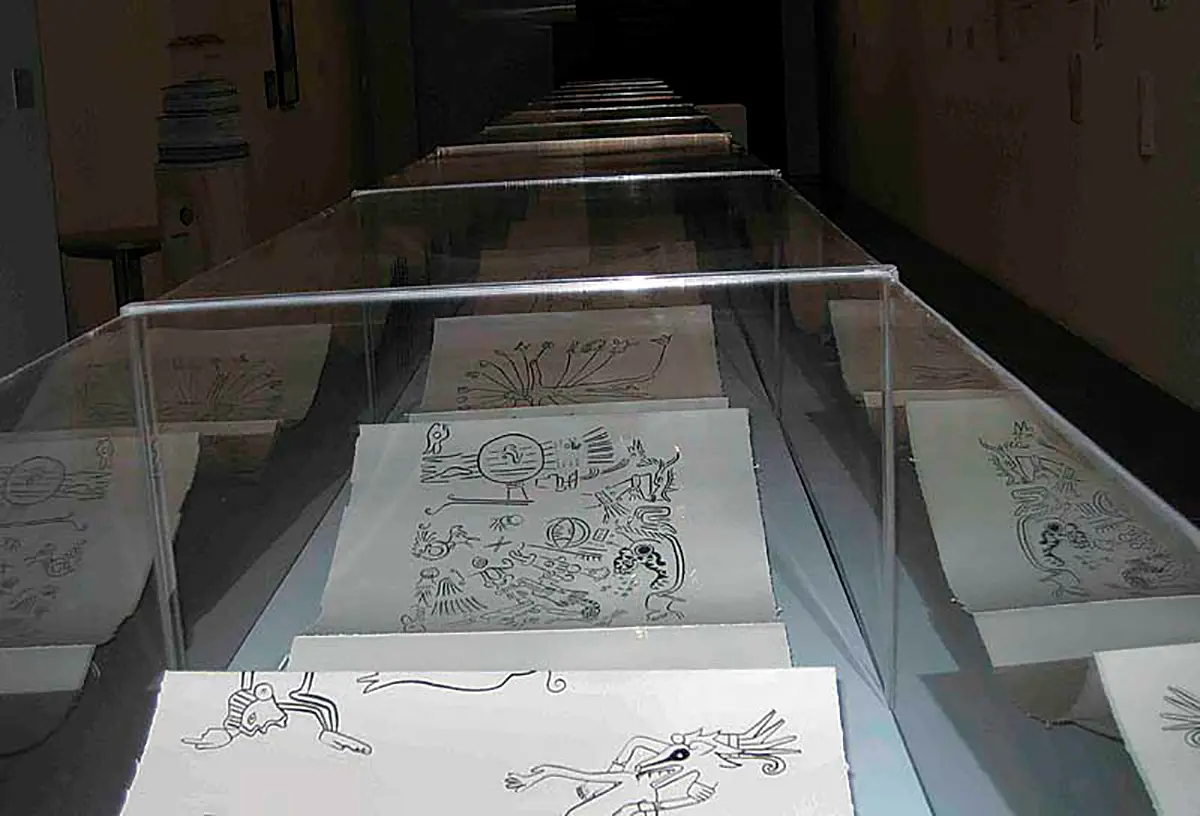
The show connects several micro-narratives of our daily lives, with their stories, indignations, and humor. It can also be accessed through a dual perspective: from the global or general towards the particular and the intimate, and vice versa. Resisting the Present, its very title embodies a two-fold interpretation: resisting as endurance; resisting as contestation. And the different examples presented (both in the ample, garden-like exteriors of the former San Juan de Letrán hospital, built-in 1538, and in the white rooms) envelop us in that same duality of meaning: tradition is broken through, but not annihilated, as in the case of the codex re-written by Mariana Castillo Deball (Mexico City, 1981.) Her El dónde estoy va desapareciendo, from 2011, is an installation that includes a display case that extends for several meters and contains the unfolded sheets of a codex with clearly pre-Columbian roots, but with approaches to symbols, ideograms, and pictographic structures from many and highly diverse cultures both Western and Eastern, ancient or classical, with or without the use of perspective, in black ink and folded accordion-like, unfurled to be seen almost in their entirety. The artist insists in her quest for origins in another installation that, although rather less impactful at the visual level, is infused with a sublimated beauty: white, letter-sized couché sheets showing the folds that would form an ancient mask from an extinct tradition, as the culture that produced it was colonized, defeated, or co-opted, in Visage Faux, from 2008.
For his part, and along the same dual-reading lines, Jorge Méndez-Blake (Guadalajara, 1974) builds his Das Kapital (2009)—or, rather, piles up a number of wooden planks, as they are not glued—to form a wall, 170 cm tall and 6 m long, with a German-language copy of Marx’s Capital under its bottom corner for support.
Close to that wall, our attention is captured by a round table, partially segmented at its tangent to connect with a birdhouse. On top of the birdhouse, a column of books about “contemporary Mexican art” exhibitions during the last two decades, under a small, empty cage, in a tribute or satire whose title is densely meaningful: Epílogo (2011). Caught between the wood and the wall is a ticket to the museum, which I attempted to pick up thinking it was garbage only to be kindly informed that it was part of the work. Oh. It was an installation by Jonathan Hernández (Mexico City, 1972).
Surprisingly, Alejandro Jodorowsky’s original drawings for Fábulas Pánicas accompany a projection by the same artist (Tocopilla, Chile, 1929), done forty years later: sentences, aphorisms, reflections, and catharsis by a mature artist who shares space with his legacy—the silkscreen-on-paper drawings created by Bayrol Jiménez (Oaxaca, Mexico, 1984), framed in the wall with a mixed-media on-site graffiti. Both the posters and the mural condense the visual universe of contemporary pop culture. Jorge Satorre (Mexico City, 1979) and Erik Beltrán (Mexico City, 1974) present a detailed complex devoted to Fantomas, la amenaza elegante. In this case as in the previous one—in fact, Jiménez’s work is titled Recuerditos (2011)—we are offered small “pieces” of the art as souvenirs, more than as a relational gesture although with well-handled interactivity.
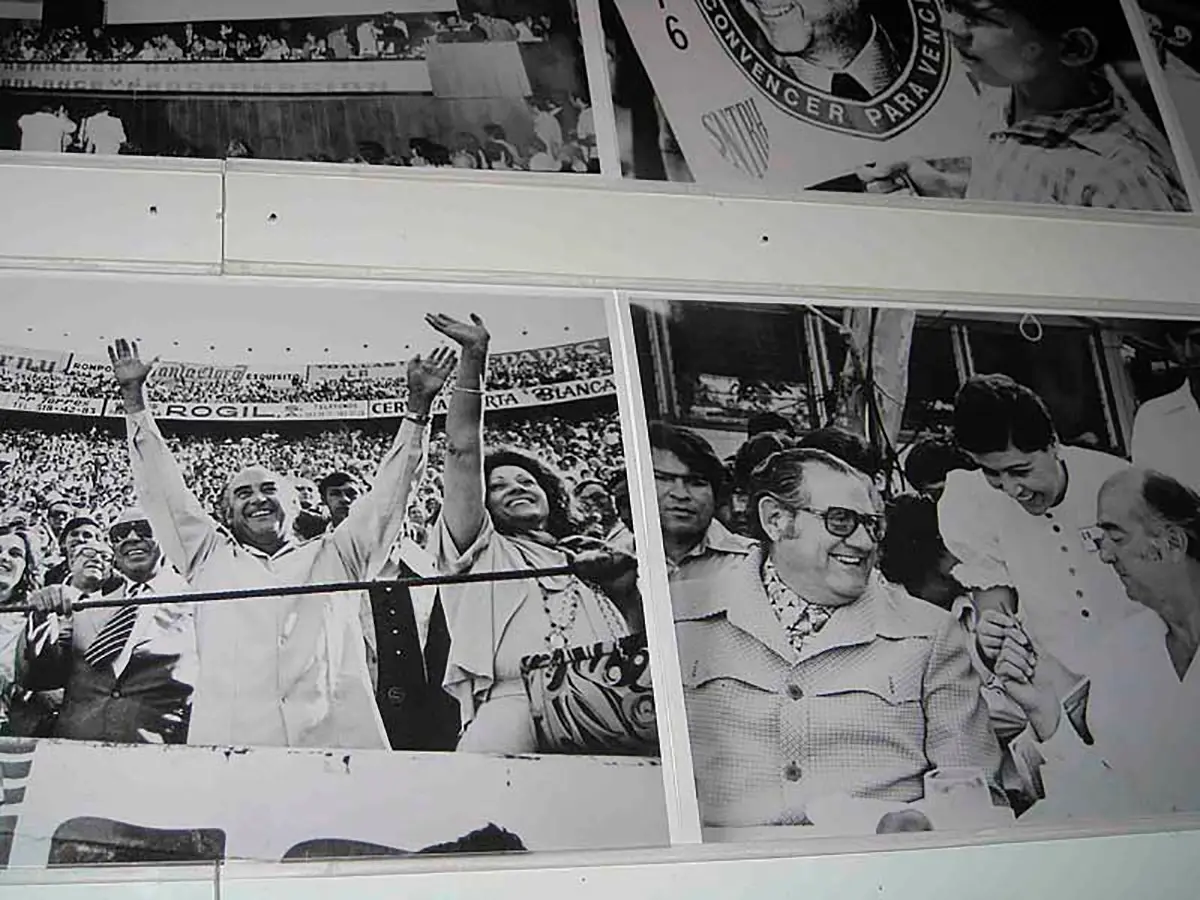
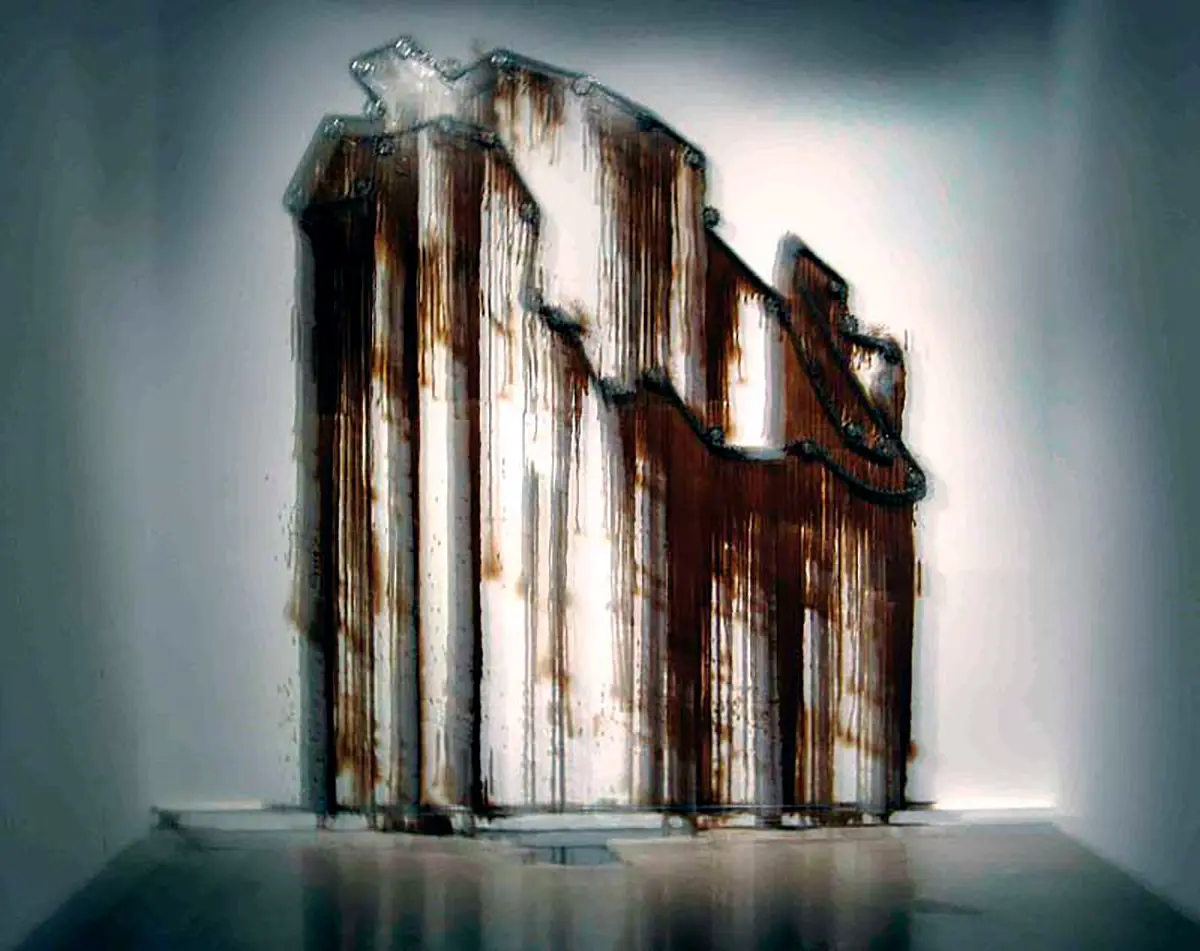
Again in the same dual line of interpretation, Marcela Armas (Durango, Mexico, 1976) surprises us with I-Machinarius, from 2008, which consists of a map of Mexico turned upside down, outlined by moving chains that drip oil down the wall all the way to the museum floor, creating a growing, slippery puddle and evoking saddening thoughts of all the Mexican oil that flows to the United States, like its best citizens. A blood-curling work, visually strong, ugly, harsh, yet at bottom fragile and slow. Despite such a sudden blow, we come to rest with a plethora of images offered by Diego Berruecos (Mexico City, 1979): former Mexican president López Portillo at his peak; an amazing record for its localization and placement in La solución la tenemos todos, of the series PRI: Genealogía de un partido, from 2011. How was the artist able to gather these images and arrange them into a festive, optimistic recreation of a Mexico that never was? (As a parenthesis, the exhibition is presented at the same time as political pre-campaigns throughout the country.) Across from his “glorious Portillista” wall, Berruecos deploys the coldest gaze on his depiction of the highly renovated Lomas Taurinas in 2008, the site where PRI candidate Luis Donaldo Colosio was shot in the head in the midst of his presidential run 18 years ago.
Another high-impact work: the (literal) installation, by Héctor Zamora (Mexico City, 1974), of a number of flags in a New Zealand beach, implying Maori peoples in support of their traditional rights, in White Noise (with video and flags). Transferred to the museum’s narrow, dark gallery, the installation acquires greater solemnity, oozing respect and almost a sense of veneration, up to the point when we walk next to it to discover that the sensation of freedom that the video projects with the flags flapping along the seashore are definitely absent from the inert blankets, hanging in impotence from their wooden masts, that are exhibited as Sin título, an installation from 2012.
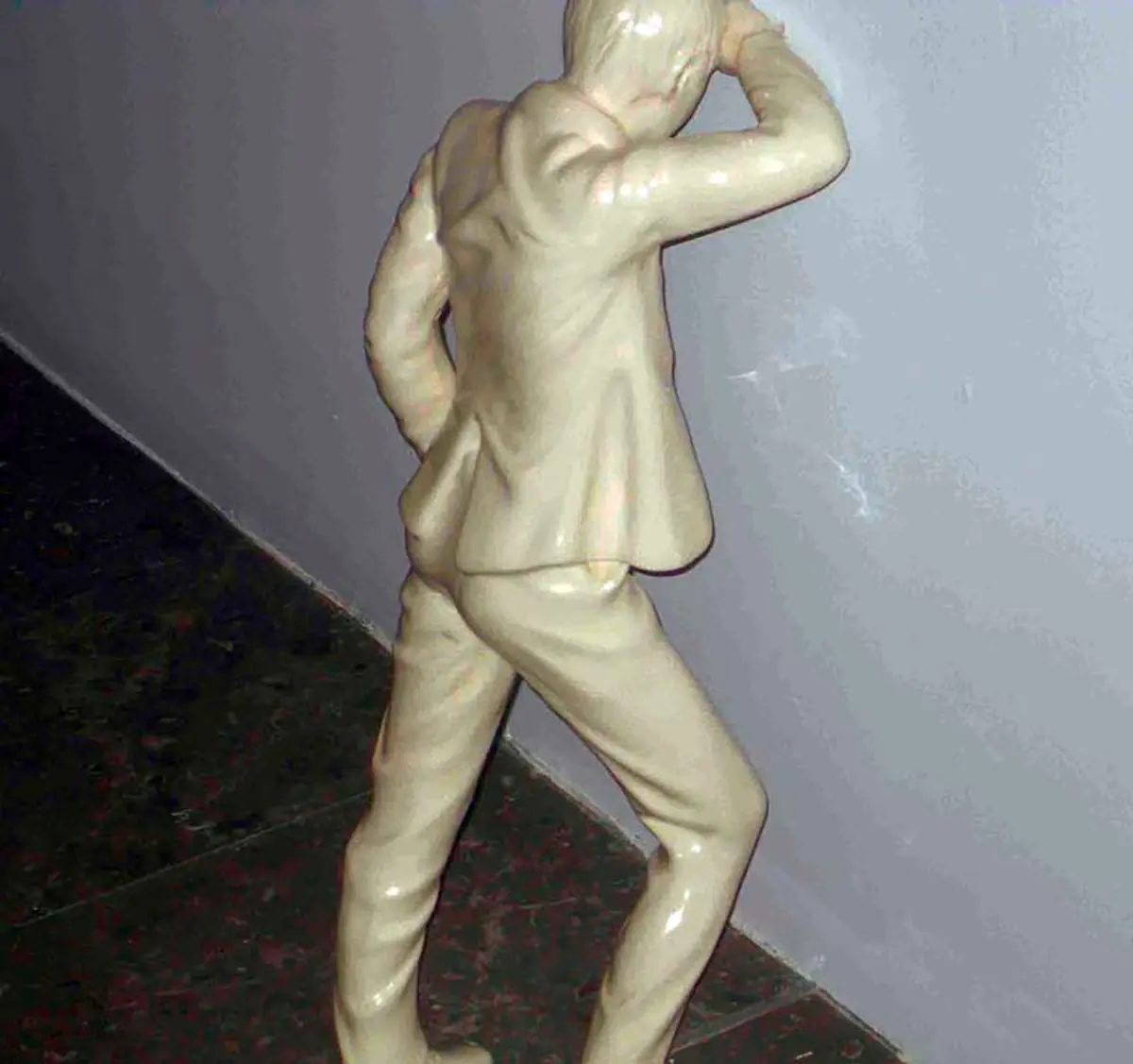
Gonzalo Lebrija (Guadalajara, 1972) quickly dispels any certainty we may have of knowing anything with his Lamento, from 2007: his “reflecting man” in neat porcelain, in a pose of lamentation on his own arm, with an indirect light that—paradoxically—reveals his (in)correct feature and projects a sinister shadow on the “wailing” wall, all of which impresses on us a new kind of sadness. An almost tender feeling for the small figurine, less than 50 cm in height, that can fill us with an absolute sense of misery, alongside its “big brother”, from the Jumex Collection, which is made in glass, rises to 175 cm and is titled Big Lamento.
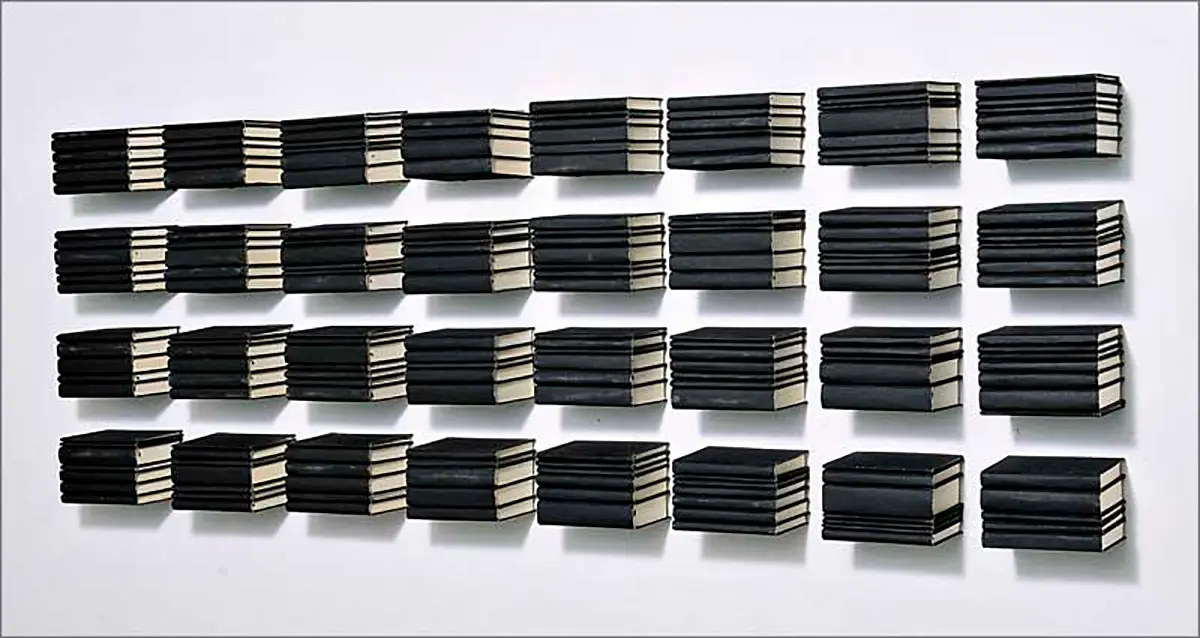
Juan Pablo Macías (Puebla, 1974) uses electronic media to track down “impossible-to-find” texts on anarchism, which he downloads, prints, and binds in hardcover; with dust covers made of thick black sandpaper, these 200 books can be read and returned to the wall to complete the Biblioteca de anarquismo y anarquistas, from 2009-2010.
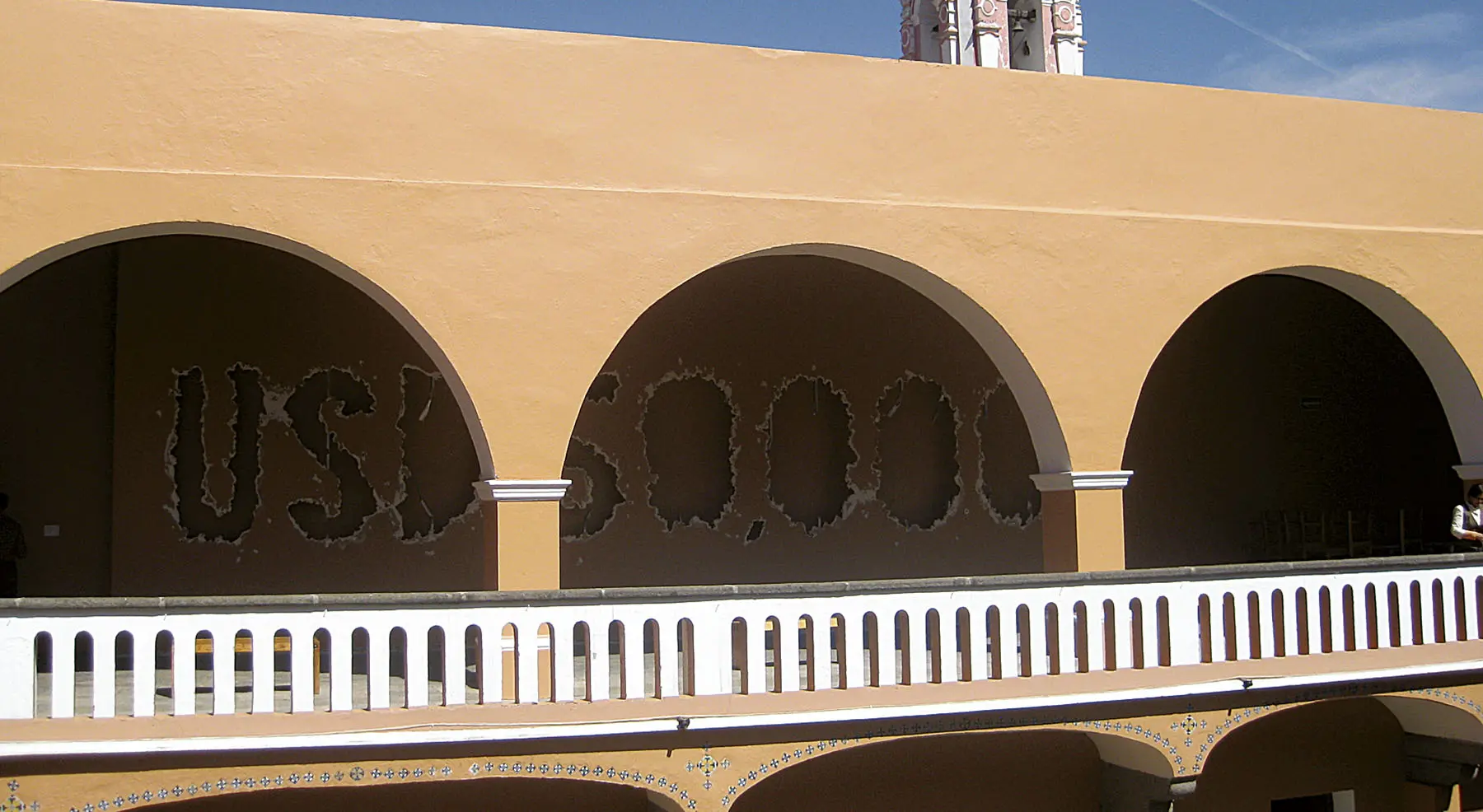
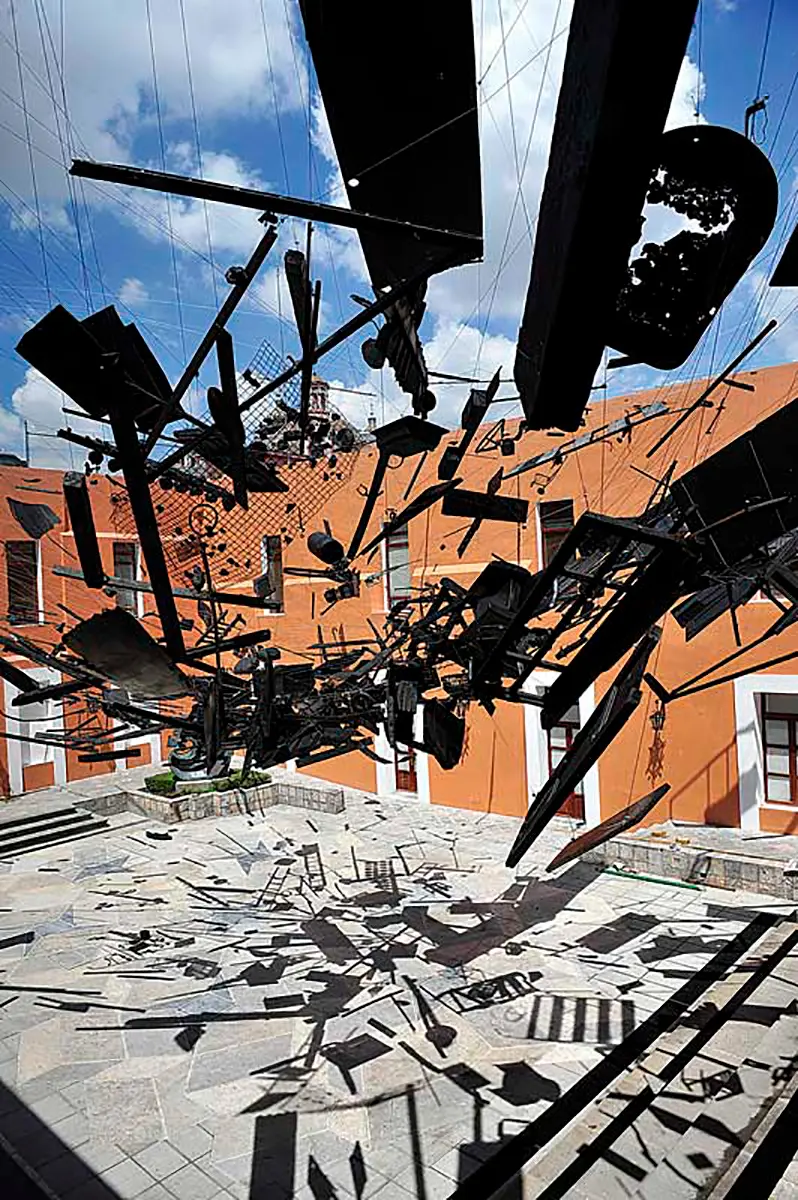
In the hallways’ external walls, enclosed by arches, and around to the typical Sixteenth-Century garden with fountain, we find a work by the Monterrey trio Tercerunquinto (a collective formed in 1996): a false wall perfectly integrated into the original, pockmarked by cannon-ball holes that spell 'USD $50,000', money for artists against the billions spent on wars, and the confession/warning explicit in its title: No hay artista joven que resista un cañonazo de 50,000 dólares (“No young artist can resist a $50,000 dollar blast). And in an adjoining patio, Capital suspendido (2011), a mega-installation by Arturo Hernández Alcázar (Mexico City, 1978), comprised of pieces of furniture, utensils, toys, and a long assortment of items that were lost in an explosion in San Martín Texmelucan, caused by a leak in the Pemex pipeline; the explosion, in December of 2010, left more than ten dead and incinerated cars, vans, houses, and trees. The objects were found partially burned in trash heaps; Hernández paints them in black and hangs them from an outsized spider web that extends from the building’s roof to form a large cloud that covers the architectural complex’s second patio and contrasts with the deep blue Puebla sky. Each item contains a particular story, extinguished in the vastness of the world. A feeling of generalized loss persists, even as it is impossible to know the intrinsic reality of each soccer ball, ladder, chair, door, plank, box, table, or whatever is added to the “cloud of tragedy”, entirely in black and entirely silent.
The show will travel from the Museo Amparo in Puebla to the Musée d’Art Moderne de la Ville de Paris.
LUZ SEPÚLVEDA