
A multiplicity of languages is a characteristic of contemporary art, and it often becomes an artist’s leitmotif. Such is the case of Sergio Romagnolo, whose work was recently presented in A Feiticeira e as máquinas, an exhibition at Casa Triángulo in São Paulo, in tribute to his 35 years of artistic activity. Romagnolo, a faithful representative of the generation that worked with the second period of Pop Art in Brazil, in the 1980s, confirms with this solo show that he remains committed to the hybridization of techniques and languages, connected by a solid aesthetic coherence.
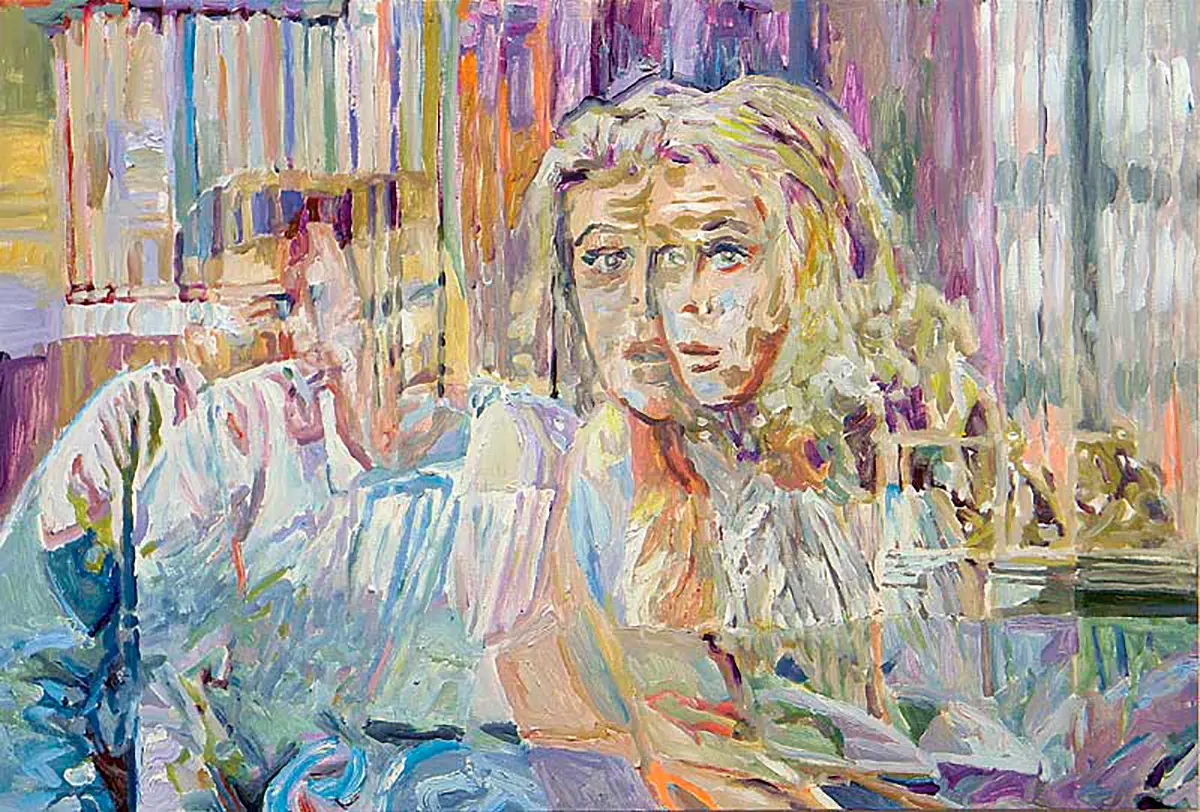
The paintings and sculptures that give the exhibition its title are typical examples of Romagnolo’s poetics, which constantly uses elements taken from the mass media in order to transform popular characters into art. The paintings, for instance, are created through the superimposition of images from the 1960’s TV series Bewitched. With great technical care, the acrylic canvases present the characters of Samantha and her husband Darrin together in bed. The images are duplicated and mimic the flaws that characterized analog TV broadcasts.
The sculptures, made in plastic, have as their models Volkswagen “bug” cars, tennis shoes, or Hawaiian-style sandals, icons of Brazilian consumerism already well established by the 1980s, when the artist graduated from the Armando Álvares Penteado Foundation’s Art School, a key incubator of the 1980s generation in São Paulo. Romagnolo’s style, connected to urban and industrial elements, is strongly rooted in the work of some of his professors there, such as Regina Silveira (1939), Nelson Leirner (1932), and Julio Plaza (1938-2003). Fresh out of school, Romagnolo was already creating works like cars, buildings, airplanes, photo cameras, video cameras, and trash cans made of hand-modeled heated plastic. His earliest works also included comic-book characters, such as superheroes.
The relationship between the two-dimensional and the three-dimensional reveals the coherence of Romagnolo’s work. His matteric paintings made with colors of well-defined contours or even with other materials such as resins, free themselves from the surface and become almost-sculptures, very similar to the sculptures proper. Plastic, used often, becomes its own language; even when the artist molds his work in bronze, he simulates the folds of melted plastic. His bronze sculptures—a symbol of the secularization of art history—are a tribute to plastic, prime material of consumerist culture, which puts an end to any tradition.
Romagnolo was the main driver behind the show Painting as Medium, at the Museu de Arte Contemporánea of the University of São Paulo (MAC/USP), in 1983, which also presented talents such as Leda Catunda and Ana Maria Tavares. This show was essential in the breakthrough in contemporary Brazilian art, which was then undergoing a Neo-Pop period at a time when the country’s military regime was hardening its repressive practices. Romagnolo’s generation gambled or aesthetic democracy through a multiplicity of styles, not necessarily intended to declare its adherence to any specific concept or language.
This is not just modesty. In fact, Romagnolo is a well-established intellectual, with a Master’s and a Doctoral degree, and the author of critical texts. As critic Lisette Lagnado reminds us, in the 1980s in Brazil, issues as non-mimetic or gestural representation were at the forefront. The 1983 show in São Paulo proposed, above all, a deepening of the debate around the issue of representation. Romagnolo’s canvases depicting narratives of superheroes, using the metropolis as their stage and human relationships and loneliness as their topics, are emblematic here. The heroes appear in prison or in an office environment, or even in more dream-like scenes (giant heroes resting on buildings or bridges).
This generation also brought center stage the issue of Latin America’s recent internationalization, now more complex and multi-faceted, which could no longer be understood as a simple result of the unjust interaction between colonizers and colonized. With his constant, rough-hewn re-readings in the plastic of religious narratives and of saints (Santa Teresa, 1990; Pietá, 1989, Corona de Cristo, 1989), Romagnolo brought into the debate matters previously appreciated by Modernist artists, who defended a genuinely national identity. In 1993, Romagnolo created twelve figures whose referents were Aleijadinho’s prophets, revisiting the Brazilian Baroque through techniques such as the corrugation and piling of shapes. The gesture is always present in his work, as revealed by the finger and hand imprints on the plastic.
In A Feiticeira e as máquinas, the artwork is related to a literary fiction Romagnolo is currently working on. Sharing its title with the series, the story tells of a couple, a woman and an android, living in a world dominated by machines. Once again, the artist reorders various poetic elements in order to compose a coherent series; the passage from literature to visuality in which his entire oeuvre is based. Romagnolo presents the viewer with unexpected situations in intelligent narratives. He questions the degree to which common sense definitions are real, this being the essential point of his artistic freedom.
ALESSANDRA SIMÕES