
En el medio de las cosas is a sculpture-based proposal, where Soledad Pinto (1978) recreates a unique register of everyday objects as artifice strategies that ultimately reveal certain hidden meanings in the realm of things, not as much in the abstract sense of the term but referring to our contemporary life. The artist has had an active career for ten years, but because she has spent some of that time studying in London and exhibiting internationally, only now is she becoming visible in Chile.
A series of old tools and artifacts from the domains of industry, science, telecommunications, and everyday life take over the gallery space in an installation that can be explored as one would a large workshop. These are “things” fallen in disuse, left in what seems to be a haphazard fashion with a Dada tinge. Thus, we find a suspended pulley next to a kind of radiator set on a metal tripod, an electric fan, a strongbox, a radio transmitter, a fuel tank, a house slipper, a toy gun on a wooden chair, Venetian blinds hanging on the wall (and others on the floor) next to iron, and further beyond a staircase with an open book on one of its steps, where all we can read is a Faulkner quote (in Spanish): “¿Qué estrella cae sin que nadie la mire?”, cited by Chilean writer Roberto Bolaño in Estrella distante (1996).
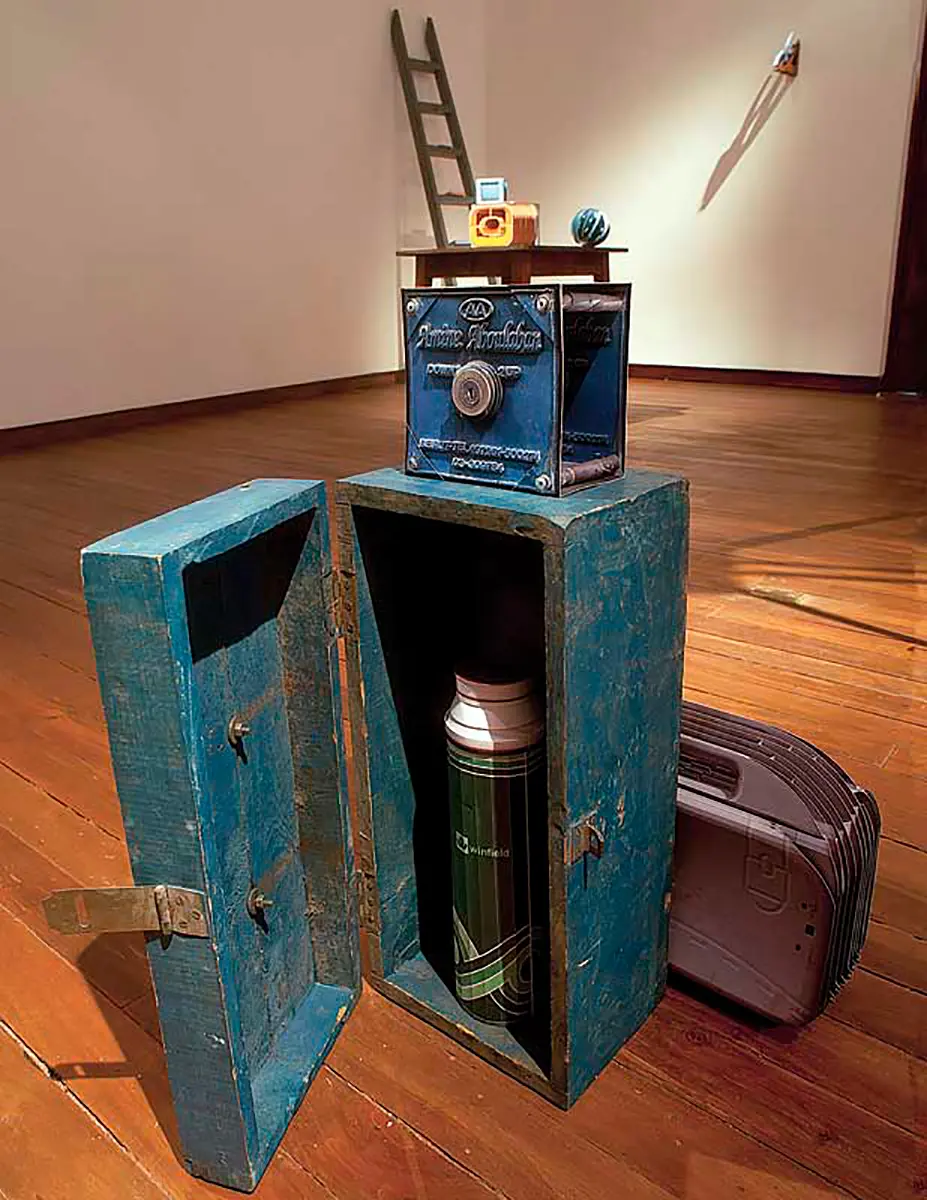
In this panorama of discarded objects, Pinto combines real items with others she has built so that, with an unadvised gaze, we do not perceive the deception. The latter items are life-sized volumes made with printed paper—silk screens and color laser prints—that are folded and assembled like pop-ups. The visual complexity and richness of the forms are present in their totality, but material properties such as peeling paint, plastic staining, rust, and the opaque shine of metal have been exchanged for high-quality registers, for a photograph that refuses to be lost. In the salvaging of objects, Pinto makes use of technical reproducibility, and also a manual process that invests things with a certain aura that transcends the mere nostalgic expressiveness of the antique and discarded. Intension on the face of technology, the artist re-materializes the experience of the object and renders it extremely fragile. She achieves a physicality reduced to pure surface and vacuum, to the possibility of deconstructing, unfurling, or crumpling paper, which ultimately voids the body.
Soledad Pinto invites us to look at her decontextualized and recontextualized objects two, three, or more times if necessary. There are many layers of meaning pointing towards a slippery zone.
In a Heideggerian sense, a “thing” is comprised of matter and form, where thingness resides in materiality. Following the logic set forth by the German Philosopher, the show does then include both utilitarian objects and works of art. The objects have expired, and the sculptures are always on the verge of disappearing. Materiality stands out, but it is deceiving, a prisoner of time, it mimics or fakes the object, like a contentless shell. Between one glued or folded paper and the next, we think we are seeing objects. The work of art forces us to look in the interstices, in the crevasses of form and matter, allowing us to discover the way in which thingness, in the end, vanishes. From the domain from where these items are extracted, Soledad Pinto situates us in the context of contemporary consumption. Here, materiality is more susceptible than ever to expire and disappear. The obsolescence of the technological object turns it, rather, into a presence or a trace. As one of the texts included in the show puts it, “Objects are always quasi-objects, vibrating matter, or forces whose trajectories traverse the experience of the human.”
Pinto’s operations are of imitation, occultation, and unveiling, seeking to reveal what lies in the midst of things, since, we assume, it is something more than our mere passage through the world. In John Carpenter’s 1982 film The Thing, “the thing” is something that hides through a camouflage strategy: an extraterrestrial who, in order to attack a group of explorers in the South Pole, adopts human form. A constant doubt then emerges, each member of the group mistrusting the other.
We now return to the book abandoned on a staircase step in the gallery, which we assume to be Bolaño’s. If it is, the hidden story refers us to an operation of masking: it tells of a torturer living as a mythical, vanished poet, a kind of reincarnation of evil that allows the author to explore absent poetry and the Chilean dictatorship, where thingness enters the domain of the perverse nature of human beings. The question is, What star falls when no one sees it? remains unanswered.
CAROLINA LARA B.