
The exploration of cultural identity, and its materialization based on the constructed space, were the central axes of the solo exhibition titled Artificial Paradise, by Venezuelan artist Suwon Lee (Caracas, 1977). Until her 2008 solo exhibition—titled Bling! Bling!—the artist’s explorations had been centered on her own identity. Suwon Lee’s current exhibition followed a distinct transition and evolution of the themes. Artificial Paradise is part of a series of photographic explorations of the landscape that Lee has been working on and that includes the series Overnight and Crepuscular, both exhibited at Oficina #1 in 2009 and 2011, respectively. The exploration of the landscape in Artificial Paradise is complemented and enriched by Lee’s inquiries into the social, cultural, and even political context of Venezuela today. The exhibition included seven digital images—also titled Artificial Paradise—that were taken with a medium format camera and printed on cotton paper. Most of these were enlarged to 79 × 102 cm (31.10 × 40.15 in.) and then mounted on understated white frames. An installation titled El Boulevard de Sabana Grande, which contained two books that could be rolled up and interacted with, contained photographs of this boulevard that were printed on cotton paper and placed on a display table in the exhibition room.
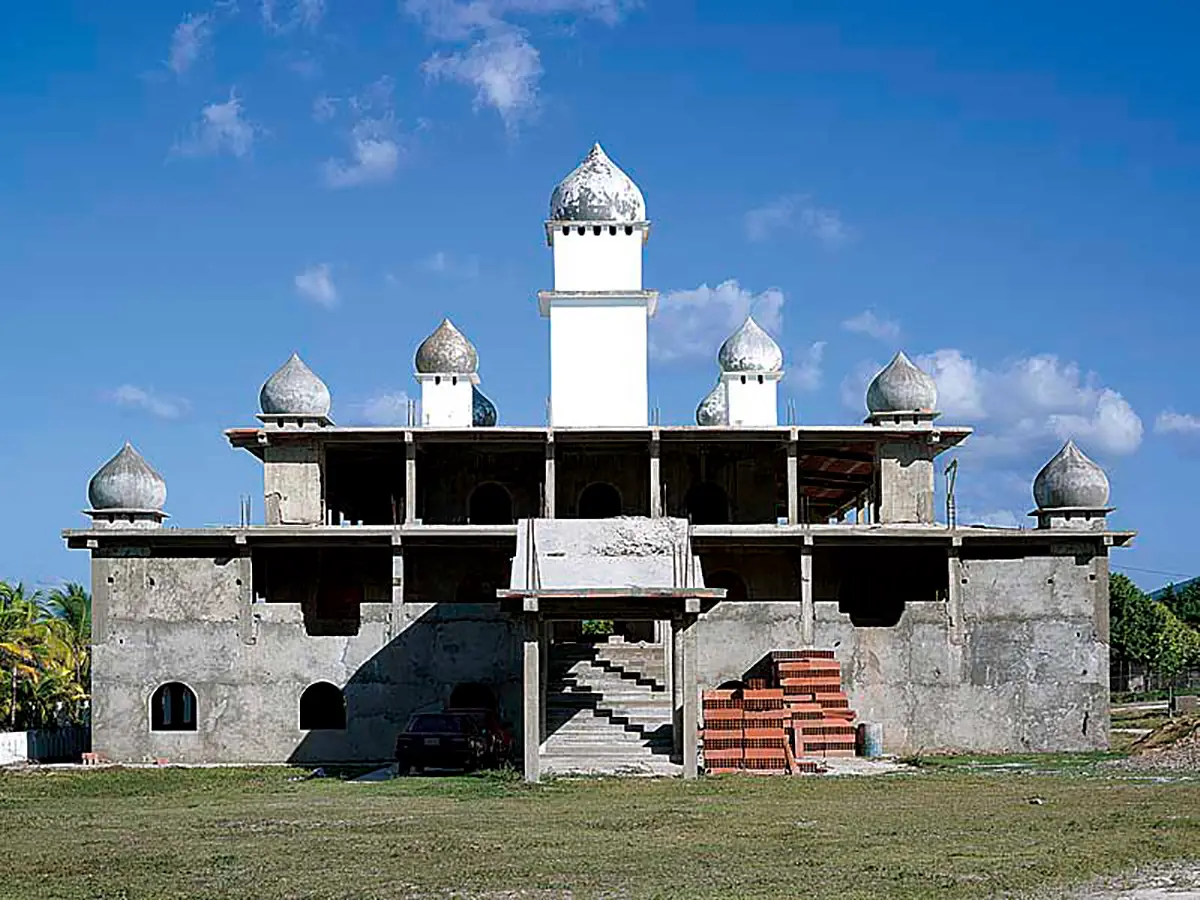
The seven images of Artificial Paradise show an odd amusement park called “Las Aguas de Moisés.” Located in eastern Venezuela, it is a part spa resort and part tourist resort that offers visitors the chance to take a dip into thermal waters. The panoramic views presented in Lee’s photographs, detail elements from the pastiche of an assortment of immense monuments that adorn the quasi-exotic, quasi-kitsch landscape of the park. These include dinosaurs, whales, polar bears, an Egyptian pharaoh, and the figure of Moses with the Ten Commandments in his hands. These elements create a symbolic environment that is undoubtedly a product of a foreign and Hollywood-like imaginary of the exotic and the paradisiacal: a strange insertion into this natural environment. Two other images demonstrate a partial imitation of the Taj Mahal and a line of spaces where visitors can stop with their cars, turn their audio systems on, and grill some food. Among the multiple cultural references that populate this park, the absence of landmarks stands out from the Venezuelan imaginary and the patriotic tone that is sometimes part of it. Is Lee perhaps suggesting here that such absence is actually the cause for the kitsch landscape and for the randomly combined cultural connotations that define the place? What is then the symbolic role of identity? The neo-objective composition of the images appears to leave viewers the option to consider the reactions these images may generate in them, without attempting to impose a defined authorial reading.
The rectangular exhibition room at El Anexo was bisected by a long MDF table on which two cotton papers were placed, showing a collage of images of the Boulevard de Sabana Grande in Caracas. These coiled on each of their ends, inside an ingenious device that allowed viewers to manipulate it so the photographic sequences could be moved backward or forward. The pictures were taken between 2007 and 2011, a time when this traditional commercial and social venue in Caracas was undergoing a serious transformation. For many years invaded by a dense informal trade market that took advantage of public policy errors in the management of the urban spaces in Caracas, the Boulevard went from being a drive-through area for leisure to becoming impossible to transit. When the eviction of the street vendors and the beginning of the ensuing rearrangement of the place began, Lee decided to capture a visual record that addresses the precarious urban conditions that characterized contemporary Caracas. The manner in which the images of the Boulevard overlapped suggests that Lee was not after the perfection or continuity of a single point of view—or even identity—but rather that she favored the recreation of a pedestrian route. This informal and provisional approach, clearly contrasted with the quasi-monumental images in Artificial Paradise, a work whose aesthetic production elevated the kitsch icons, of an “oasis” created with foreign referents, to the level of objects of profound contemplation.
The decision to combine these two seemingly unconnected works became a successful way of establishing in the exhibition a more complex dialog than the one that could have been created if the works had been shown separately. This juxtaposition generated friction that succeeded in suggesting questions about the two states that coexist in the Venezuelan reality; on one hand, society’s seclusion in self-indulgent places that promote compensatory realities; and, on the other, the crumbling and resignification of the existing symbolic capital; both instances symptomatic of the times Venezuela is going through.
LISA BLACKMORE