
The exhibition Photographs by Cuban-born artist Tomás Sánchez (Aguada de Pasajeros, 1948) at Jorge M. Sori Fine Art in Coral Gables is the presentation of a new phase of his work, seventeen large-format digital photos. This bucolic photographic essay is decantation of seven years of photographing the seacoast and a testimony to his relationship with nature in his adopted country, Costa Rica. The photos are renderings of the gorgeous coastal landscape, almost all from the Pacific Coast at Guanacaste province.
Sánchez has been internationally acclaimed for developing a significant body of work around realistic tropical landscape painting. These epic landscapes are reflections of his inner world, meticulous plans of his personal emotions, spiritual and philosophical concerns, and are done with outstanding technique; often seen by some as photorealism. Sánchez, who has used photography occasionally as a reference in his painting, is offering at this moment and for the first time his bona fide photographic gaze.
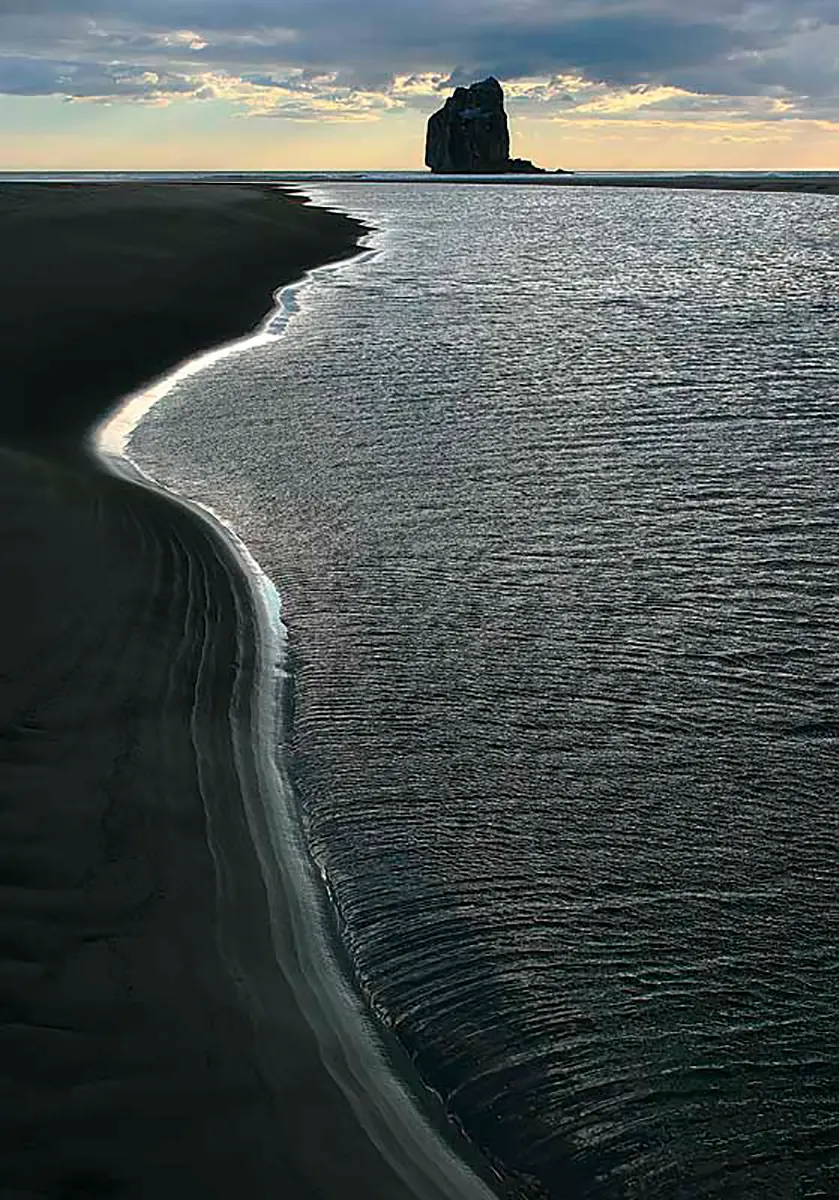
Photographs are for Tomás Sánchez an exploration of new territories, a new approach to the creative process. When he paints, Sánchez seems to own a personal definition of time, and the act of painting becomes a journey of self-immersion where the real-time and place in which the action happens is secondary and insignificant. In his case, painting grows to become an intense journey in which time is immobilized and created by his actions. His artworks are built as powerful statements of his state of mind. On the other hand, photography is an inverse process in which Sánchez goes after time, chasing it down in order to capture the right instant to be immortalized. He uses the camera to encapsulate the moment of an existing reality that reflects his vision.
In photographs like Roca bruja (Witch rock) and Drama, Sánchez explores monochromatic compositions with sea, land, and sky going from iridescent whites to intense shapes of gray, almost blacks. The natural elements turn into planes of color with texture and life. Meanwhile, in La mantra de las olas (Mantras of the waves) and Nube ligera al anochecer (Light cloud at dusk), he plays with a greenish and blue palette of colors that refers to those of the tropical forests often found in his paintings. Misterio de la isla y rocas (Mystery of the island and rocks) and Isla y rocas, luz y sombra (Island and rocks, light and shadow) are examples of the topographic elements that attract Sanchez as main pictorial subjects.
Tomás Sánchez, in his photos, is able to create impeccable compositions, well-structured and balanced, showing the eye of an experienced painter. He captures successfully and with imagination the teasing renditions of light and shadow over the seacoast, with the same painterly approach of his work of the late 1980s and early 1990s.
However, it feels that the ideas behind the photographic work of Sánchez are in need of more timely development and autonomous voice. The new medium in his body of work needs to speak by itself, and it is disappointing that these photos are so much like his painting. Perhaps Sánchez always has been a photographer who paints: never before have his aesthetic and interests come together as a unit in a better manner. But without a doubt, his uncanny photographic eye is more interestingly voiced as a painter.
Above all, several questions are hovering over this exhibition and Tomás Sánchez’s new creative paths. Is Sánchez tired of painting? Is his production overdone? How will collectors react to this new turn in his work? Only time would have answers for us.
RAFAEL DÍAZ CASAS