The relationship between art and science has gained significance at various times in history, like during the Twentieth Century, when several proposals from modern physics influenced artistic creation, particularly with the advent of avant-garde currents like constructivism and kinetic art. Today, ideas stemming from quantum physics do not cease to amaze humankind, as we have assimilated terms like wave-particle, dark matter, or black holes, and made them part of our everyday lexicon. At the dawn of the Twenty-First Century, we are already talking about a fourth culture, a new category that pretends to incorporate several types of wisdom—such as knowledge and sensibility and reason and intuition—in order to enable productive dialogs between scientists and humanists.
These considerations were taken into account in the exhibition titled Zero Point by Ana María Olalde, presented at the Centro de Artes Integradas, from November 13, 2011, to January 22, 2012. Divided in four central chapters, the exhibition included a group of 17 works created during the last ten years. Since 1975, Olalde has been a mathematician, a teacher, and a visual artist. This has allowed her to make inquiries on scientific proposals that offer fertile ground for the imagination. The exhibition included the work titled Redes (Nets, 2000), a series of weaves or warps that suggest symbols and signs interwoven in a subtle and harmonious manner. During that time, she also began to explore the concepts presented in the Chaos Theory and to create the series Fractales (Fractals, 2005-2006), a theme based on the concepts behind fractal geometry, a model that defines the complicated behaviors occurring in nature—a fractional, recursive, and repetitive realm. Olalde established a correspondence with these principles, as she ordered her compositions from an original matrix that fragments and multiplies itself on the format. Part of the series titled Linear Fractals, the diptych Fractales Blanco y Negro (Black and White Fractals, 2003) shows straight lines arranged to form “H” letters that are linked to each other and ordered in larger to smaller succession and vice versa. On the other hand, in the works from the series Organic Fractals, like Fractal Negro (Black Fractal, 2002), the white lines over the black background are broken and turned into branches to form curvatures that simulate rounder forms. This process led Olalde to manage the space through a more constructive approach that allowed her to design a simple linear diagram distributed in a modular manner—as it can be observed in Entre Líneas (Between Lines, 2005-2008). Here the composition is sectioned in strips, due to the inclusion of verticals and horizontals that segment the plane into differentiated blocks arranged according to color and the space between the lines. An approach that contributes to the assembly-like look images that could, hypothetically, be dismantled and put together again, just as in Entrelíneas No 3 (Between Lines #3) and Entrelíneas No 6 (Between Lines #6), both from 2007. On later works, these divisions began to fragment and reproduce to form small sectors that occupied the entire square. This was the beginning of Entramados (Frameworks), a series that is smaller in size and that was created between 2008 and 2011. Here, lines and colors are intertwined and juxtaposed to achieve tonal alternations arranged in parallel or perpendicular sequences. One example is the work Entramados No 1 and No 2 (Frameworks #1 and #2).
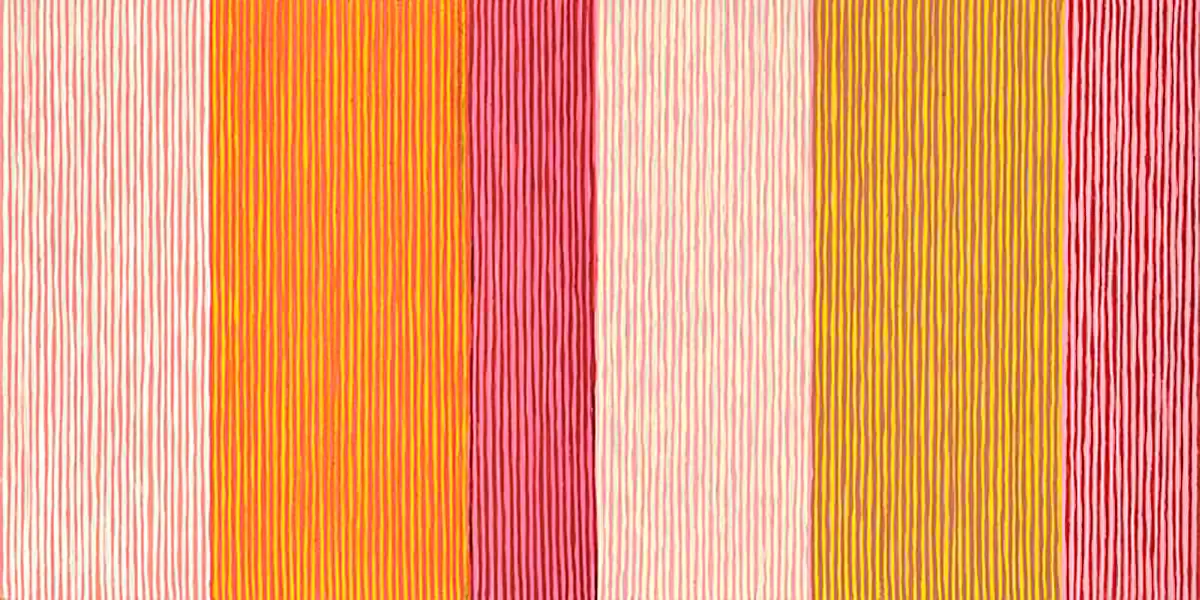
Beyond these explorations, the author delves into another concept of physics known as Zero-Point Field. Understood as zero-point energy or vacuum energy, it is considered the most basic or elemental level of a system. Based on this idea, in 2009 Olalde created the series Zero Point, in which line and color were reduced to their minimal expression to take the form of a continuous progression of vertical parallels that imaginarily expand beyond the two-dimensional surface; where the background is divided into light and dark areas of an ample chromatic range. This is the case of the works titled Zero Point N-A-F and Zero Point B-R-A, both from 2011. These paintings reveal a rigorous geometric approach that contrasts the handmade drawings and underscores the flow of irregular strokes. The combination of rational and emotional elements confers the work an imprecise quality, a handcrafted look that links these proposals to the so-called Sensitive Geometry. About this, the curator of the exhibition, Susana Benko, wrote the following in the exhibition catalog: “Throughout her artistic trajectory Ana María Olalde has been able to reconcile two seemingly opposing fields: science and art; in other words, reason, and intuition. Olalde transcends the formal aspect of the work the moment she creatively assumes the same dynamic and generative processes that are generated in nature. To thoroughly understand these processes—as a mathematician and as an artist—enables her to take her work into a new dimension where abstraction acquires new meaning…”
GLADYS YUNES-YUNES