
Among the paintings that define the history/reality of Puerto Rico are Damas a Caballo, representing Puerto Rico’s small oligarchy (Eighteenth Century), and El Niño Avilés (1808), by José Campeche (1751-1809), an armless child that foreshadowed the country’s political situation as a Spanish colony and later, from 1898 to the present day, a US protectorate). El pan nuestro (1905), by Ramón Frade (1875-1954), a malnourished peasant carrying a bunch of green plantains, representing the overwhelming poverty found in the smaller of the Lesser Antilles; Goyita (1957), by Rafael Tufiño (1922-2010), depicting the artist’s mother, an impoverished but strong, ethical, combative, future-oriented woman; Francisco Rondón’s (1934- ) portrait of Luis Muñoz Marín, from the 1970s, showing “the Father” of the Commonwealth (or the “legalized” colony of 1952) at the end of his life, tired, defeated, frustrated, disappointed; Transculturación (1975), by Carlos Irizarry (1938- ), a magnificent dialog with Frade’s El Pan Nuestro that presents the Puerto Rican subject immersed in a deadly culture clash; Hay que sonar azul (or, Blue Eyes) (1986), by Arnaldo Roche Rabell (1956- ), a self-portrait where the afro-Puerto Rican artist paints himself mulatto, his face “filled by brushstrokes resembling thorns,” but blue-eyed, demonstrating among other things his highly intelligent racial, cultural, religious, and sexual confusion. Nevertheless, the iconic and most significant painting in the history of Puerto Rican art remains, undoubtedly, El Velorio, by Francisco Oller y Cesteros (1833-1917), on exhibit at the Museo de la Universidad de Puerto Rico-Río Piedras. This is because, unlike societies possessing a great epic tale—the Iliad, La Chanson de Roland, Mio Cid, Martín Fierro, the Araucana—Puerto Rico still lacks a national epic, the closest thing being René Marqués’ play La carreta and, of course, Oller’s El Velorio.
El velorio is a monumental work (96” x 156.6”) depicting the wake of a newborn, a traditional gathering where tears were shed but people also celebrated the fact that the family now had a little angel in heaven. It was a pretext for peasants and other social groups to get together. Here, Oller captures the gazes and attitudes of a broad mosaic of people: from the parents to an old ex-slave, close to his own demise, for whom death has a deeper meaning. It is a well-orchestrated attitude/approach towards death and poverty in Puerto Rico: people talk, drink, cry, try to ignore death, etc. Because of this richness, El Velorio has been used by several prominent artists in works that pay tribute and dialog intelligently with its scene. The most important are the tributes/dialogs created by printmaker José Alicea, Carmelo Sobrino, Elizam Escobar with his Velorio before the US Supreme Court Justices, Martorell with a series of drawings and mixed-media works presented at the Museo de Arte de Puerto Rico, and, obviously, Rafael Trelles’ extraordinary, provocative installation Vista al velorio (Homenaje a Francisco Oller), from 1991 and now in the MAPR permanent collection, a work of art that interests all kinds of audiences as Trelles replaces many of the elements in the original painting with contemporary items: a TV set, soda cans, rum bottles, “windows” to Puerto Rico’s banks.
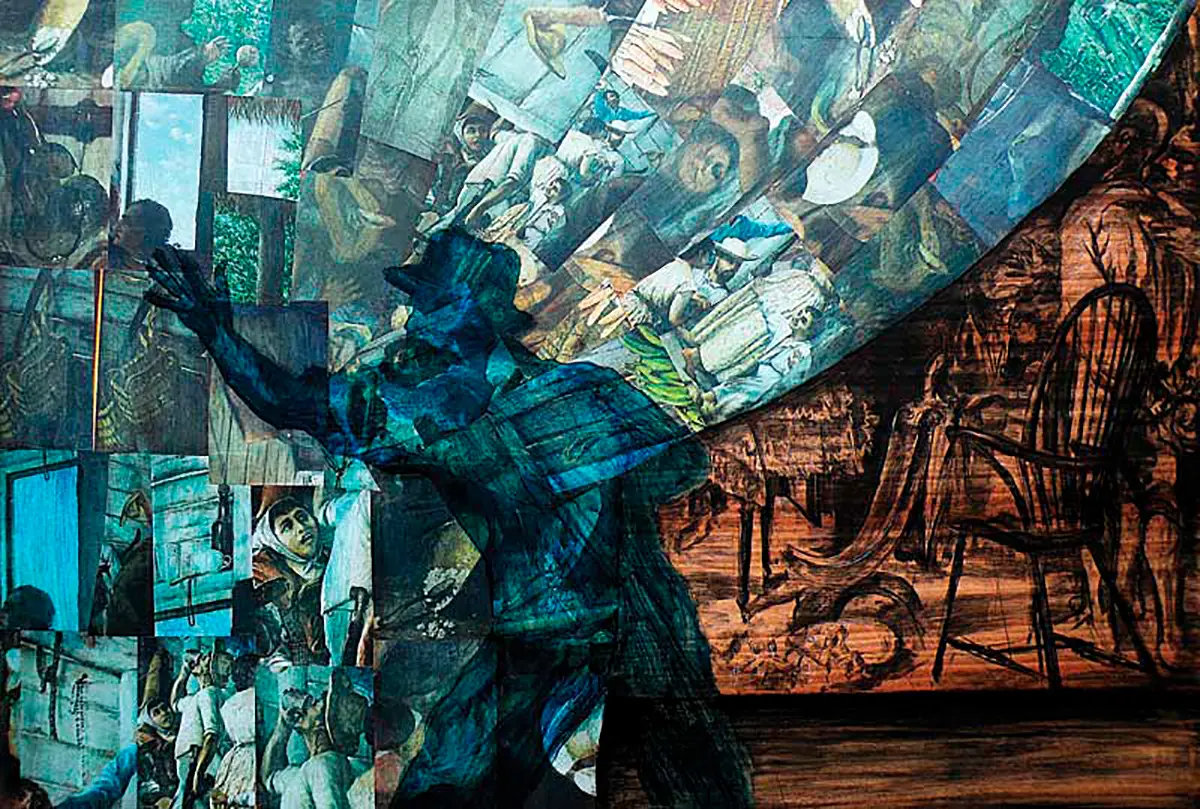
Antonio Martorell (1939- ), a masterful printmaker, draftsman, installation artist (to this critic, the best installation ever created in Puerto Rico is La Guagua Aérea, from the late 1990s), performance artist, uneven painter, and the cultural conscience of the left in Puerto Rico, has also wanted, in the face of the terrible situation of crime and demoralization in his beloved country, to pay homage and dialog with El Velorio.
Like all Martorell exhibitions, El Velorio Ahora is very well thought out, executed, and presented, and as always it is a political and existential experience (the artist dedicates it to the controversial terrorist/patriot Filiberto Ojeda, killed by the FBI on September 23rd—the day of the Grito de Lares, landmark of Puerto Rican independence—four years ago.)
There are excellent works that indeed interact intelligently with Oller’s original, such as El negro Pablo, where the eponymous character confronts death in his advanced age in a very different manner, and El Angelito. Yet in this exhibition, Martorell is not only paying tribute to and dialoguing with Oller, but with all we have suffered for centuries: he is in dialog with death—political or otherwise—throughout Puerto Rican history, and in particular with the more than 1000 homicide victims in the country in 2011 (in El muerto parao). Present here are unknown “patriots” and the terror of the Puerto Rican people (El Velorio en la Ciudad).
But even more interesting and revealing is the fact that this exhibition is a dialog with Martorell himself: his career, his resources as a printmaker and draftsman, his preferred topics. Even the portraits he makes of Oller can be read as self-portraits. Like any Martorell show, this one, presented in collaboration with many artists, apprentices, and believers in the cause of a better Puerto Rico, is a valid, thought-provoking experience. The intelligent fragmentation of Oller’s with the elements incorporated by Martorell unveils the grief we are suffering through today.
MANUEL ÁLVAREZ LEZAMA