
The excellent display of Rodriguez Caballero’s work at Marlborough Gallery in Chelsea offered a selection of aluminum pieces with painted enamel, in which light is as much a color/component as the metal or the paint. It is actually this agent of constant change that makes the pieces so arresting in the impact: Because of the way the light plays with the metal and the contrast with the enameled and colored surfaces one can never be sure to see the same piece in the same way twice. This is all more understandable when we discover that prior to applying the folding techniques to his pieces, the artist had considered the sanding process of the surfaces as his manner of painting, that his work originates from training in painting and that he himself considered his pieces as incorporating painterly aspects, and as integrating/combining painting with sculpture.
Another remarkable evidence in the provenance of ideas that inform his work is the strong influence and presence of a Japanese aesthetic. Though he himself has not traveled there, his appreciation of Japanese art, and particularly its literature, informs his works. These pieces, particularly the monochrome silver wall reliefs, exude the simplicity of Zen temples’ architecture and the frugality of décor that we see in Japanese swords, to quote from a metal source, though in form and modeling the pieces also have a strong connection to Origami, the Japanese art of folding paper, which in this case applies to the turnings and positioning of the metal surfaces. The influence of this technique appears in his work from 2008 when he was compelled to incorporate into his work the forms of the kites that children fly at the beach in Valencia where he was staying at the time. This is more evident in the artist’s drawings which though very compelling as works on paper, were not exhibited, but are the best source for understanding his constructions. Having seen the drawings at his studio, it was much easier to comprehend the finished pieces, the reflection, and the process that goes on behind the scenes before it morphs into a metal piece.
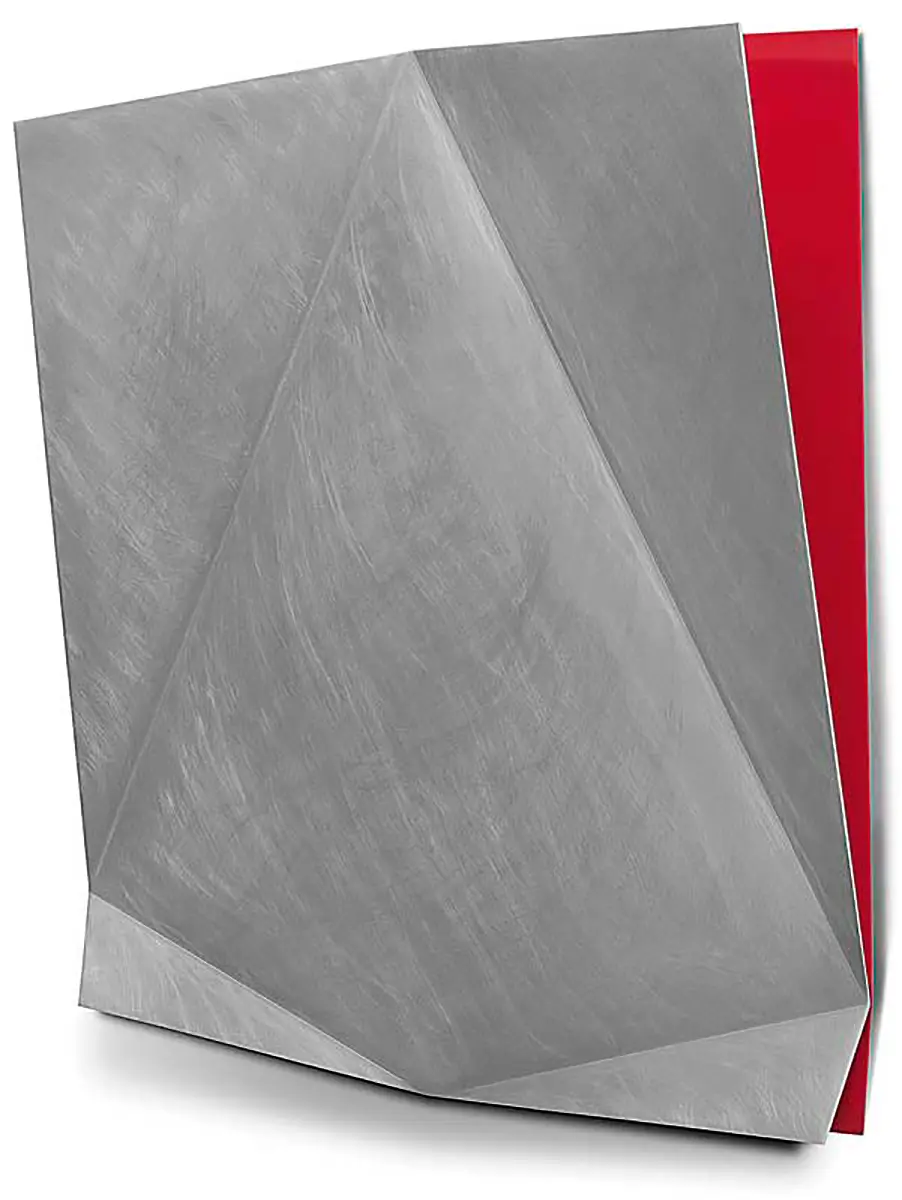
Needless to say, there are also strong references to the abstractions of the Minimalist School and further back in time to the very beginning of abstraction as it appeared before the First World War in the works of Mondrian in the West and Malevich and the Suprematists in Russia. The simplifications of all forms to color fields that these artists introduced while opening the doors into abstraction are very much a part of this artist’s vocabulary, yet adapted within the parameters of contemporaneity, to new interpretations.
The choice of pale colors, for example, contrasted with the starkness of the metal is a constant source of dynamic play between surface/contrast, starkness/color, which aided by the play of light adds a new dimension to these abstract re-interpretations.
More importantly, is the case for ambiguity that these pieces present. Neither paintings nor sculptures, reliefs nor engravings, stand in a separate zone of aesthetic appreciation where the very definition of the work is challenged. It is in these areas of boundaries where so much of the excitement of contemporary art takes place, re-defining the roles of ornamentation/architecture, painting/sculpture which is one of the most salient characteristics of Rodriguez Caballero’s work and also what makes him an interesting artist to watch.
A catalog of his exhibition at the Fundación María Forcada in Tudela from 2010 documents in detail the process of making the pieces. We see the artist involved at every stage of development, working the metal into the shapes, elaborating the details of the folds, and applying the finishes that make the surfaces respond to light in his unique signature style. There is a feeling of satisfaction as an observer in seeing the ideas that were sketched in the drawings of the studio taking shape one step at a time, as well as in appreciating the process of the artist as a maker, who physically transforms the materials into his finished works. It comes as a relief to see the process particularly at a time when we have been inundated by conceptual material for so long; it is an additional and much appreciated refreshing progression.
ALBERTO BARRAL