
On November 14 of 2011, the exhibition titled The Necessary Instability by artist Érika Ordosgoitti was inaugurated at the Galería Universitaria de Arte of the Universidad Central in Venezuela (UCV). Since 2009 Ordosgoitti has stood out as a singular performance artist with a powerful presence.
Ordosgoitti was born in Caracas in 1980. She completed a BA in Visual Arts—with a specialization in Mix Media—from the Universidad Nacional Experimental de Artes Plásticas (UNEARTE) in Caracas. Today, she is completing an MA in Visual Arts from the Universidad Pedagógica Experimental Libertador, also in Caracas. The beginning of her artistic career was characterized by private actions and self-videos—centered on highly intense and introspective themes—that little by little turned into urban interventions and actions that led to the themes her performances are based on today: the nude female figure and its revulsive power, the crude city as an environment that contains, conforms, and signifies; the excrescency that reminds us who we are and that reveals the social masks we put on; as well as the notions of abyss and imbalance as places from which to originate a genuine existence.
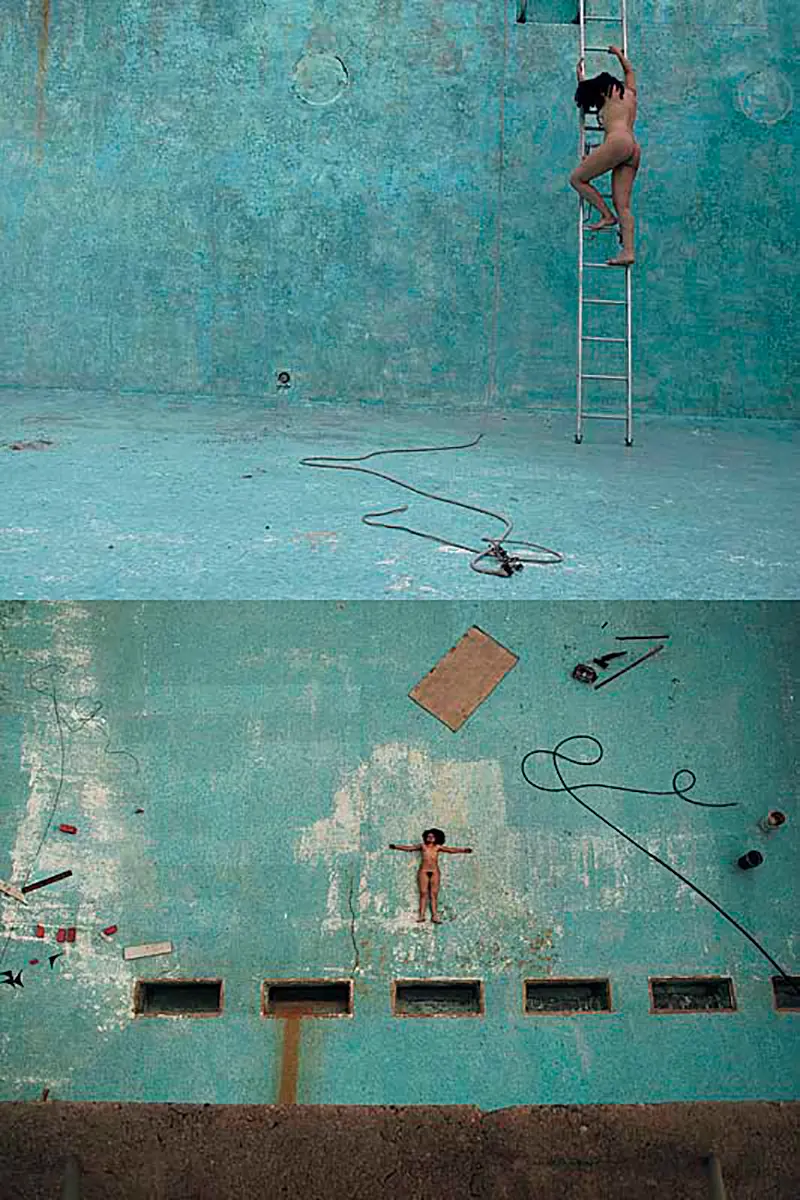
The exhibition The Necessary Instability received one of the recognitions Ordosgoitti was awarded in 2010 when she won at the Salón Nacional Universitario. Impeccably curated by Nancy Urosa—who for some time now has been documenting with photographs the actions by Ordosgoitti—the exhibition included twelve diptych photographs that, like a calendar, registered the actions performed by Ordosgoitti inside the university campus.
Each diptych corresponded to a month of the year. They depicted interventions by the artist with her naked body—already a clear symbol of her work—the beautiful architectural spaces in the Ciudad Universitaria in Caracas—named World Heritage Site—and actions that involved the members of the university community and that, as usual, paved the way for a dynamic of reactions that confirm the close connection between Ordosgoitti’s work and life, the city, and the communities in which her work develops.
The titles Ordosgoitti gives to her works underscore not solely the libertarian commitment behind her proposals, but also the deeply poetic substratum and ferocious emotion that impregnate her work and her artistic conceptions.
Pieces like Repetir Hasta la Muerte una Idea Instalada en Nuestro Cerebro por Fuerzas Exteriores a Nosotros Nos Parece Miserable e Inmoral (To Repeat to Death an Idea Placed in Our Brain by External Forces Seems Miserable and Immoral to Us), Ordosgoitti contrasts two photographs in which she appears climbing a window fence of a university building. The formal force of the spaces rendered by the university’s modern architecture contributes to create a counterpoint of the senses when set against the image of the artist who could fall at any moment. It is like a confrontation between Apollonian and Dionysian forces, rational arguments versus instinct and imbalance in a struggle to win the debate. The inquisitive and daring gaze by the artist underscores these characteristics.
In La Vida Parece Ser una Sucesión de Imágenes Insólitas (Life Appears to Be a Succession of Unusual Images), Ordosgoitti juxtaposes two photographs where she appears lying down on the roof of the famous building that houses the library of the Engineering Department—its façade was created by Venezuelan artist Alejandro Otero—of the UCV. Once again the association between the straight lines from the mural, its flat colors, and the very modernist obsession with forms of equilibrium, serve to claim the internal and external nudity of this artist, who attempts to bend her body in the “U” shape of the arch at the top of the building.
The piece ¿Cómo Podría Transgredir sin Transgredirme? (How Could I Transgress without Transgressing Myself?) consists of two photographs: one of them shows Érika lying down on the roof of the covered corridor at the campus’ northern entrance. The other picture shows her firmly standing inside the concrete spiral that shapes the pedestal of the university clock, a symbol of this institution of higher learning. We once again sense the imbalance of a human figure that can hardly find rest on the concave concrete. Nonetheless, she upholds her affirmation of unconditional freedom that is always contravening, risking, living in instability as a trance that is necessary for existing and creating; elements that intertwine in Ordosgoitti’s work, in order to deliberately evade the limits imposed by the status quo of the arts.
La Inestabilidad Necesaria is without a doubt a sui generis exhibition within the artistic production by Érika Ordosgoitti. The beautiful university surroundings with its formalist emphasis make it impossible for us to observe the images without being seduced by the aesthetic elements: certainly, the contrasts between the cold geometric rhythms and the artist’s nude figure encourages such an approach. The nudity of the body and the nudity of art appear in these works to reveal Ordosgoitti’s purpose; in her own words: “My commitment in life is freedom.”
KATHERINE CHACÓN