It has been conjectured that to create new art, one must create a new space. Iran do Espirito Santo has done both in his latest show at Sean Kelly Gallery. As the artist gives form to light, the space created is theoretical, illusory, and representational.
Continuing a personal aesthetic trajectory of Minimalist, ethereal purity, the Brazilian artist brings past enterprises into play. When younger, he worked at a photography lab and the endless gradations in test strips have been repurposed. The title of the show, Switch is also the title of a pair of subtly shaded wall paintings.
The two paintings are at right angles to each other. One is a progression of apparently receding frames. Each of the 54 meticulously painted squares is slightly darker than its predecessor. The result is a dark, concave negative space, at once inviting and foreboding.
Identically constructed, the opposite work is composed of increasingly whiter squares. Here, the center bulges up in rising terraces. The manipulation of space is palpable and emotionally magnetic. The appearance of depth and height, while “visible”, remains ambiguous and mysterious.
The two paintings exist in a sort of symbiotic suspension. The artist has found a way to propose a dynamic of contradiction whereby one painting follows the other.
The push/pull the two components exert on each other is perceived eventually as a cyclic phenomenon, like a revolving door. This interruption of stasis belies the meditative tranquility accompanying the initial encounter.
Entering a second gallery, a mood of meditation continues. Suffused in cool, puffy light, 14 “Globes” perched on a shelf. Quoting actual light fixtures that the artist has collected from around the world, these globes are carved in white Slovenian marble.
Here again, the artist contemplates contradictory equations. First of all, the original, utilitarian models were made to emanate light. These new, functionless objects merely reflect light. They emanate mass and its invert, the “idea” of light, in auratic flair.
Further, the contrast in materials — of the ideal and the realized — calls into question our ability to critically discern. An unnerving sense of corollary values vibrates between what is presented and what is represented.
Perfection aligns with simplicity. The archetypal elegance of the forms along with their industrial style generates an assuring, but the false sensation of glowing. Funereal disembodiment tinges the jeweled atmosphere. In their new, highly metaphoric renditions, the varying globes resemble urns full of empty time as well as relics possessing alchemical awareness.
More playfully, the overhead lights reflected in the snowy globes glint like tiny eyes. Moving across the room, the pinpoints follow you, animating the marble and bringing impish personality to each sculpture.
The third gallery offered a vertiginous experience. Here, three sculptures of semi-reflective glass proposed an endless geometry of shapes, shades, and phantom spaces.
Expressing an ongoing affinity for architectural elements, Epirito Santo used glass construction material. The material is made for high-rises and while reflective, it is made in such a way as to be semi-transparent.
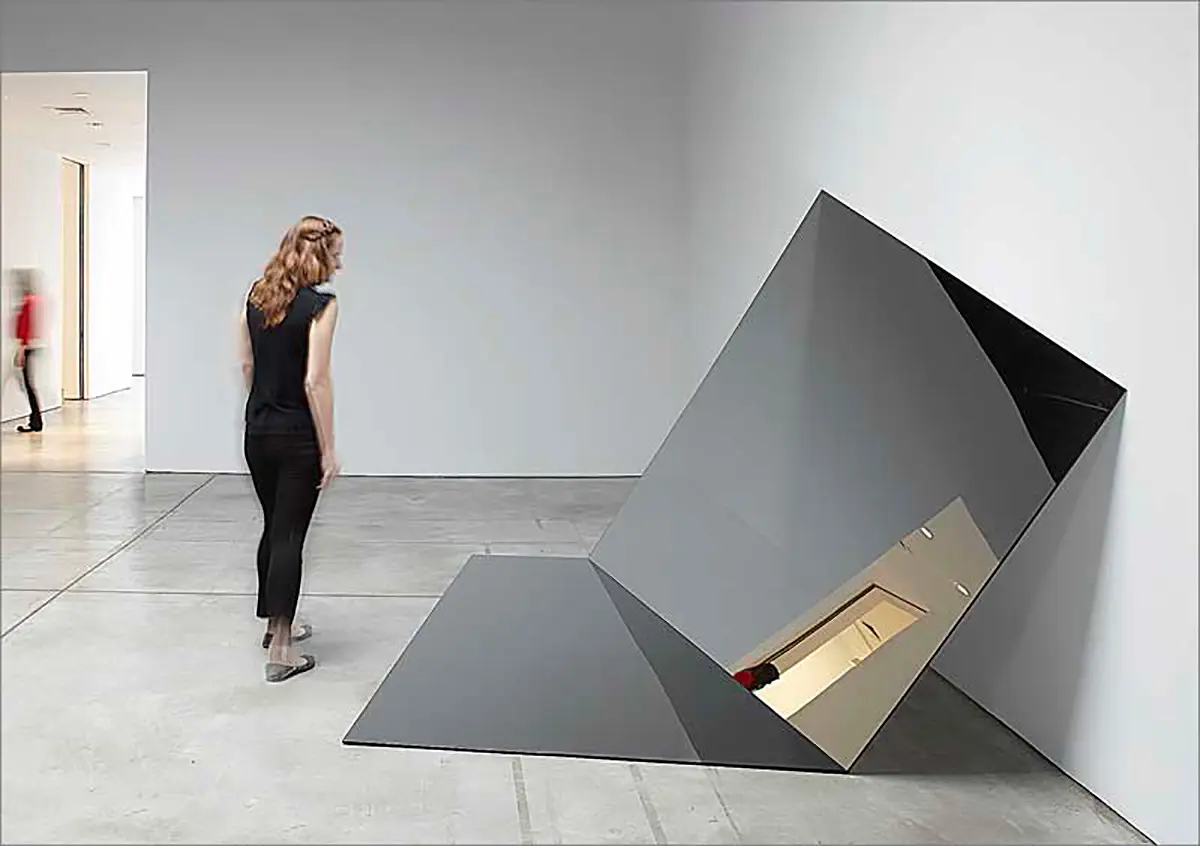
Slabs of precision-cut, angled glass leaned against the walls, anchored by complementary pieces abutting them on the floor. The provocative balancing act attested to the artist’s passionate attachment to material and craft.
Acting as mirrors, the three sculptures formed a network of energy, charging the room. Arranged in a semi-circle like bases on a baseball diamond or the crosses in Calvary, each piece was composed of two planes that met. At the intersection, it appeared the glass folded.
These intersections caused a locus of refractory and fragmented images to appear on the surfaces of the glass planes. Looking down into one of the floor pieces, the ceiling became the floor. An indeterminate depth opened queasily below you.
From another angle, you seemed to stand on the wall. Crossing the room while focusing on the sideways image of yourself caused dizziness. Disorientation and reorientation questioned assumptions about equilibrium, symmetry, direction, and comprehensiveness.
The empty white walls of the gallery tempered the funhouse atmosphere, adding layers of punchy abstraction. The old wooden ceiling, a survivor of a former age, added a warm, folksy vibe to the reflections. Nooks and crannies beckoned from among the joists and joints, timbers, and stained planks.
The light that poured through twin skylights was unpredictable and on occasion dramatic. The glass could get dark suddenly as clouds covered the sun. This endless texture amplified the myriad mirrored vignettes.
The odd angles and shapes of the glass resonated. One could see the sloping lip of a coffin or the protruding fin of a great sea creature. The artist conjured solid, liquid, and gaseous in receding space.
The three sculptures were vessels. They could take us away. They were monuments as well to our fleeting transitions. Espirito Santo’s unique quest is to discover substance within the insubstantial and reveal depth on the surface.
JEFFERY CYPHERS WRIGHT