
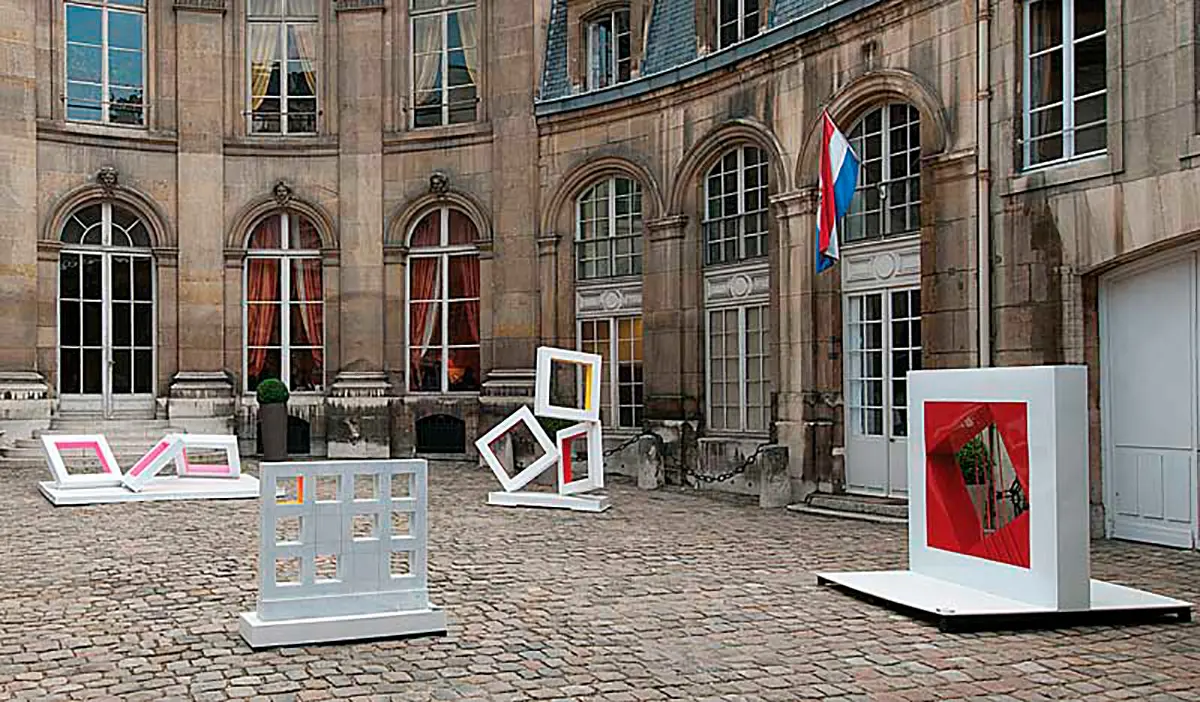
Brazilian artist Jaildo Marinho presents The Oblique Vacuum , an exhibition inaugurated at the Cour Ovale de La Maison de l’Amérique Latine in Paris. This magnificent solo show includes 7 monumental sculptures and several paintings that constitute a magnificent example of Marinho’s most recent work. But most importantly, they offer the opportunity to assess the current state of Latin American art inside and outside its borders.
Jaildo Marinho was born in Pernambuco—in Northeast Brazil. In 1993 he moved to Paris where he befriended a large number of Latin American artists who, like him, traveled the same intercontinental route—including several back and forths—some decades before, to contribute the incredibly rich modern narratives they brought from the other side of the ocean.
More than ever, the importance of this dialog centered on geometry and abstraction—on the artistic interaction between Latin America and Europe—today represents a solid excuse to propose genealogies of new modern art that leave behind the canonical and unilateral interpretations of the art from the last century. A contemporary artist like Jaildo Marinho exemplifies the reinvigorating nature of these intercontinental proposals and the manner in which they have been exponentially projected.
In Paris, Marinho met Uruguayan artist Carmelo Arden-Quin (1913-2010), cofounder of the MADÍ group (Buenos Aires, 1946), which the Brazilian joined in 1999. This connection will become very important to Marinho, as he will concentrate a great part of his inquiries on the compositional current of abstraction contained in the MADÍ principles—which propose art that is “cold, cerebral, and dialectic.”
Jaildo relies on the universal language of geometrical abstraction to perfect and free its constitutive elements from any representation. The sculptures and paintings included in this exhibition answer to an arrangement of dynamic and ludic forms, lines, and subtle color profiles that have been given a geometrical and concrete treatment.
To cut and drill the monumental sections of marble that Marinho selected, the pieces were subjected to several industrial processes. The artist broadened the rational dimensions of his visual proposal and conferred the same organic attribute sought by the Neo-Concrete Movement.
It is precisely this point of reflection of Marinho’s sculptural proposal, given that, in spite of being created with material as cold and heavy as marble, these colossal stones put equilibrium to the ultimate test as they regenerate as if we were about to witness their movement over their own axes or the rotation of one of their parts.
The Museo Nacional Centro de Arte Reina Sofía in Madrid recently held the symposium Rethinking Latin American Modernisms: Flows and Overflowings. Speaking about the beginnings of Modern Art in Latin America, the event underscored the urgent need conveyed by some Latin American artists of conferring their proposals—still historically trapped under the rigorous precepts of Geometric Abstraction—a life of their own so they can pursue independent paths.
Brazilian artist Lygia Clark conferred a dose of life to Planes in Modulated Surface series until, in 1959, she transformed them in the series Creatures and Cocoons, in which she definitely frees her work from the two-dimensional support, and let it colonize the museum space. This liberating and organic intention generates tension as it overflows the compositional plane; something that can be sensed in Metaesquemas (Metasketches, 1957) by Brazilian artist Hélio Oiticica; which could share something in common with some earlier work by, for instance, Theo Van Doesbourg, who energizes the plane through the serial movement, dislocation and repetition of its geometric forms.
In this sense, the two-dimensional proposals by Marinho experience all kinds of movements, cuts, and dislocations. The artist has sectioned certain geometric forms in his compositions, to underscore openings and empty angles with the objective of gradually appropriating the space to ultimately let the work break it, by dissecting it in an oblique and diagonal manner.
Questioning the static, permanent, material, and contradicting work of art has been the central objective of art for more than a century. Piet Mondrian demonstrated it in 1919 when he inverted the rectangular position of the frame and presented it as a diamond; Uruguayan Rhod Rothfuss, the founding member of the MADÍ group, did the same when he broke the orthodox frame; and so did Carmelo Arden-Quin with his Coplanals (1946), geometric surfaces united by an articulated structure.
All these gestures are nourishment for Marinho, who gives these attempts from the past a particular continuity, as he is able to confer his work a certain organic and vital potential, and even presents pieces that are, paradoxically, light in spite of their solidity. His structures and paintings serve as objects for experimentation. It is possible to enter into an endless conversation with them, as the compositional elements are alternated, perforated, arbitrarily illuminated with fluoride color. This can be observed in Novo Limão or in Branco-Vermelho, works that appear to lack gravity and their bloated openings play with the notion of the vacuum.
I think that Jaildo Marinho’s most contemporary attitude resides in his commitment to making the apparent immateriality of the space perceptible, turning the idea of the vacuum into a reality, through compelling marmoreal metaphors conceived to be presented in open spaces in order to generate experiences for the public.
Jaildo does so in The Oblique Vacuum, an exhibition that destroys this void in a subversive manner, through enormous stone sculptures that resemble cemetery tombstones and that are ludic monuments to the vacuum.
ELISA RODRÍGUEZ CAMPO