Born in Seville, Spain, but raised in Puerto Rico, José Lerma is one of the most prestigious and relevant artists of his generation. It is interesting that, although a distinguished professor for many years already at the Art Institute of Chicago—also a Visiting Scholar in several other higher learning institutions in the US and Puerto Rico—Lerma has achieved the success he now enjoys because of two existential decisions he made. Already in his second year as a law student at the University of Wisconsin at Madison, Lerma decides to abandon the legal career and refocus his passion for the visual arts. What began in a small elementary Puerto Rican school that emphasized the visual arts—where he studied with two of the most important artists in Puerto Rico, Chemi Rosado-Seijo, on the one hand, and Guillermo Calzadilla from the collective Allora & Calzadilla on the other—soon became Lerma’s present and future. The other decision occurred ten years ago after he had solidified his position as a prominent conceptual artist when he made the very difficult but necessary decision of abandoning (or using it in combination with other elements) conceptual art to embrace painting with a daring and controversial gaze.
We must remember that this occurred when conceptual art and other new media were already established and had begun to “displace” painting as the central creative approach among young emerging artists. Nonetheless, in that phase of his career, Lerma chooses to experiment with extremely daring avant-garde techniques. He utilized many of the resources implemented by the abstract artists from the New York School, and eventually combines them with elements of figuration, in order to convey an emotional life that is not solely his but one that is shared by many of the people around him: namely, according to the artist, the desperation and pathos we experience.
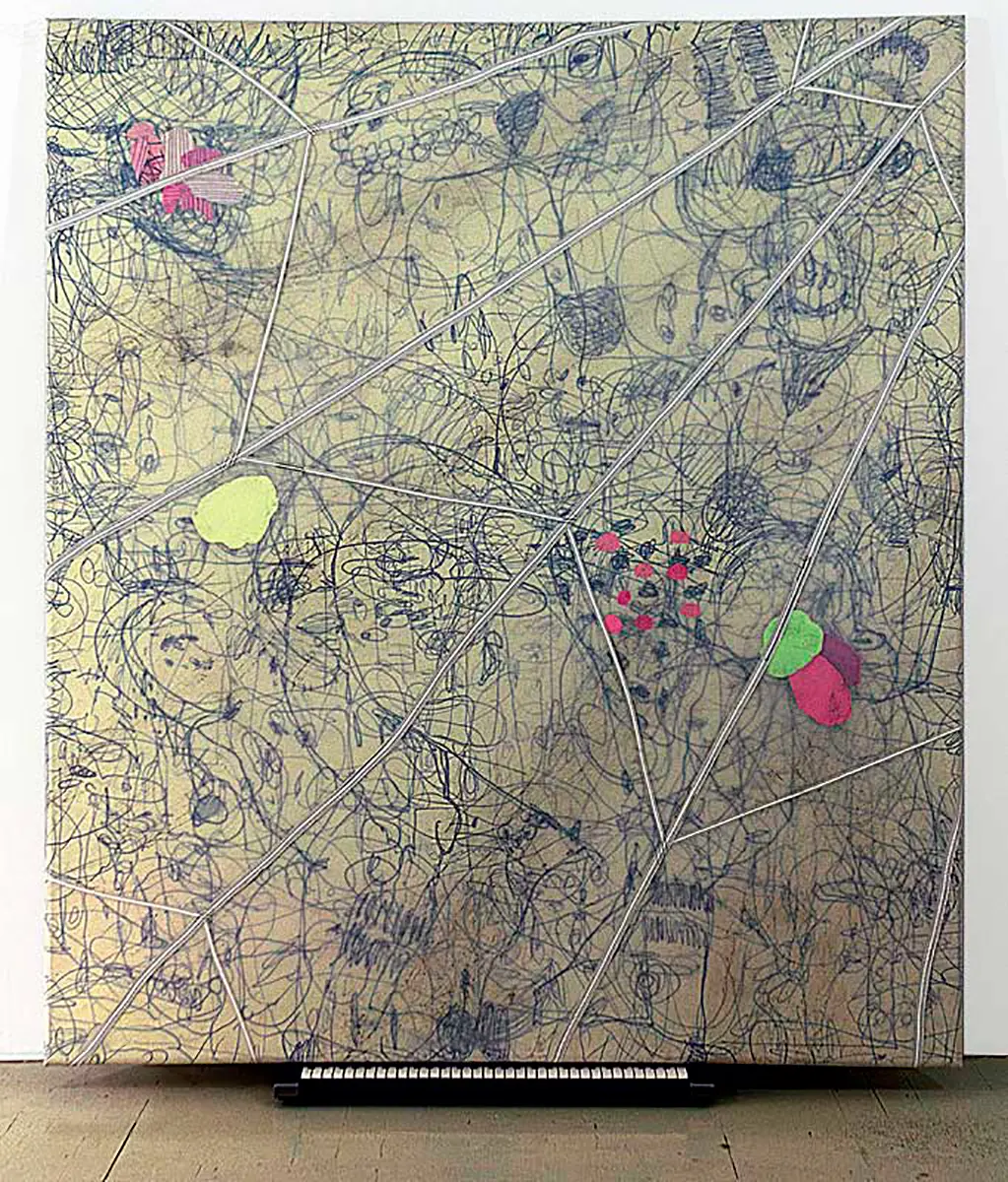
Within his visual discourse, we can observe the generous amounts of paint he uses, the manner in which he renders it, the expression of his strokes, and the shapes: imperfect essences that draw us closer to a certain kind of reality. What is Lerma trying to capture and share with the public? Is it sadness, tragedy, or the human pathos—a society full of injustices, falls, fake values—that does not allow us to fully celebrate life?
From the start, Lerma’s painting—the events and sceneries in it, his family, those close to him, every day—present a rereading and a conversation centered on art in general after Impressionism, Picasso, Duchamp, Figurative Expressionism, Warhol, and New Figuration. Both in Puerto Rico and the US, Lerma exerted great influence in some prominent disciples of his who were impacted by his discourse, among these: Fernando Pintado, Roberto Márquez, and JUNI Figueroa.
This exhibition entitled Jibaro Jizz at the attractive Roberto Paradise Gallery is Lerma’s first solo exhibition in Puerto Rico alongside Tito Rivira. Here Lerma, who is also a musician, names the exhibition after an album by Pedro Guzmán entitled Jibaro Jazz. Every work is mounted on an artifact that produces a specific type of music. The works on their own can be interpreted as harshly critical and ludic; a “trivialization” of an often pathetic, degenerate, and absurd past, represented by characters of questionable reputation or, as Lerma puts it: “truly pathetic.” His referents are characters like Charles II of Spain (The Hexed), Charles II of England, John Locke, Samuel Bernard, etc. They are constructed like enormous doodles created with that which would appear to be a blue ballpoint pen. These images were actually rendered with regulated airbrushes. Then Lerma covers them—through a highly sensual aesthetic process that is also very cold—with translucent fabrics taken from used parachutes—a visual effect that forces us to indulge in some kind of intellectual/historic/sexual voyeurism of sorts, in order to find out exactly what is going on in this enormous, epic, and very well-conceived doodle with small and large “anecdotes.” It appears that Lerma is paying homage to Steve Jobs, who once told a class of graduating students at Stanford University: “Stay hungry, stay foolish.”
Lerma challenges the public to discover and learn the presences—faces and figures—of important figures afflicted by complex, sad, hated evil, and yes, pathetic personal lives. To do so, the artist studies to the last detail each of his “models.” In this singular exhibition we observe them accompanied by music, we see them naked or almost naked; the way we arrive into this world and leave it.
MANUEL ÁLVAREZ LEZAMA