During the months of September and December of 2011, the Galería Vasari presented an exhibition by Kazuya Sakai (Buenos Aires, 1927 – Dallas, 2011), an Argentine artist of Japanese descent. The selection of works exhibited centered on the period between 1972 and 1979 of Sakai’s artistic career. Thus, it dealt with works created mostly in Mexico City, where the artist lived from 1965 to 1977; a city he remained closely connected to in spite of moving to Texas in 1977.
Aside from the look centered on Sakai’s artistic production associated with the different periods and places he lived in, the exhibition also proposes a historic study of his contributions to the art scenes in which he acted; namely, Buenos Aires, Mexico City, and Texas. Sakai’s early career took place in Buenos Aires until 1963 when he moved to New York for less than two years. In 1965 he relocated to Mexico City and, in 1977, he traveled to Texas; first to Austin, then San Antonio, and finally to Dallas, to pursue a teaching career at the University of Texas at Dallas.
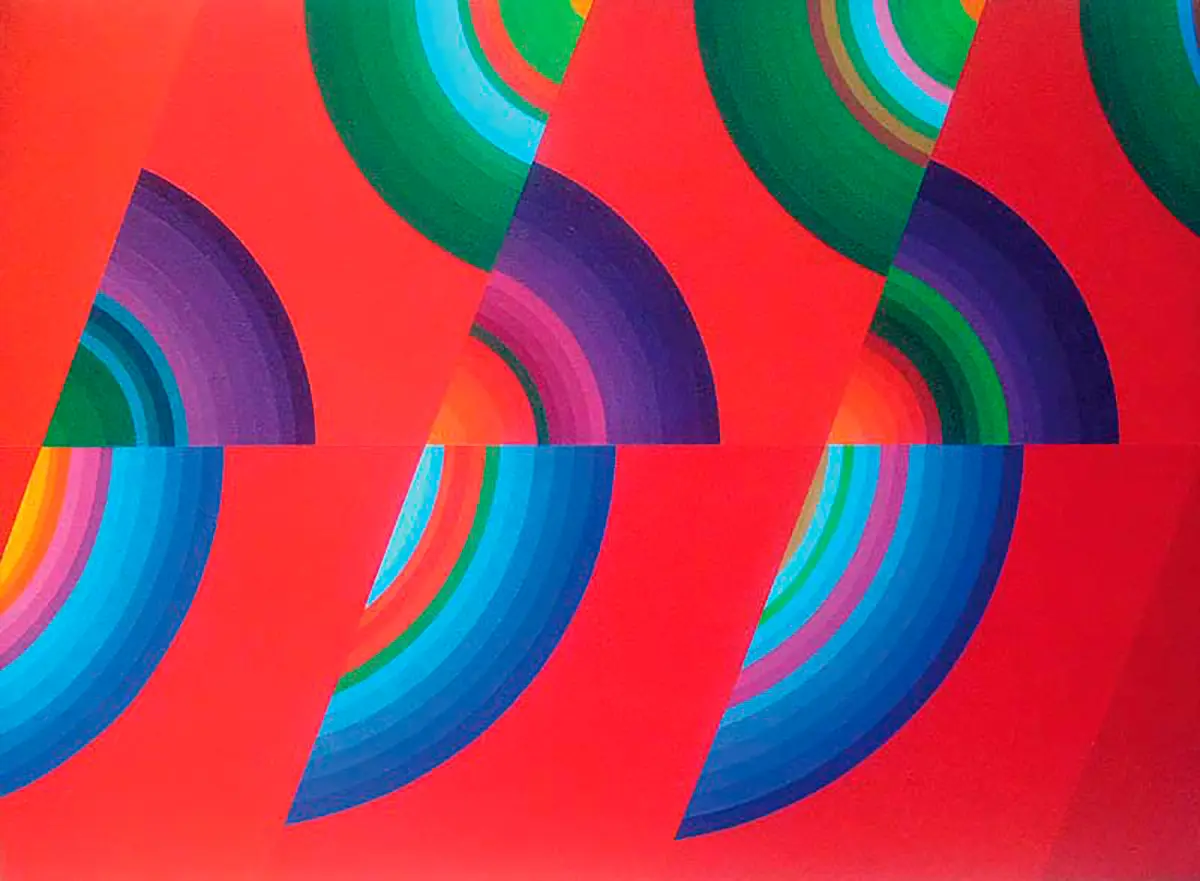
As a result, looking only at the work created in Buenos Aires would leave out an entire period in which he delved into geometrical form and the use of saturated colors—his Mexican period—that led to the creation of works shown at the Galería Vasari exhibition.
Marina Pellegrini, one of the directors of the gallery alongside Lauren Bate, in 2000 contacted Sakai for the first time to organize an exhibition of his informalist works in Buenos Aires. In 2004, Pellegrini traveled to Dallas to meet Sumiko Kawano—Sakai’s widow—with the intention of bringing, not solely his geometrical works to Argentina for the first time, but also his later work, also never before shown in Argentina. Those were the efforts that led to the 2005 retrospective exhibition titled Itineraries, at the Cronopios Hall of the Centro Cultural Recoleta. There, the curatorship addressed the twists of fate that marked the life and production of the artist. This is how the monumental polyptych like Miles in the Sky (Miles Davis) and Homenaje a John Cage (Homage to John Cage), both from 1976, came to be shown in Argentina; alongside other works from that period, preceded by a group of informalist works and another group of more recent pieces created in the US—all influenced by eastern art approached from a unique perspective.
In 1951, after having completed his studies in Japan—where he also got a degree in Literature—Sakai returned to Buenos Aires and concentrated in promoting the Japanese culture across several areas. While he thought he was going to pursue a literary career, he eventually turned his attention to painting. It was the height of concrete art and the beginning of several abstract movements, and Sakai felt attracted by what was going on in the art world of the time and decided to focus his energy in becoming an artist. By the mid-1950s, he began to paint calligraphic signs, an inherent part of his aesthetic approach, as he was Japanese after all. He became a member of several art groups interested in abstract art, like the Seven Abstract Painters (1957) and the Five Independents Group (1960). His painting was also influenced by the formalism that emerged during de the 1950s, but still with a heavy Japanese influence—particularly in the use of calligraphic signs and a certain set of gestures—that will set him apart from the rest of the artist following that artistic tendency. From then on, Sakai’s use of color became quite unique. Until 1962, when he traveled to the US never to return to Argentina again, Sakai was a prominent artist in the art scene of Buenos Aires.
As a result of an invitation to teach at the Centro de Estudios Orientales of the Colegio de México, the artist moved to Mexico City following his brief stay in New York; where he had a taste of the artistic and musical—he was particularly interested in jazz—environment of the time and where he met John Cage.
Once he settled down in Mexico, he became an active contributor to the intellectual scene and his work experienced yet another decisive change. Referring to that moment which took place somewhere between1966 and1967, Juan Acha wrote the following: “He began his geometric aesthetic with an exhibition in Mexico (…) That initial exhibition by itself constituted the very first exhibition by a geometric painter in Mexico.” (1976). In other words, Sakai was a pioneer of this artistic tendency in Mexico City.
The works exhibited at the Galería Vasari in 2011 correspond to that approach inaugurated by Sakai. The artist affirmed to be influenced by Japanese artist Ogata Korin (1958-1716). “The sinuous curves, circles, and lines that flow without apparent beginning or end,” wrote Sakai in a document that conveyed his admiration for his predecessor. Nonetheless, it is not solely about shapes, but also about the daring utilization of color that accompanies and changes elegantly and abruptly from one painting to the next. Sakai’s interest in music and jazz support the option of an aesthetic that was already apparent—after the fact—in the Buenos Aires of the mid -2000, and one that continues to surprise us to this day.
MERCEDES CASANEGRA