The gaze of Argentine artist Mercedes Schamber (Posadas Misiones, 1972) is added to those by other artists who exhibit their work at the First Women’s Gazes Festival that takes place in Madrid at several galleries and institutions. It is a festival that does not attempt to go through us with a double-edged discourse or to confine the wide-ranging selection of proposals by women into a single category. Each gaze is different, distant, and nonconformist. In my opinion, the show only intends to inform us about a single fact: namely, that the most important revolutionary transformation in the contemporary art world of the Twenty-First Century is the end of machismo in the system of creators. Women’s contributions have enriched the artistic landscape and have put an end to a blatant historical insult. The next step is to terminate machismo in the system of creators at a higher level and in the system of directives of artistic institutions.
Schamber plays in another league. I applaud the initiative by the Galería Blanca Soto to not only showcase the work of prominent figures but also promote other projects like Schamber’s that will not necessarily yield them great financial gains. They saw in Mercedes Schamber the strange beauty of a different approach to drawing and the primordial element any critic must always evaluate: honesty.
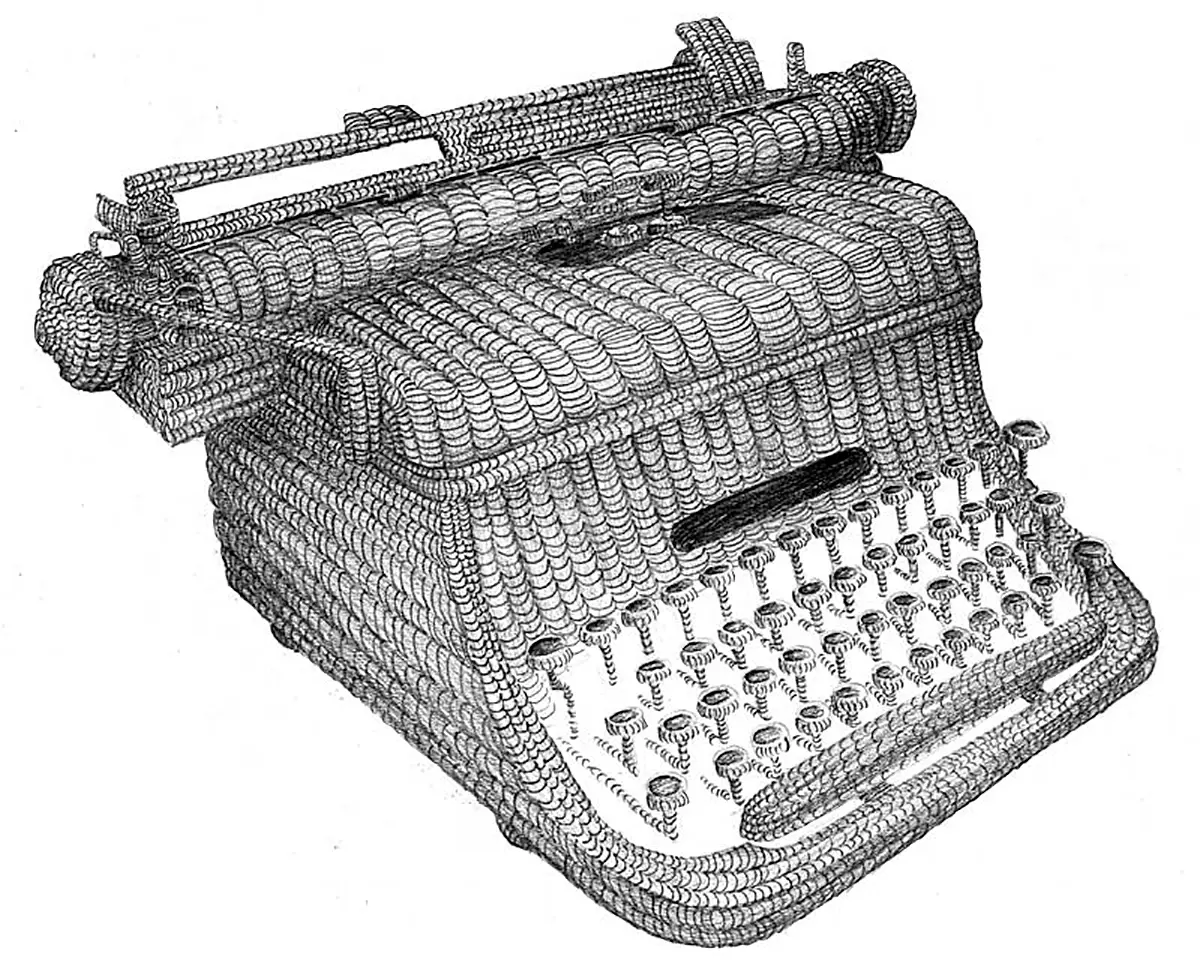
Recorte (Cut-Out) is the title of the show that encompasses the drawings by Schamber. It is a title that accurately describes the visual and simulated forms that this artist has created. Drawn with pencil, with objects like typewriters, cars, insects, and other animals—such as frogs or dragonflies—the images are presented as if they were cut-outs on a white background as if they had been extracted from their already forgotten environments and landscapes. The artist cuts-out these figures from personal photographs and private mementos, and confers them autonomy as she rescues them from oblivion. Given all the technological advances we enjoy today, the objects selected remit us to a past that already appears ancient to us. These are images that take most viewers to a journey into the past. The animals indicate the rural environment in which Schamber used to live, but they also remind us of the natural science textbooks we used to study or to pretend to study when we were children. The selection of the drawing as a means of transportation coincides with our early artistic manifestations: children doodles along the margin of the notebook. Nonetheless, these works are nothing like the drawings of children. Schamber’s work stands as the sublimation of a presence set against an absence; an homage to memories and to the perennial nature of life. This artist is a medium in a trance that explores the basement of her mind through the continuous creation of drawings, without ever lifting the hand from the paper, she goes on to render light curves and half circles. Once the ecstasy has been overcome, the eyes distinguish a sort of mutation that usually experienced with needlework, as if the invoked figures were reconstructed with wool. That one of these figures is a sewing machine is deserving of a psychoanalytic study. The Argentine artist introduces in her discourse a magical concept: she affirms that evoked memories can be imaginary; something we must confront with Borgerian composure.
Another series that relies on memory, but a collective one, is Machine to Destroy Subjectivities. It presents accounts by women who were incarcerated between 1974 and 1983. The artist extracted this from the book entitled Nosotras, Presas Políticas (Us, Women Political Prisoners). About the letters written with typewriters, Schamber drew the object from memory in order to give the act of remembering a central role at the moment of the revision; more so than to the experience of the military terror during that period. It is a poetic demand that the title also alludes to. Schamber uses the machine as a metaphor for the repressive policies during the Argentine dictatorship.
I leave one question out in the open. I formulated it at the time I visited the exhibition… the drawings had been described to me as soft delicate feminine works. If I were to visit the gallery today, and observed the works without thinking who the author might be… Would I think that the author is a woman? Is there such as thing as a feminine drawing?
I have said that the exhibition Recorte is from another league. So why are the works not highly valued economically? The presentation of the drawings is innocuous, the artistic impact is rather modest, the originality of the drawings does not serve as an intrinsic quality, and the efforts invested in the works are relative. On the other hand, Schamber does not pretend anything else other than to confront two variables of memory: collective and personal. And she succeeds in doing so with unsurpassed coherence by using drawing and effective allegorical elements like, for example, the typewriter. To a public fresh from a visit to the nearby Museo Reina Sofía or to the Caixaforum, the exhibition could perhaps appear unfinished, or a mere amateur exercise. But not all that is relevant has to be megalomaniac works that sell for millions of dollars.
JUAN JOSÉ SANTOS