The Americas Society presented Observed, the first monographic exhibition in New York City of the Peruvian-born artist Milagros de la Torre (1965). A collaborative project with the Museo de Arte de Lima that is hosting a parallel exhibit from March 6-July 1, 2012, the exquisite curatorial vision was in the hands of guest curator Dr. Edward J Sullivan, with the assistance of Christina de León and Theodora Doulamis. His vision brought exponential value to this mid-career retrospective–part of a strategy of exhibitions the institution opened to relevant artists of Latin American origin, under the guidance of Gabriela Rangel. The curator’s selection helped to expose the tip of the iceberg of De la Torre’s work, spurring the curiosity of those with inquisitive minds.
Surveillance, criminality, violence, memory, and socio-political construction of identity are the themes that inform De la Torre’s photography. An awareness of “the other” is perhaps an underlying ongoing subject of her visual investigation, which has developed since the beginning of the 1990s, and is developed through series that are associated with specified photographic techniques. Observed did not follow a chronological narrative; the curator organized the works by series, highlighting a minimal representation of each and creating an essential notion of the artist’s creative paths.
De la Torre’s photographic work is characterized by a sharp-witted focus of her stories that concisely assembles her imagery, always based on in-depth archival and bibliographical research–a process that also informs her technical approach. The Lost Steps (1996) is a series that takes its title from the name given in 1912 to the hallway and main patio of the Palacio de Justicia in Lima. In this series, she uses the archives of the courthouse to focus on incriminating evidence of everyday violence cases, at a time in which Sendero Luminoso–the Maoist terrorist group–was violently beating Peruvian civilians. Nonetheless, her photographs’ subjects are humanized metaphors of violence and its players. The photos are named following a literary description of the photographed object, with the intention to establish a clear understanding and a lineal connection with the viewer.
Shirt of journalist murdered in the Uchuraccay Massacre, Ayacucho is a straight picture of the mentioned shirt on an isolated black background using a nineteenth-century process that creates a dark halo around the object. The mysterious dim halo infuses the subject with an emotional charge related to the still-unclear circumstances of the January 26, 1983 massacre. The criminal event produced a public outcry and, as a result, that date was established as National Journalist Day in Peru. Another haunting photograph of this series, with a popular relevant connotation, is Police identification mask of criminal known as ‘Loco Perochena,’ a popular Robin Hood-like thief who targeted upper-class houses. The mask picture has a frightening feeling that conveys death and biblical references, an image that reminds me of the work of Joel Peter Witkin. Within this photo De la Torre revisits one of the original utilitarian uses of photography: identification.
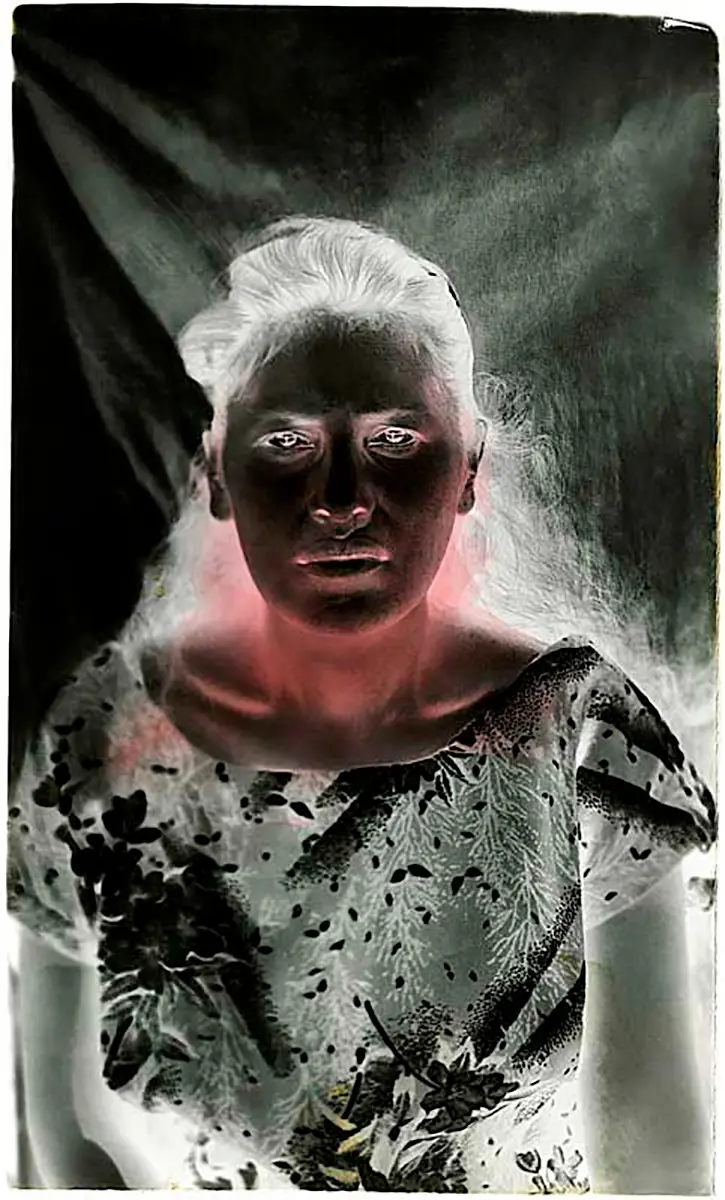
Exploring issues of identity, control and surveillance is Under the Black Sun (1991-1993), the earliest series of work represented at the exhibition and one of the most visually overpowering. Technically it is based on the rudimentary technique of street photographers in Cuzco who produce a direct print on the photographic paper. De la Torre hand-colored the impression with mercurochrome and later re-photographed it following the same procedure to create a final impression. The illuminated retouching of the skin color of the subjects induces not only – in the artist’s own words – a “racial improvement,” but also an aesthetic, economic, and even a cultural one, in the belief that a person with fair skin intrinsically represents all of these qualities. The artistic ludic interconnection between the intention and the result is the reason for which these photos could not be trusted as identification tools, even though they are taken in that fashion. The red-colored second skin is also a reference to violence. It gives the impression of identification photos of the dead.
The Bulletproof series (2008) is built around clothing, those specially designed to protect the life of the user. At the exhibition, it is represented by two austere contrasted works creating a negative-positive dialogue: a black corduroy jacket with a relaxed cutback look made of a dressy-elegant fabric, versus a white cotton dinner jacket of a dress-up artisanship. Both photos are printed on cotton paper that helps the viewer experience the sensation of common-wear ability. The straightforward documentation of an object of quotidian use conveys a socio-political reference for its nature and the intended user.
Armored (2000) is a series of small three-quarter portraits of armored vehicles taken in Mexico City, where the artist once resided. The “humanization” of the trucks by the photographic approach and the playfulness with the size carry a commentary about the relationship of power. Based on a six-month survey among Mexico City residents, Fears (2004) is a series of monochromatic dark rectangles with imperceptible texts expressing fears of daily errands around town, where the icon is absent. The idea is to develop an intimacy with viewers, bringing them close and inviting them to establish a personal connection with the expressed fear.
Observed exposed Milagros de la Torre’s works as calm and intelligent allusions built on the basis of caustic wisdom with a sophisticated contemporary language.
RAFAEL DÍAZ CASAS