José Damasceno’s exhibition Storyboard, organized by the São Paulo Cultural Center, was open to the public from mid-March through late May, as a new initiative on the part of the institution’s visual arts curatorship. The São Paulo Cultural Center, conceived as a public space for integrated actions, offers theater performances, dance, music, visual-arts shows, film and video projections, workshops, and courses for the general public, and it has become a focus of support for research and experimentation in the arts in the city. Storyboard was included in the Center’s Monográficas program, which focuses on solo exhibitions by artists geared towards a review of their entire careers.
Damasceno’s show acquired great importance in the program due to its temporal dimension, especially as it proposed the gathering of some 20 works by the artist created over a period of two and a half decades since the 1990s to his most recent production -Último Lustro- including works from 2010 and 2011. The exhibition investigated every day, the scales, the weight of matter, the format of objects, solid bodies, and their opposites. The artist proceeds as an archaeologist of the contemporary, researching our material culture. In his work, it is possible to find a wide array of research interests centered around binary elements—lightness/weight; emptiness/fullness; smoothness/roughness—that surprise the viewer with the ingenuity of extraordinary forces.
Next to the entrance to the gallery, as a kind of opening for the show, we found Ultra mini-golf, from 2004, in granite and resin—a curious and unusual narrative dichotomy: a large golf ball, in granite, deposited on the floor as if seeking interlocutors, a player, or the small resin figure attached to the gallery ceiling, in an inconspicuous place. This mode of communication, detouring the viewer’s attention, dominated the show and the narrative of Damasceno’s next interventions.
When we follow the arc of Damasceno’s career, from his production of the late 1980s (1989) and the early 1990s (1993), we note that his interests centered around an exaggerated three-dimensionality, with special emphasis on the problem of materials. The sum of his incursions in that terrain reveals the pirouettes of an essentially meditative artist.
The materials used by Damasceno are disconcerting. They are always impacted by statements that acquire a certain degree of autonomy and generate humor, enhancing the lives of his works. Materials like wood, steel, concrete, felt, burlap, glass, granite, marble, resin, clay, metal, among many others, embody all that is fleeting in a conception of the world as a place of inverted recurrences.
Among the works on exhibit, Cartogram, from 2000—made with painted-metal threads and protractors, in variable dimensions—proposed the notion of alternative scales connected to the dynamic of other interventions found in the artist’s trajectory.
The directors of the action, silent actors strategically attached to the floor and tied to the threads rising towards the ceiling, were a series of metallic protractors: they were responsible for the electrical charge that would course through those elements as if through silhouettes suspended in the air.
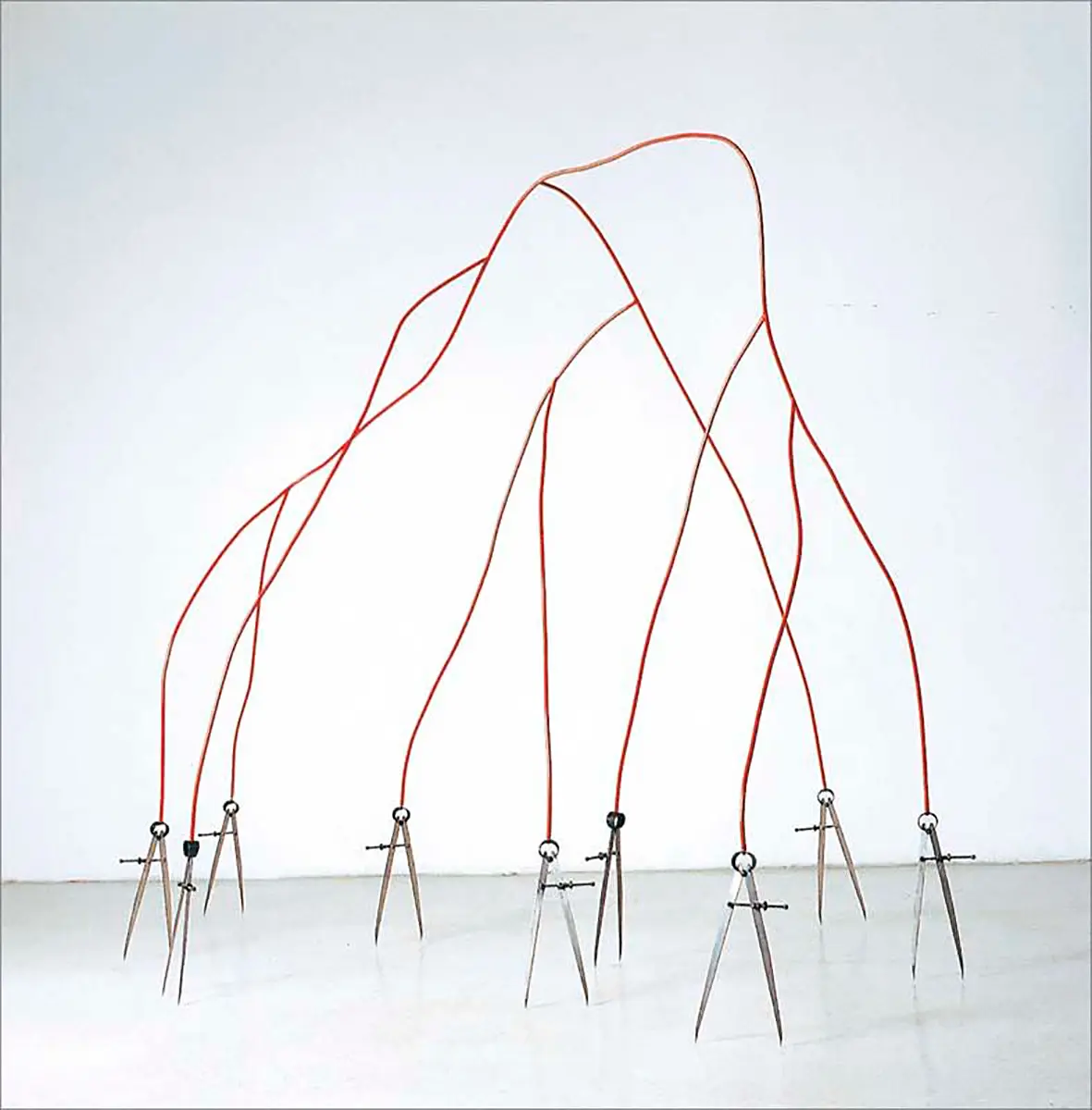
The audience, guided by the seductive sensation of a sinuous motion that activates an attentive gaze without any echoes of a mechanical attitude, discovered the movement of a vivifying flow in expansion throughout the entire gallery.
José Damasceno belongs to a generation educated under the influence of the experiments of artists like Waltercio Caldas, Cildo Meireles, and Tunga, inserted into the international scene. These Brazilian artists, motivated by aesthetic concerns, fed their own insecurities and generated a kind of electrostatic action of conceptual radiation upon the viewer.
Damasceno’s production interrogates constructive variables, almost always subjected to a misconnection with the usual expectations. When we stop to contemplate one of his works, we find variable supports, structures, formats, and dimensions destined to the banishment of a perception too well adjusted to banal everyday readings.
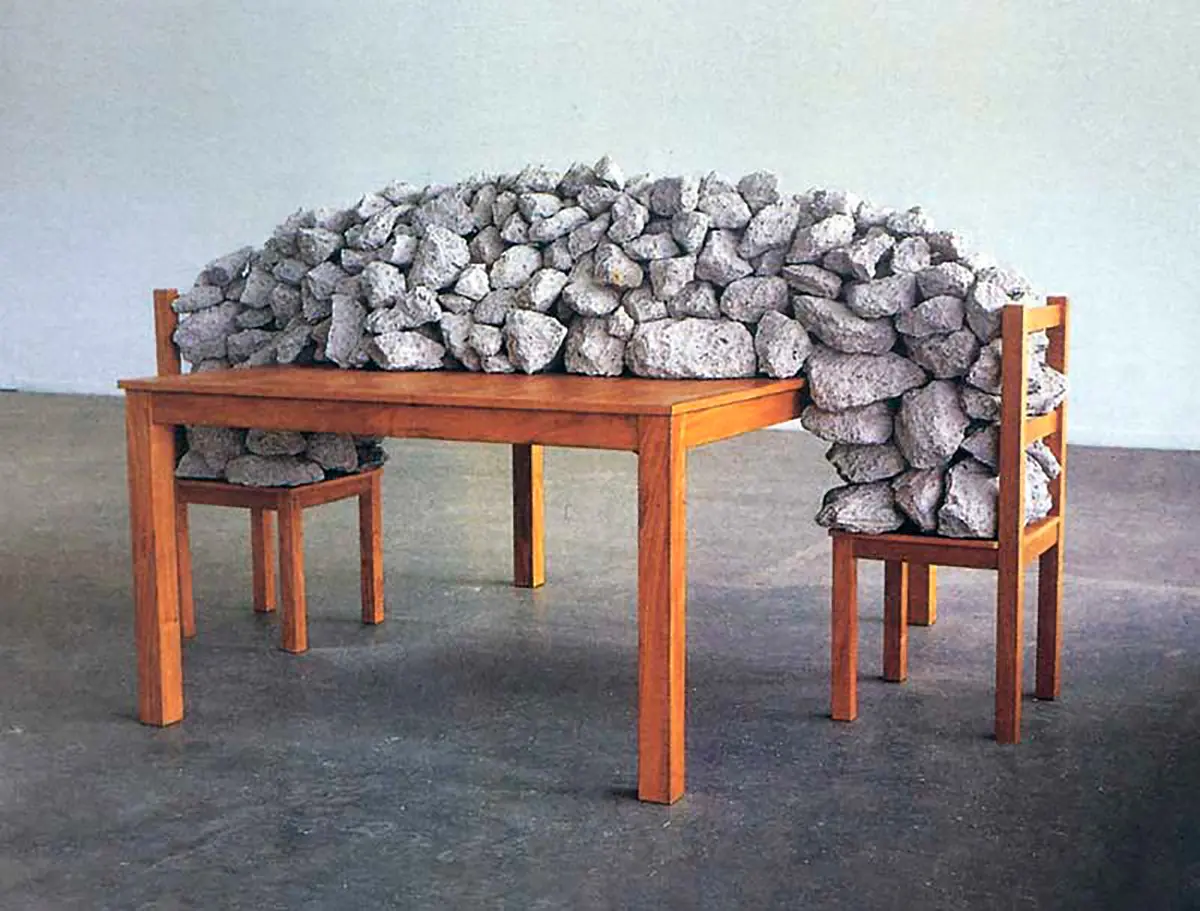
Among the works on exhibit, we find Soliloquy, from 1995, built using wood and concrete, an arrangement conceived on the basis of the encounter between a spillage of rocks on a table and two chairs, record of a silent monologue.
José Damasceno’s creations are never conventional. Each grid elaborated by the artist’s visual poetics invents time and circumstances that make it possible for us to rethink relationships, positions, and spatial arrangements.
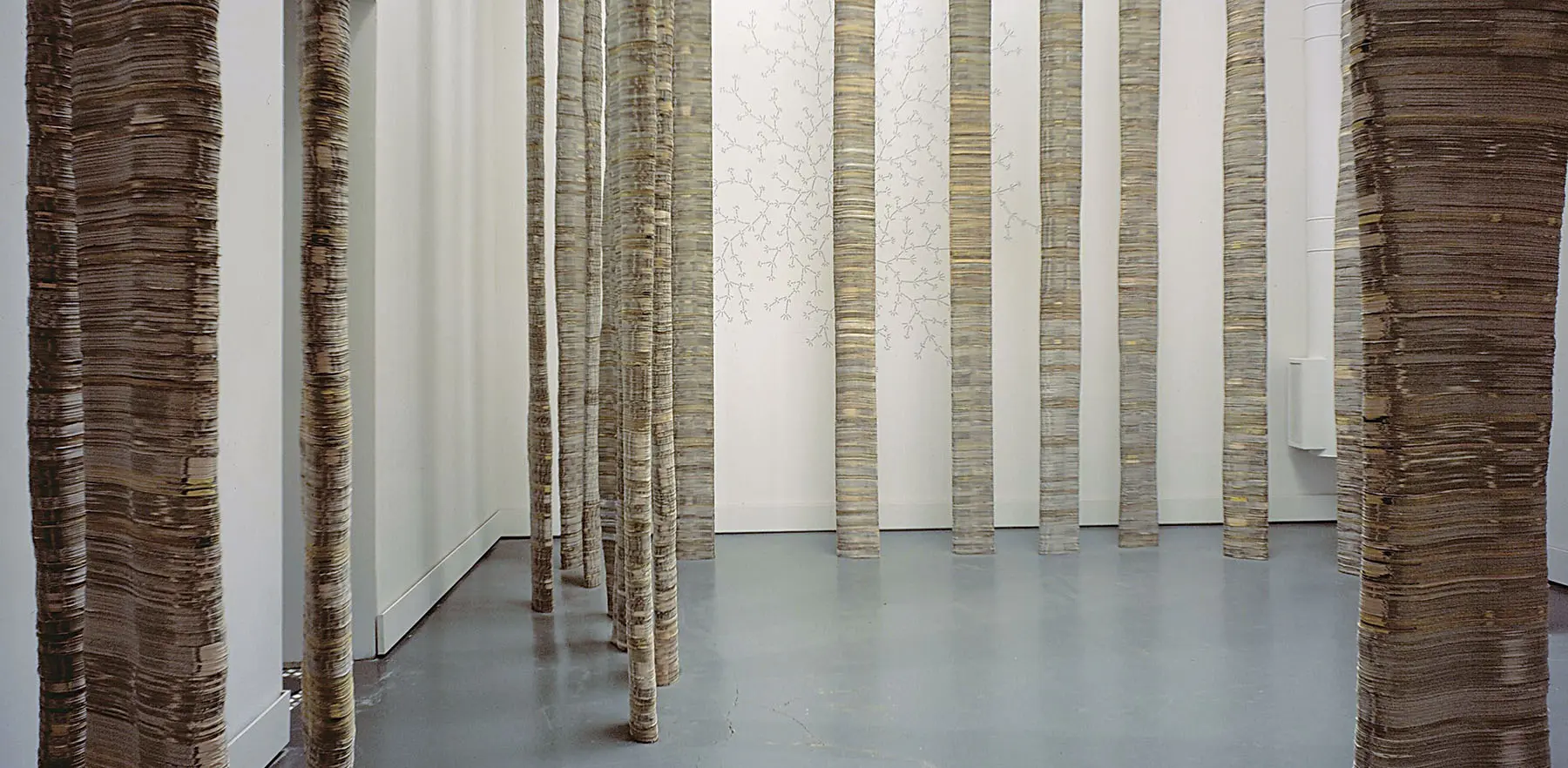
For a significant example of his vitality in the establishment of unexpected relationships between opposites, we can go back to his participation in the 51st Venice Biennale, in 2005, invited by curator María de Corral to participate in the group show pe. The Brazilian artist proposed his 2001 installation During the vertical path, for visitors that unfolded in space.
The installation, with an iron structure, occupied the entire exhibition space in Venice and was comprised of superimposed paper layers made of thousands of newspaper pages. Its vertical arrangement in columns, very close to one another, invited the audience to a tortured path, walking insecurely on longitudinal shapes.
In José Damasceno’s works, steps are built in an ambiguous zone, like a constant presence in his creations. They are resources that acquire material existence and meaning, generating the need to realign our expectations.
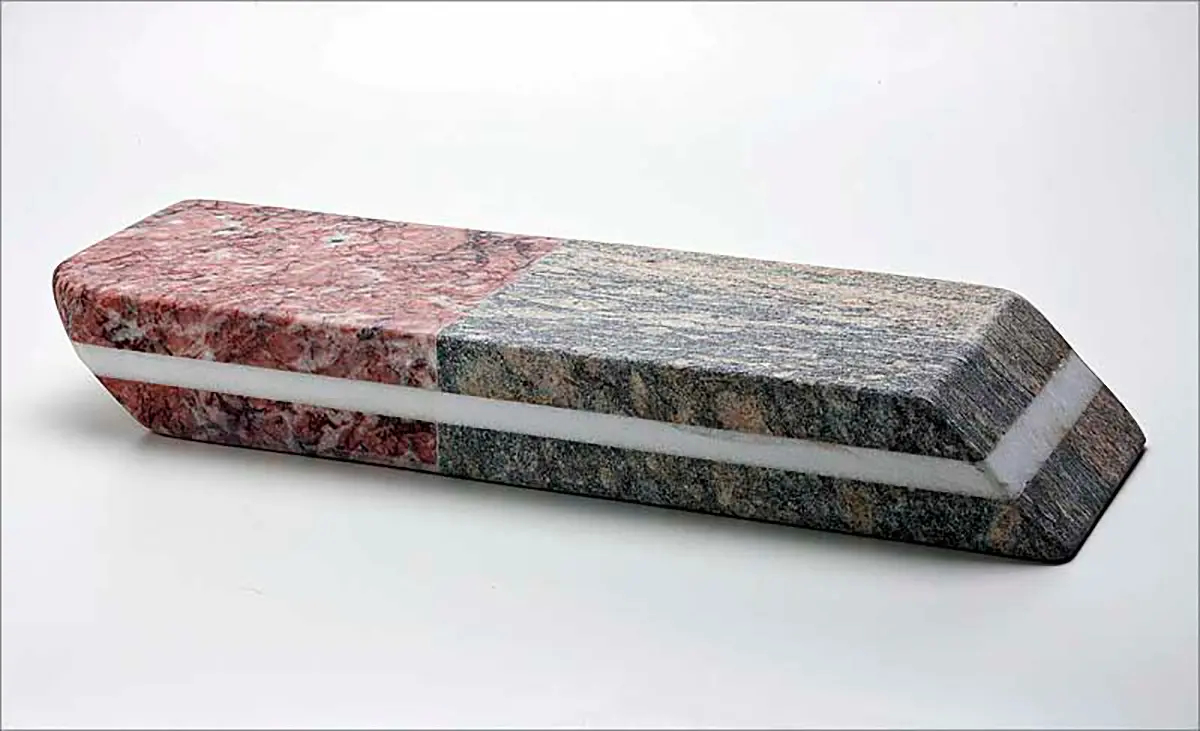
These perceptual adjustments are not provoked in Damasceno’s recent productions. For example, Eraser sculpture (2010), in granite and marble, and Eraser sculpture (2010), in MDF, Formica, and marble, disconcert us and make us think. These works understand three-dimensionality with a lyrical quality that becomes a delicate sense of humor. The two works refer to utilitarian objects that deviate from their original conditions of use; they are sculptures seeking a new meaning by interrupting our everyday understanding of the object.
The artist uses school-supply erasers to erase graphite-pencil marks at a shifted scale, boldly breaking with their function. These works produce unusual coordinates and leave the viewer in a state of perplexity.
Finally, it is important to note that, as Damasceno puts it, every work of art is “an exercise in expanded attention,” an elaboration necessary to confront the unstable character of life. There are no pre-established pathways. Tension courses through this restless artist’s entire oeuvre.
CLÁUDIA FAZZOLARI
Professor of Art History, Researcher, General Secretary of the Brazilian Association of Art Critics, and member of the AICA-International Association of Art Critics.