
The recent exhibition by Valeska Soares titled Paragraphs was inaugurated at the Galería Fortes Vilaça (Galpão) located in the Barra Funda neighborhood in São Paulo. Soares presented a series of unpublished paintings and a group of photographs.
The gallery presented a project by Soares that invited viewers to enjoy the experience of a literary itinerary, on the one hand, and a proposal of conceptual and formal compositions based on her literary taste, on the other.
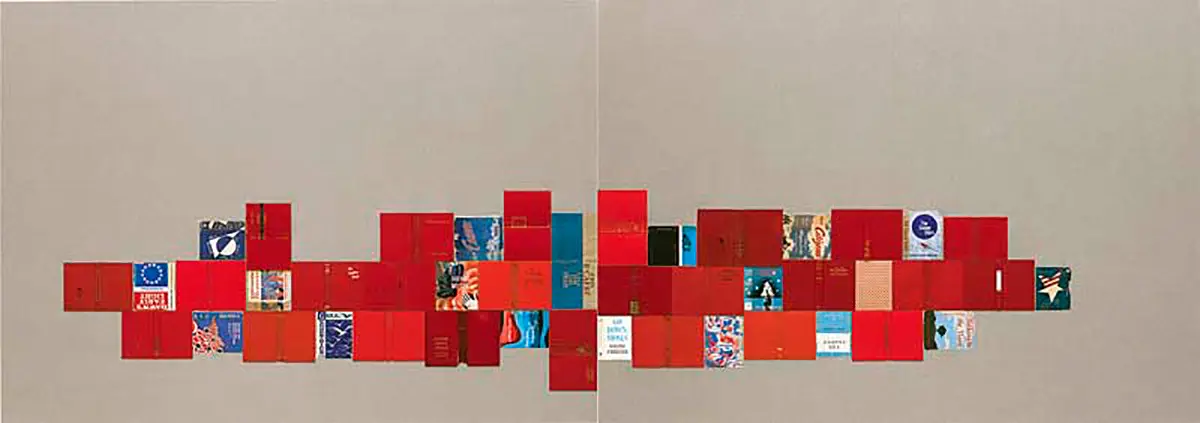
The exhibition consists of geometrical paintings created with the covers of several books. Soares challenged the public to the joy of surveying a true reading itinerary that she constructed in order to generate new conceptual and formal compositions based on her personal literary selections. The artist would challenge visitors to dig in their memories to remember the reading that marked each person.
One component of this journey through the show was the exhibition space itself: the so-called Galpón of the Galería Fortes Vilaça in the Barra Funda neighborhood in en São Paulo. This working-class section of town nests between the urban and marginal arteries of the Tietê river—an area that still conserves testimonies of the past, allowed Soares to heighten the narrative tension of the works. Real-life images of an industrial neighborhood were part of the montage of the exhibition.
The context and intension in the utilization of paragraph images—the sections of texts indicated by the alternation in the arrangement of written lines that guided the artist’s gaze through the selected collection of publications—were transformed into the living resources of a contagious environment that would interact with the imaginary of visitors as it invaded their retinas. Walking through the colorful works of various sizes and dimensions, each creation reinforced in the viewer a mental reflection activated by the immense visual project that was taking form in the proposed group of works.
Such works could be understood as textual architectures, constructions destined to the creation of new meanings for covers, dustcovers, spines, and printed titles; all arranged on the natural untreated canvas.
When we approached this new proposal, our memory revisited Valeska Soares’ participation in the 28th São Paulo Biennial. On that occasion, the artist presented a piece entitled Catálogo (Catalog, 2008), the project that consisted of a rug with superimposed letters rendered with pulp (paper) of various dimensions—pressed and created to be touched by the public walking through the exhibition.
In fact, it has always been the viewer—freed by the Soares to become a sort of translator-interpreter—who has felt the literary works, colors, textures, and formats in order to establish new itineraries to approach the artist’s creations.
In Paragraphs, the artist revisited a fundamental aspect of her artistic trajectory: the attention to the graphic project of everyday life. This constructive resource selects signs to establish a critical conversation with the visual environment, through the combination of sources in several modulated arrangements.
Amid these modulated arrangements, in the middle of paintings, book pages, covers, dustcovers—all forms of visual interaction—the meaning of each proposed reading was reinvented in a process that deconstructed the physical structure of the referenced publications.
In the compositions displayed, every literary work was properly glued to the untreated canvas support: each black, red, blue, white, or gray leather spine was displayed in an easy to view location and as an autonomous presence. Each author selected from a kaleidoscope of literary sources—Pound, Faulkner, Kafka, Nabokov, T. Williams—reemerged into a new mental survey. With the covers and dust covers in a dialogue, the bindings included in the series precisely entitled Bindings—a large scale work created by the artist—assumed the central role in the aesthetical narrative. Destined to create a space of fiction, a place for decryption, Soares’ paintings are phases of a journey of literary associations put into action by the recreated narrative environment that had been rebuilt with the imaginaries of the viewers.
The exploration of sensations has always been present as a central preoccupation in the creations by Valeska Soares. Sensations appear, for instance, as part of a project exhibited at the Museo Rufino Tamayo and at the Museo de Arte Carrillo Gil, both in Mexico, in 2002.
It was the work entitled Puro Teatro (Pure Theater). It focused its attention on an experimental environment of sensations. By turning to the senses—smell, touch, sight—in the creation of a space constructed as if it were the “extravagant construction of a garden” in the middle of the exhibition space, Soares was inviting the public to accept theatrical fiction—that which addressed the imaginary as something real.
This is the manner in which Soares created Gardens, in the middle of the construction of a lake of mirrors and a pavilion of glass and iron. Such scenery was understood as a place for contemplation, where reality and fiction converged.
Soares often makes literature a part of her creative process and her explorations never exhaust discursive possibilities. The exhibition Paragraphs, which included the series Bindings and the works in the photographic group Edits—digital manipulations of the work entitled A Lover’s Discourse: Fragments, by Roland Barthes—reclaimed the silent intervals of a mental journey that surpassed mere formal exercises. As a result of the strategies developed for her proposals—especially for the series Bindings—Valeska Soares would place the interval of her latest invention in the fusion of geometric camps and literary narratives: the richness of human nature and the diverse forms of expression it creates.
CLÁUDIA FAZZOLARI