Inaugurated in October of 2010, the Galerie Mor-Charpentier is particularly interested in contemporary Latin American Art. It plays a prominent role in attracting artists from Latin America, in a Parisian artistic environment already inclined to do so. Following exhibitions by Milena Bonilla, Marcos López, Oscar Muñoz, and Teresa Margolles, the gallery now presents the work of Mexican artist Yoshua Okón.
For his first solo exhibition in Paris, Yoshua Okón (1970) decided to include two installations of recent videos. Under the generic title of Pulpo (Octopus)1—in reference to the essay "Pulpo/Octopus", Mexico 2011, texts by Raúl Hernández Valdés and John C. Welchman—the videos addressed several political and social themes; in particular, the Latin American immigration to the US (Pulpo, 2011, 18 min. 31) and the survival of Nazism in Mexico (Bocanegra, 2007, several durations). At a time when France was dealing with the racist massacres in Toulouse and Montauban, the themes proposed by Okón resonated with extreme violence and clarity. Although his proposals were not conceived to address the French reality of the moment, the tragically exceptional environment in which the real events unfolded served to exacerbate the fiction/reality of the situations shown in the videos.
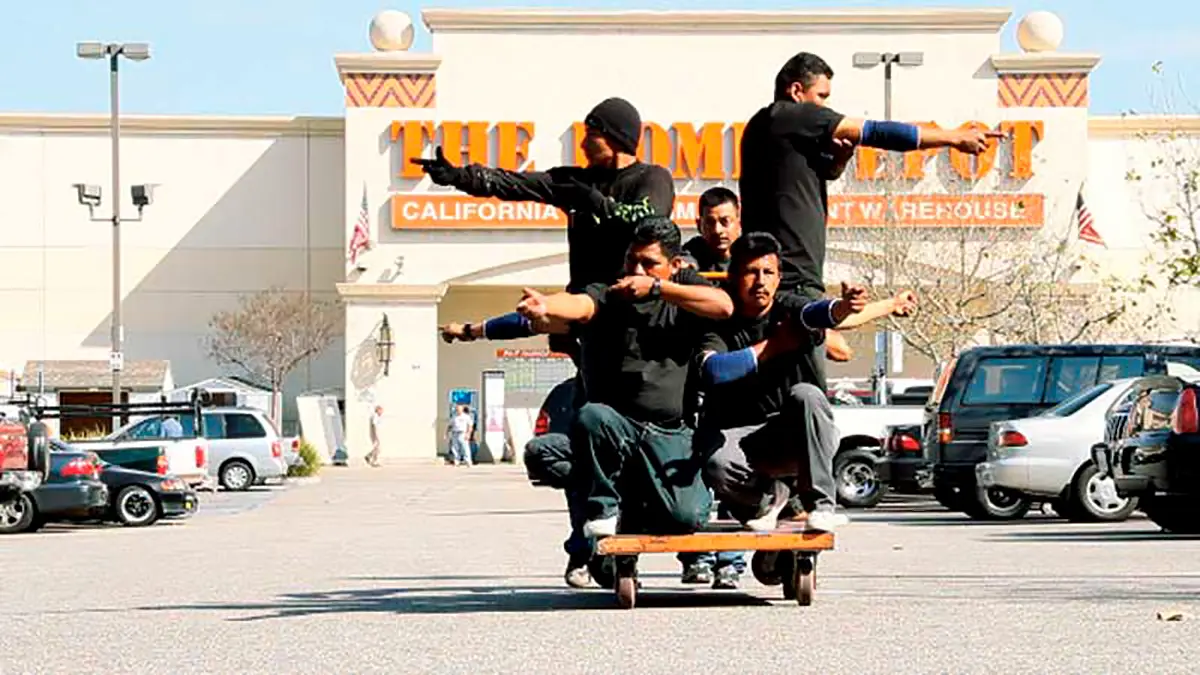
The installation Pulpo is shown in the first exhibition room of the gallery. It consists of 4 screens that show images of the same movie—but at different times of progression—that show staging of the Guatemalan civil war. This installation created by Okón during a stay in Los Angeles depicts undocumented Guatemalans—most of them Mayan peasants—gathered in the parking lot of a Home Depot store while waiting to be hired for construction work. Viewers are physically positioned at the center of these images projected around them, while they are immersed in the fictitious war. Entirely directed by Yoshua Okón, the combat scenes between two factions constitute a pantomime to which the immigrants add their own personal stories. While they drag themselves, hide, scout, run, ride the shopping carts, and shoot each other with imaginary guns, Home Depot customers walk across the scene completely indifferent to the gestures and voices, while fragments of the K’iche’ Mayan language can be heard mixed with other indistinct sounds coming from the street. In this artistic act, which is also an act of political consciousness, Okón wants to underscore the problems caused by migratory movements—aggravated by poverty and political prosecution— not only in Latin America but around the world. The theatrical staging of the real drama reminds us of the discrimination and ostracism that hit these displaced communities more than any others. Okón clearly achieves his objective with the highest level of intellectual honesty. On the other hand, are not the dramatically miserable and solitary wanderings of the actual undocumented or illegal immigrants—in the center and periphery of our cities—much more violent and unbearable than fiction? The theme addressed here by this artistically and intellectually effective proposal is the confrontation between fiction and reality.
On view in the exhibition areas located in the gallery’s basement, the installation titled Bocanegra—which consists of four videos, three of these recorded by the artist—Okón presents an absolutely carnivalesque view of ten Mexicans in Nazi uniforms who look more like characters from an operetta than horrible fascist ideologues. If, according to a popular saying, ridicule does not kill, then, what is going to happen to these comic, eager, fetishist, and idle clowns who instill so little fear? Yoshua Okón recorded the group—although he needed six months to convince them—in the apartment located in the downtown section of Mexico City, where they meet to drink in honor of Hitler and his ideas, which they have adapted to the “pure Aztec race” and to the wholesomeness of the peoples of Oaxaca. The artist recorded them at a park, transforming them into marionettes with jerky and stereotypical movements. The group decided to direct the fourth video—the artist supplied a cameraman—that resulted in the delirious and saddening monologue by one of the men in uniform who wants to convince us—while we observed his collection of slogans and nostalgic objects—that the ejaculation in his kepi is somehow associated with his admiration for Hitler. The parody is not in the formal content of the video, but in the laughable reality of these men who do not understand that ridicule does kill after all—just as Yoshua Okón decided to demonstrate. But, is it not possible that the grotesque folklore of these manipulated fools could actually minimize the sense of danger that they appear to wish to impose in other latitudes? Could this exhibition perhaps compel us to become more aware of such danger? Did it reinforce our alertness? The entire value of a work like this resides in the answer to these questions.
NOTE
1. The name Pulpo (Octopus) refers to the name given to the United Fruit Company for controlling for decades the distribution and sale of citrus fruits in Central America.
CHRISTINE FRÈROT