
The most recent production of the Pernambuco-born painter Bruno Vilela, his series of paintings and drawings titled Ouroborus, reveals an unprecedented vigor. Part of these works, exhibited in the homonymous show at Laura Marsiaj Gallery in Rio de Janeiro, presents visitors with an optimistic proposal: faith in painting, trust in the human figure, certainty in the narrative.
It is not that such is the purpose of Vilela’s poetics. The artist has never stated that. And it is not the leitmotiv of his work. Yet, the strength of such elements, present throughout almost the entire production of this young artist (he is now 35), provokes a sense of hope in the midst of a melancholy Postmodern world, where our episteme is wholly mediated by the digital image.
Truly, making “meta-art”, this is to say, an art that refers to its own (Western) tradition, is not the intention here. Vilela’s conversation with the History of Art is not an end in itself, but a result. In the end, always present in his work is the thread towards narrative: the figure of our classical tradition, which the crisis sought to extinguish. These are characters, landscapes, animals, ships, among other prosaic elements that, reformulated in paintings, drawings, photographs, or installations, are invested with a powerful symbolic and archetypal energy.
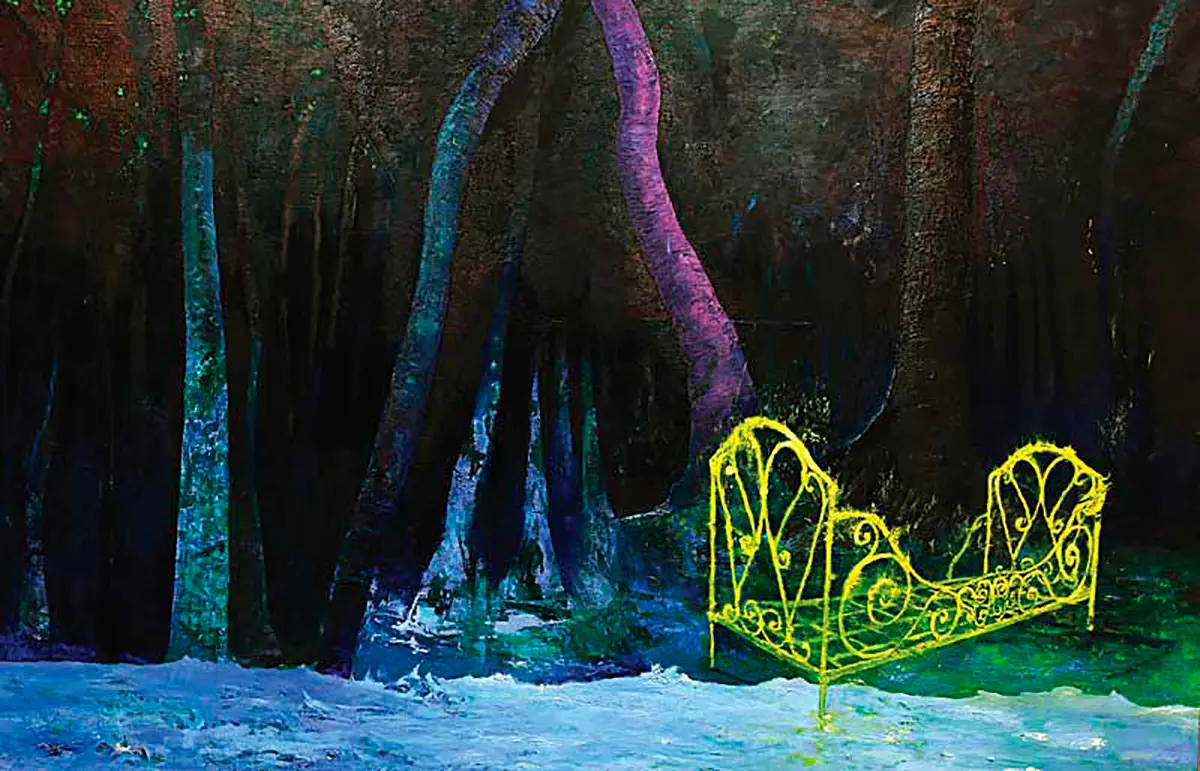
Vilela calls his work “umbando-Rauschenbergian”, in reference to the use of signs from Umbanda, the afro-Brazilian religion, and the influence of American Pop artist Robert Rauschenberg (1925-2008). And this really is pertinent to a review of his earliest works, from ten years ago, many using collage techniques and with results that approach the syntax Pop in their manifest form. Later, after that phase, Vilela’s work changed completely. There is a distillation of references, and a new appreciation for silence enters into the noisy Rauschenbergian space.
A focus on certain aspects takes Vilela’s painting to a forceful maturity. What are these aspects? It is not difficult to cite them, because they are in perfect synch with one another. There appear variegated characters who, nevertheless, speak in the same language. Among them, female figures from fairy tales. Red Riding Hood and Alice are here not only as references to the Pop Art repertoire and as a critique of cultural consumerism. They are spectral figures and offer, above all, instructions on how to explore the deeper regions of the male and female psyche.
This is what happens in The Blood on the Princess’ Dress and the Hunter, from 2010, made with dry pastel on paper, in large format. The girls never reveal their faces and seem to be always looking for a path towards instinctual nature. In an earlier series with photographs, titled Bibbdi Bobbdi Boo, Red Riding Hood’s gaze escapes and confronts the viewer from the side of her red veil. In other images, the same character appears as a murder victim, soaked in blood; her punishment for resisting the excess of her domestication. Human figures with faces but lacking any definitive features appear also in the series Heaven’s Heaven (2009) and Requiem on Paper (2006); in the latter, only a section of the bodies can be seen, not the faces.
In Ouroborus, a Greek word for the snake biting its tale used to symbolize eternity, we can see with even greater precision the path taken by Vilela towards a further distillation of his elements. Divine figures, a cow (sacred animal in the Hindu religion) made of light, natural features coming together in almost monochrome representations where a deep, glowing blue reminds us of that which Yves Klein (1928-1962) considered divine. Despite this terrain so cleansed of formal excesses, Vilela is a master draftsman, and this gives his work a certain virtuosic undertone. In that sense, it is interesting to remember his education: he abandoned his college studies in order to train directly with Japanese artist Sunishi Yamada, a master in anatomy and drawing who lived in Recife for some years.
Vilela is so focused on his microcosm that he even falls into a trance when he paints, evoking in that state “childhood memories, extra-corporeal sensations, preserved feelings of experiences with nature,” as he says. For him, respect for this meditative condition became necessary in the creative act. Thus, his process is similar to what philosopher Gaston Bachelard defined as a poetic universe, where dreaming and thinking interweave in a pendulum-like oscillation of opposites such as day and night, reason and spirit. Understanding art as a celebration of the very stations of his psyche/soul, Vilela shows that an understanding of the self will remain as a legacy for those who will come after us.
ALESSANDRA SIMÕES