In recent years, the phenomenon of urban art has made valuable contributions to the philosophical debate around art. A sustained look at the specifics of images superimposed to urban furnishings such as walls, lampposts, manhole covers, etc., reveals the peculiarities of this kind of art, which needs to be investigated in depth in order to formulate a theory that does justice to its importance.
The work of Rio-based artist Carlos Contente provides essential clues for that effort. As revealed by the exhibition Traços e Tarsilões, 1 held recently at A Gentil Carioca Gallery in Río de Janeiro, Contente’s work comes from a very precise veneer: that of the artist with a college-level education in the visual arts who incorporates into his or her poetic project the occupation of the urban space. Thus, Contente’s work distances itself from other significant urban visual phenomena, such as graffiti—connected to US hip-hop roots—and the pinchaçao movement (staining, writing on walls, cornices, and foundations, often dismissed as minor yet possessed of strong political and ideological connotations for the less-favored in Brazilian society.
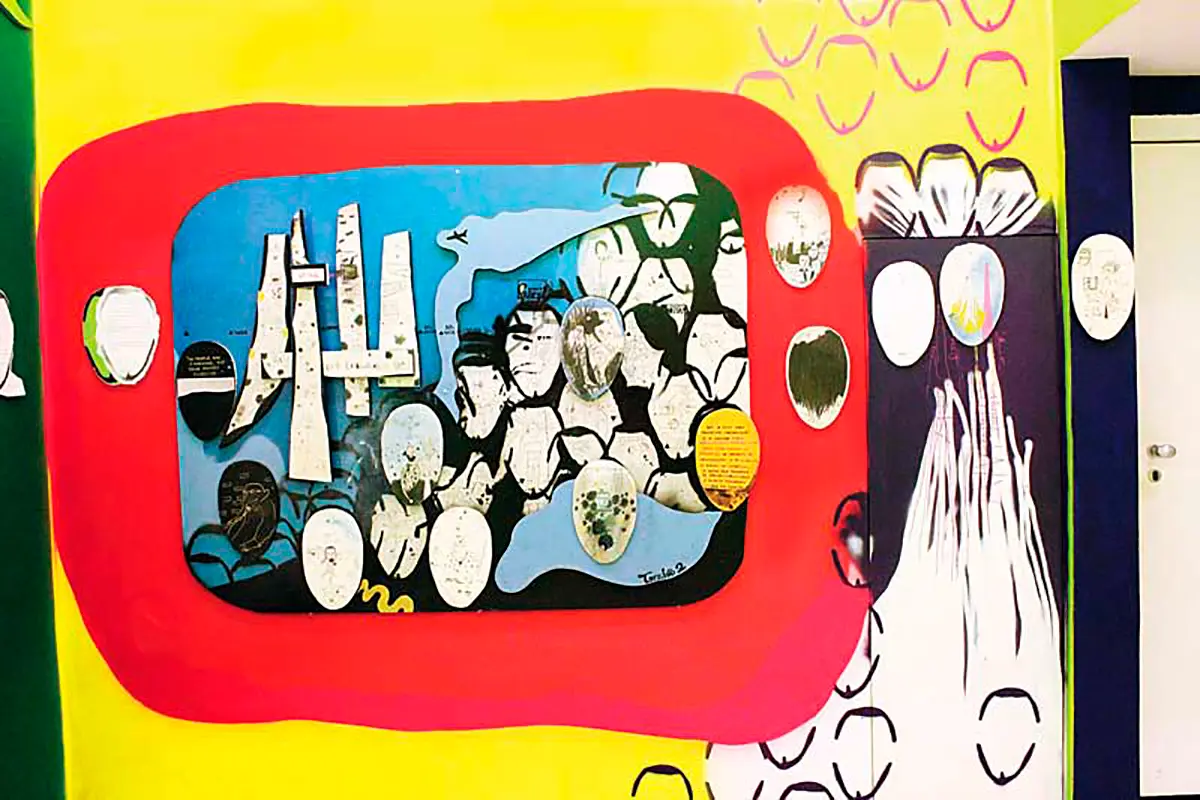
The techniques and styles that characterize these categories—urban art, graffiti, and pinchaçao—are not mutually exclusive (and let’s remember also that attending college is not a mandatory step in becoming an artist). One of the most emblematic issues in that sense is the graphic element, often associated with graffiti artists but also present in the work of urban artists like Carlos Contente. In Interview with the color green (2002), a work comprised of drawings in several independent vignettes, we find a direct connection to the schematic format of comic books. Here Contente presents us with a self-portrait interviewing a blotch of green paint, with which he converses about philosophical matters.
Another resource deployed by Contente is the repeated presence of a single character, the Tarsilão, a kind of alter ego represented by an oval-shaped face that refers to a characteristic of the work of Modernist Brazilian painter Tarsila do Amaral (1886-1973), repeated ad infinitum on a variety of supports. Characters are also common in the work of graffiti artists. However, Contente’s art leans on a poetic intention, which also distinguishes a vigorous generation of urban artists now asserting itself in Brazil, for instance, Os Gêmeos (The Twins) and Alexandre Órion.
Contente began his career making street art and art in informal spaces. From an early age, he created comic strips on his own. He learned silk-screening techniques, China-ink draftsmanship, and narrative construction by attending free courses. Before being admitted into Art School at Rio de Janeiro’s Federal University (UFRJ in its Portuguese initials), he was already a student of the language of graffiti in Rio’s streets. Formal education, however, gave him conceptual keys that pushed his work as an artist forward. He relates that the idea of repetition came from Minimalism, a movement he became acquainted with through Rosalind Krauss’ writings.
Despite this confluence of different languages, Contente’s work moves from graffiti semantics to artistic semantics on the basis of his well-defined conceptual project. The central nerve in his production began with that idea of repetition, a topic that cannot be dissociated from the secularization of Western culture since Walter Benjamin laid the ground for a debate of art in the era of mechanical reproduction. Before his academic training, Contente already had the technical resources for it, with his knowledge of silk-screening, stencils, and stamps. After becoming a passionate student of art history and of the most refined draftsmanship techniques, he loosened the reins of his forceful aesthetic project. He came to the attention of curator Lauro Cavalcanti, who in 2005 invited Contente to exhibit his work in an important Rio institution. “That was my official entry into the institutional circuit of contemporary art,” the artist says.
Among his most powerful works are drawings in which he expresses an erotic sense by means of phalluses, vulvas, breasts, hairiness, and androgyny. The confusion provoked by the displacement of his stylized visage (the Tarsilão) into different bodies (often, female bodies), suggests a destabilization of the borderline between sexuality and its most primitive and grotesque aspects. Contente also gives significant aesthetic weight to the relationship between speech (his work is always permeated by words) and the meaning of his creations. There are interesting insights here. For example, when he establishes a connection between the words public and pubic.
“Being able to draw and express what I think is a powerful tool in taking advantage of legitimized spaces, because now is when I have something to say,” says the artist, who currently declares himself in search of an “ideal object.” With this term, Contente definitely seals his poetic purpose. He shows that artists need a project, the development of which must incorporate shifts that nevertheless remain coherent with his or her principles. As the historian Hans Belting said, in times like ours, marked by extreme cultural hybridizations, when the distinction between high and low is much less than evident, the artist who enters the terrain of the mass media must have a plan of escape. And it is this resource that differentiates an urban artist from a graffiti artist. Contente moves with solvency in both realms.
NOTE
1. The term alludes to Tarsila do Amaral (1886-1973), a Brazilian Modernist artist.
ALESSANDRA SIMÕES