
Chiara Banfi’s exhibition at Vermelho Gallery, in São Paulo, had music as its central theme. Sound, landscape, and nature have always prompted the artist’s curiosity and motivated her research. Banfi explores profound experiences, building meanings on the basis of the imaginary and of the possibility of shaping a variety of materials.
Graduated in 2003 from the Visual Arts program at São Paulo’s Armando Álvares Penteado Foundation (FAAP, in its Portuguese acronym), in 2005 and 2008 Banfi participated in the Art in Residence Programme at Gasworks Gallery, in London, as the Brazil winner of the Chamex Young Art Award. Another important experience in her education was a residence at the Mountain School of Arts, in Los Angeles.
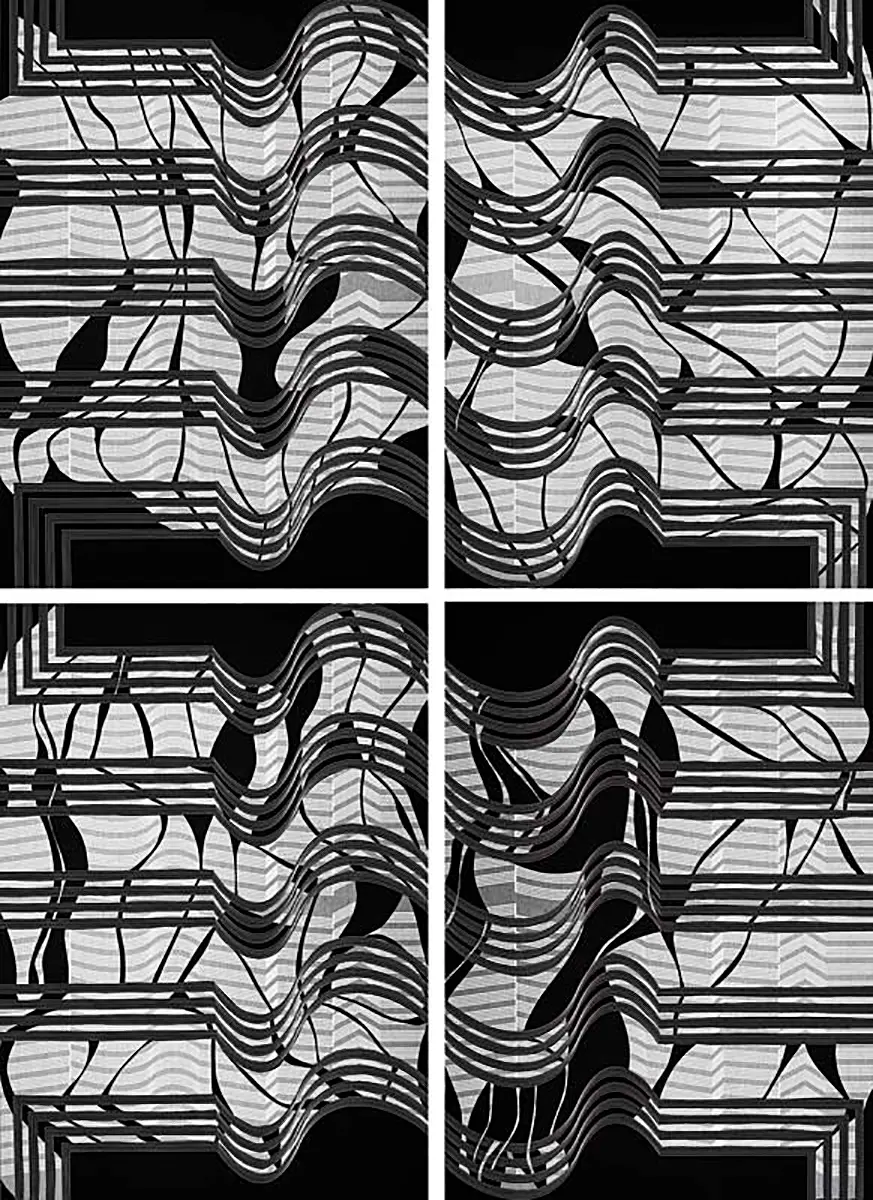
At Mountain School, Banfi experimented with different types of paper, cutting, drawing, superimposing, and investigating inverted lines in the construction of her work. She discovered musical scores and started to take advantage of notations, creating a vocabulary of her own. Banfi realized that music sheets were able to provide an organic shape and support for her art, beyond the visual, as their use is the foundation for rhythm: a displacement towards the field of sound takes place in her work. Exploring tirelessly, Banfi alters those music sheets, reinventing shapes, superimposing, creating volumes. In this way, the physical characteristics of the sound is incorporated into the artist’s poetics and her investigation gains movement, rhythm, and sound. Banfi takes advantage of pauses, produces waves, and her work acquires three-dimensionality.
Immersed in musical morphology, Banfi also creates resonances when the notations in those scores are subtracted, deconstructed, undone, as if dripping down the wall.
Music, a prodding interest for the artist, one that indexes anguished explorations, achieves a new centrality in her creative process when Banfi enters into a relationship with musician, composer, and producer Kassin, whom she married. The encounter with Kassin unleashes new dynamics in her constructions, privileging an immersion in the musical universe. Banfi started to coexist with musical realities, well beyond visual-arts investigations.
Kassin’s record collection was incorporated into Banfi’s repertoire. In her creative process, Music became an aesthetic code. Added to her symbolic universe are now guitars, bass guitars, captadores, keys, strings, violins, shapes, and meanings that generate new relationships in her drawings.
That terrain entered as a consequence of her marriage to Kassin, generated new horizons. Banfi began observing also the materiality of paint and of instruments. She discovered sunburst painting, the kind used in the 1960s on guitars and automobiles, with forceful, explosive colors. The sunburst style made her curious. She noticed that this sort of tonal “explosion”, based on primary colors, created impressive effects in the bodies of instruments.
Taking advantage of this technique, Banfi created for her show at Vermelho Gallery installation of wooden shapes, in a 1.10 cm x 1.10 cm format. In the process, she worked with Celso La Costa, a painter of musical instruments and a specialist in sunburst painting. The result the artist was seeking was an investigation of the relationship between the guitar and the human body. Thus, Banfi explores bodies and matter, highlighting the wood’s organic veneers, working the surface with varnishes, sealers, and colors. Through the sunburst technique, she formulates a connection between the shape of the musical instrument and the human body.
In another installation, Banfi uses the wall, paint, captadores, and strings, generating a musical semantics that invites viewers to interact with the work. In that second installation, she collaborated with Gilberto Borges Fortes Filho, “Gil”, who taught her to make instruments. The artist used her luthier skills to create sound installations.
The third section of Banfi’s show is comprised of guitar and bass guitar shields, used for the protection of the instruments. These shields have sinuous, strikingly visual shapes and retain the anthropological markings of musical culture, the traces left on the instruments by the musicians who used them. These protective shields also preserve memories.
Banfi’s show is a visual and sound experience that reveals her curiosity and ingenuity, a large-scale commitment to the aesthetic investigation. The artist reached deep in her immersion into the vocabulary of music. She connects with that universe like a laborer in the musical field, exploring instrument-maker workshops, building her own instruments in wood, applying sunburst paint, collecting parts of instruments, and, in new situations, giving them new life through the visual dimension.
Chiara Banfi’s exhibition is titled Sunburst and is open to the public at Vermelho Gallery from May 22nd through June 16th.
HÉLCIO MAGALHÃES